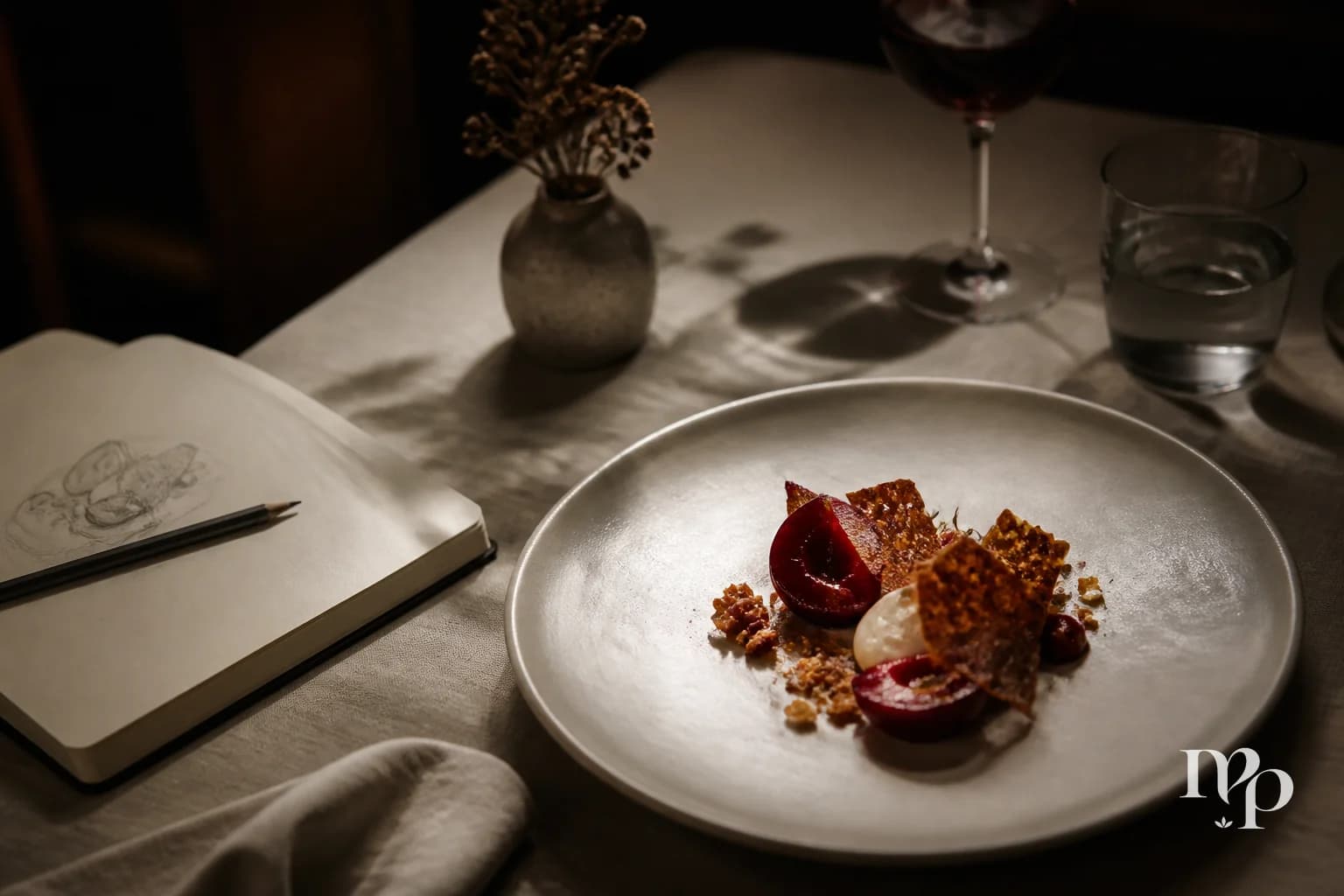
Studio Note
A dining room near the end of a meal is not blank space. Guests are full, conversation has shifted, the table is reading the room, and the final decision is often emotional before it is rational. The last course has to hold that room without asking everyone to begin again.
That is where dessert can either help the meal land or feel like a separate business bolted onto the end.
This week’s journal notes circled one idea from several angles: a restaurant dessert should belong to the room. Not just look current. Not just photograph well. Belong.
The strongest final courses usually make fewer moves than weaker ones. They know what they are doing with appetite, pace, texture, temperature, and memory. They do not ask the guest to restart the meal. They help the guest understand where it has arrived.
Featured this week: When the last course holds the room
Dessert Strategy
A dessert menu gets into trouble when it is treated as a list of sweet options instead of a sequence of final impressions.
For restaurants, cafes, hotels, and hospitality groups, the better question is not only “what desserts should we offer?” It is:
- What kind of ending does this operation want to own?
- Does the final course match the guest’s energy at that point in the visit?
- Are the desserts extending the restaurant’s identity, or borrowing someone else’s pastry language?
- Is the menu giving choice, or just repeating sugar, cream, chocolate, fruit, and crunch in different costumes?
The tradeoff is real. A dessert that is too safe may sell, but it rarely builds memory. A dessert that is too performative may get attention, but it can pull the guest out of the meal. The useful zone is narrower: clear, desirable, operationally realistic, and specific to the room.
A good internal review exercise:
- Read the savory menu first.
- Read the beverage program second.
- Look at the room, the pacing, and the guest profile.
- Then read the dessert menu.
If dessert feels like it came from a different restaurant, the issue is not garnish. It is strategy.
Related notes from the week:
- How to design a signature dessert that belongs to the restaurant
- Before the dessert menu changes
- When the last course holds the room
Ingredient Study
This week’s ingredient is not a single fruit, spice, or chocolate. It is texture.
Texture is often treated as a finishing detail: add crumble, add tuile, add crisp, add something cold. That is how desserts become assembled instead of composed.
Texture should answer a job.
A few examples:
- A brittle element can create attention at the first spoonful.
- A soft cream can slow the guest down after a high energy savory course.
- A warm element can make a small dessert feel generous without making it heavy.
- A clean sorbet can reset the palate, but only if the rest of the plate does not drag it back into sweetness.
- A crumb can carry salt, toast, spice, or bitterness instead of acting as filler.
What people often get wrong: they confuse texture contrast with texture clutter. Five textures on one plate do not automatically create a better experience. Sometimes they create indecision.
A cleaner test: remove one texture from the plate. If the dessert becomes clearer, it did not belong. If the dessert loses its rhythm, it was doing real work.
Read the full note: When texture carries the final course
Also worth revisiting: When dessert decoration becomes composition
From Mistoura Pastry
Mistoura Pastry works around a simple belief: dessert should not feel like an afterthought at the exact moment guests are forming their final memory of the experience.
That applies to a plated restaurant dessert, a cafe pastry case, a hotel amenity, a seasonal menu change, or a signature sweet that has to carry the brand without shouting.
Design desserts that guests remember.
Visit Mistoura Pastry
Question of the Week
If you removed the most visually decorative element from your current dessert menu, would the guest lose anything meaningful?
Not would the plate look less finished. Would the dessert taste less clear, feel less paced, or land with less memory?
If the answer is no, the garnish may be decoration in the weakest sense. If the answer is yes, it is probably part of the composition.
That distinction is where better dessert menus start.