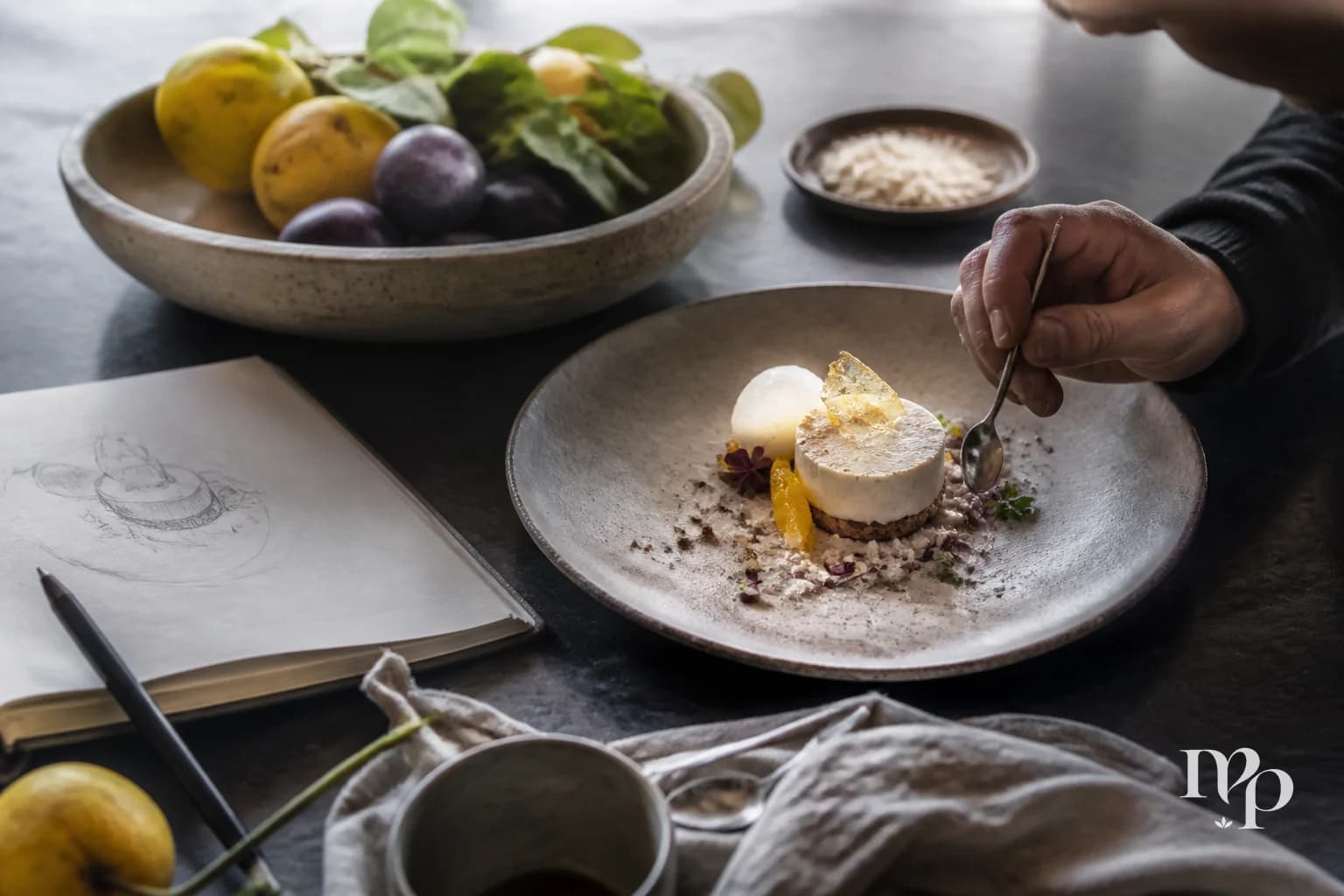
A guest can want dessert and still not want much.
That is easy to forget when a dessert is being designed on a prep table, away from the pace of the meal. In isolation, a larger portion can feel generous. More cream, more crumble, more sauce, more garnish. At the table, after wine, bread, salt, heat, conversation, and the slow closing of appetite, that same generosity can become weight.
Restaurant dessert design is not only about what tastes good. It is about what the guest can still receive.
Appetite has a rhythm
Dessert enters a room that is already full of information.
The guest has moved through acidity, fat, spice, smoke, bitterness, starch, protein, and often alcohol. Their palate is not blank. Their attention is not blank either. The final course has to meet an appetite that has changed since the first bite of the meal.
This is why proportion matters so much. A dessert can be rich without being heavy. It can be small without feeling mean. It can be restrained and still feel complete.
The mistake is treating size as the main signal of value. In a restaurant, value is often carried by clarity. A clean idea, a precise temperature, a contrast that lands at the right moment, a finish that does not ask the guest to push through fatigue.
A useful dessert respects the appetite in front of it, not the appetite imagined at the start of service.
Richness needs an exit
Richness is not the enemy. Some menus need butter, cream, chocolate, caramel, custard, nut, pastry, and deep sweetness. The question is whether the dessert gives the guest a way through.
A dense chocolate dessert may need bitterness, salt, acidity, or coldness. A cream based dessert may need crispness or fruit with enough edge. A warm component may need something cool and quiet beside it. A sweet sauce may need to be edited until it supports the dish instead of coating every bite.
The strongest version often has a built in exit. Not an escape from pleasure, but a way to keep pleasure alive until the last spoonful.
That exit can be texture. It can be temperature. It can be the clean bitterness of coffee, cacao, citrus peel, toasted grain, or roasted nut. It can be a fruit component that still tastes like fruit, not just sugar wearing color.
We have written before about Why less sugar can create more flavor, and appetite is one reason. When sweetness dominates too early, the dessert closes down. When sweetness is balanced, the guest keeps tasting.
The portion is part of the composition
Portion is not an operational afterthought. It is a design choice.
A plated dessert can fail because the idea is wrong, but it can also fail because the idea is too large. The first three bites may be beautiful. The last five may become a negotiation.
This matters for restaurants, cafes, hotels, and event menus in different ways. A tasting menu may need a few precise bites that feel inevitable. A cafe dessert may need enough generosity to stand alone in the afternoon. A hotel dessert may need to travel across room service, banquet timing, or a late dining room without losing its shape. An event dessert may need to be readable in motion, not just impressive in a photograph.
The point is not to make every dessert smaller. The point is to make the serving match the occasion.
A dessert served after a heavy main course has different work to do than a dessert ordered with coffee at 3 p.m. A shared dessert has different pressure than an individual final course. A signature dessert has to carry identity, but it should not make the guest feel trapped under the weight of the idea.
What people often get wrong
Many dessert menus confuse abundance with hospitality.
Abundance can be beautiful when it is intentional. A generous bowl of fruit at peak ripeness. A slice of tart with the right ratio of crust to filling. A warm cake that invites the table to slow down. But abundance becomes noise when every element is trying to prove value at once.
Common mistakes are easy to recognize:
- A portion that ignores what came before it
- A rich base with no acidity, bitterness, salt, or texture to create movement
- Sauces added for coverage instead of purpose
- Garnishes that increase labor but not meaning
- A dessert that photographs well but eats poorly
- A final course that belongs to a different restaurant than the savory menu
That last one is subtle. A dessert can be technically strong and still feel misplaced. If the restaurant is quiet, mineral, seasonal, and restrained, a loud final course may break the spell. If the restaurant is warm, generous, and expressive, a dessert that feels too austere may leave the table unfinished.
For broader menu context, How many desserts belong on a restaurant menu is less about counting items and more about understanding the job each dessert performs.
Questions before the spoon reaches the table
Before changing a dessert or adding a new one, it helps to ask questions that are closer to service than fantasy.
What has the guest already eaten by the time this arrives?
Is this dessert meant to refresh, comfort, surprise, settle, or extend the conversation?
Where does the richness begin, and where does it release?
Does the final bite taste cleaner than the first, or heavier?
Would the dessert still make sense if one garnish disappeared?
Is the portion designed for appetite, plate coverage, perceived value, or habit?
Does the dessert express the restaurant, or only the pastry station?
These questions are not meant to make dessert cautious. They are meant to make it precise. A final course can be playful, bold, nostalgic, spare, or deeply generous. It just needs to know what kind of appetite it is entering.
A quieter checklist
A simple way to test a dessert before it reaches the menu:
- Taste it after a full staff meal, not only on an empty palate
- Check whether the last bite still has definition
- Reduce one element and see if the idea becomes clearer
- Look at the ratio of creaminess, crunch, acidity, sweetness, and temperature
- Ask whether the portion supports the restaurant's pace of service
- Make sure the ingredient named on the menu is truly present in the eating
- Notice whether the plate feels finished before it feels full
The best edits are not always dramatic. Sometimes the dessert needs two fewer spoonfuls of mousse. Sometimes the sauce belongs underneath, not around. Sometimes the fruit should be sharper. Sometimes the crisp element should be thinner. Sometimes the plate needs more silence.
From the studio
At Mistoura Pastry, we often think of dessert as the last act of hospitality, not the last opportunity to impress.
That changes the work. The question becomes less, "How much can this dessert contain?" and more, "What should the guest carry away?"
A dessert that respects appetite can still be memorable. Often, it is more memorable because it does not overstay. It lets flavor arrive clearly. It gives texture enough space. It allows the room to keep its rhythm.
The final course should feel considered, not forced. It should leave the guest with the sense that someone understood the meal all the way to the end.
If your restaurant, cafe, hotel, or event menu needs a dessert language that fits the appetite of the room, Mistoura Pastry can help shape that final memory with restraint, clarity, and intention.
Studio note
Mistoura Pastry approaches dessert as culinary design. The goal is not more sweetness or more decoration. The goal is a final course with flavor, restraint, and intention.