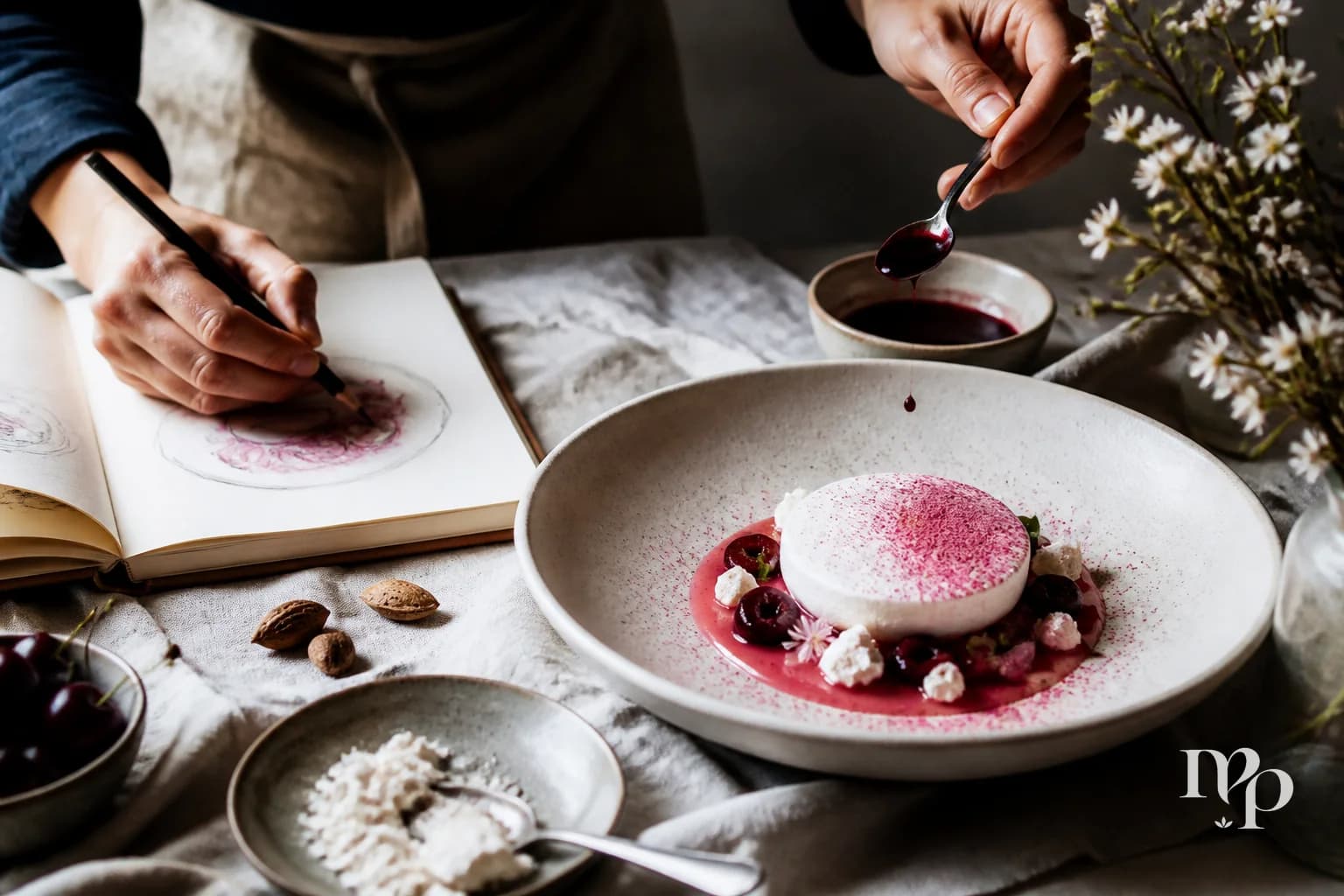
Some desserts arrive wearing a name before they have earned one.
They are called signature because they are larger, taller, plated with more gestures, or repeated across every menu format. But a signature dessert is not made by insisting on importance. It becomes recognizable because it has a job inside the restaurant.
It knows where it appears in the meal. It understands the appetite left at the table. It reflects the kitchen's way of thinking without shouting over the savory courses. It gives the guest one final sense of place, proportion, and care.
That is where signature dessert development begins: not with spectacle, but with purpose.
A signature is not a louder dessert
A signature dessert should feel specific enough that it could not be lifted from one restaurant and dropped into another without losing something.
That does not mean it needs rare ingredients or elaborate technique. It may be quiet. It may be built from three clear elements. It may avoid height entirely. What matters is that the dessert expresses the restaurant's identity in edible form.
A seafood restaurant may need brightness, salinity, citrus, herbs, and a clean finish. A fire led restaurant may need bitterness, smoke, warmth, and a texture that feels grounded. A cafe may need generosity without heaviness. A hotel may need a dessert that feels composed across many tables without becoming anonymous.
The strongest signature desserts often begin with a narrow question: what should the guest remember after the final spoon?
That memory should connect to the restaurant's larger dessert language, not sit outside it like a mascot. We wrote more about that relationship in Why every restaurant needs its own dessert language.
The table decides more than the plate
A signature dessert does not live only in the pastry station. It lives in service.
Can the server describe it without reciting a paragraph? Does it make sense after the most popular savory dishes? Is it satisfying for one guest and shareable for two? Does it hold its texture long enough to reach the table with dignity? Does it photograph well without being designed only for the camera?
These are not small questions. They decide whether the dessert becomes part of the restaurant's rhythm or another fragile object the room has to work around.
A dessert may be beautiful in tasting, then fail in service because the frozen element softens too fast, the garnish distracts, the plate is too wide for the table, or the portion punishes a guest who was ready for a graceful ending.
Signature work has to respect appetite. It should feel considered, not forced.
The shape of recognition
Recognition comes from decisions repeated with restraint.
Flavor gives the dessert its voice. Texture gives it movement. Composition gives it order. Proportion decides whether the guest wants the next bite. Temperature controls pace. The name sets expectation before anything arrives.
A signature dessert might begin with one ingredient the restaurant can honestly stand behind. Not an ingredient used as decoration, but one allowed to taste like itself. From there, the work is editing.
If the fruit is fragrant, sugar should not blur it. If chocolate is central, bitterness may be more useful than sweetness. If cream is present, acidity may be needed to keep the dessert awake. If crunch appears, it should change the bite, not simply announce effort.
The point is not to add more interest. More elements often create less memory. Guests remember clarity. They remember contrast that made sense. They remember a final course that felt like it belonged.
For restaurants still defining that anchor piece, How to design a signature dessert that belongs to the restaurant may be a useful companion.
Where the idea gets overworked
The most common mistake is treating signature dessert development as a search for novelty.
Novelty fades quickly. A strong dessert can be served again and again because its idea holds, not because it is busy.
Another mistake is mistaking decoration for identity. A logo stencil, gold leaf, or dramatic garnish may create recognition, but not necessarily meaning. If the decoration disappeared, would the dessert still feel like the restaurant?
There is also the danger of building a dessert for the owner's memory instead of the guest's experience. Personal references can be powerful, but they need translation. The table does not receive biography. It receives flavor, texture, temperature, timing, and service.
And then there is sweetness. A signature dessert that depends only on sweetness often has nowhere to go. It can please for two bites, then flatten. Balance gives the dessert stamina.
Questions before the first test batch
Before development begins, a restaurant can ask a few grounded questions:
- What should the final course say about the restaurant's point of view?
- Which flavors already appear in the savory menu, and should dessert echo or contrast them?
- How much appetite does the guest usually have by the end of the meal?
- Should this dessert be intimate, shareable, ceremonial, or restrained?
- What texture will make the final bite memorable?
- Can the team execute it with consistency during real service?
- What can be removed without weakening the idea?
The last question is often the most revealing. A dessert that collapses when one garnish is removed may not yet have a strong center.
A quieter checklist
A signature dessert is ready to move closer to the menu when it can answer yes to most of these:
- The idea can be described in one clear sentence.
- The main ingredient remains legible.
- Sweetness supports flavor instead of covering it.
- Texture changes from bite to bite without becoming chaotic.
- The portion respects the meal that came before it.
- The plating can survive the pace of service.
- The dessert feels related to the restaurant, not borrowed from a trend.
- The final bite is as considered as the first.
This checklist is simple on purpose. Signature work is not about proving complexity. It is about protecting the idea from noise.
From the studio
In our work, signature dessert development often becomes less about invention and more about listening.
We look at the menu's rhythm. We notice where the meal becomes rich, bright, slow, sharp, generous, or restrained. We consider what the guest has already experienced before dessert appears. Then we build a final course that belongs to that movement.
Sometimes the answer is a warm dessert because the room needs comfort. Sometimes it is fruit because the meal needs air. Sometimes it is bitterness because sweetness alone would feel too polite. Sometimes the strongest move is to make the dessert smaller, cleaner, and more precise.
The work is not to make dessert important by force. It is to make it necessary.
The last mark on the meal
A signature dessert should feel like the restaurant signed the evening with intention.
Not loudly. Not with decoration pretending to be meaning. Not with a dish designed only to be noticed.
The best version leaves a trace: a flavor that lingers, a texture remembered after the plate is cleared, a sense that the meal ended in its own language.
If your restaurant, cafe, hotel, or hospitality project is shaping a final course that needs to feel unmistakably its own, Mistoura Pastry can help think through the dessert with you.
Studio note
Mistoura Pastry approaches dessert as culinary design. The goal is not more sweetness or more decoration. The goal is a final course with flavor, restraint, and intention.