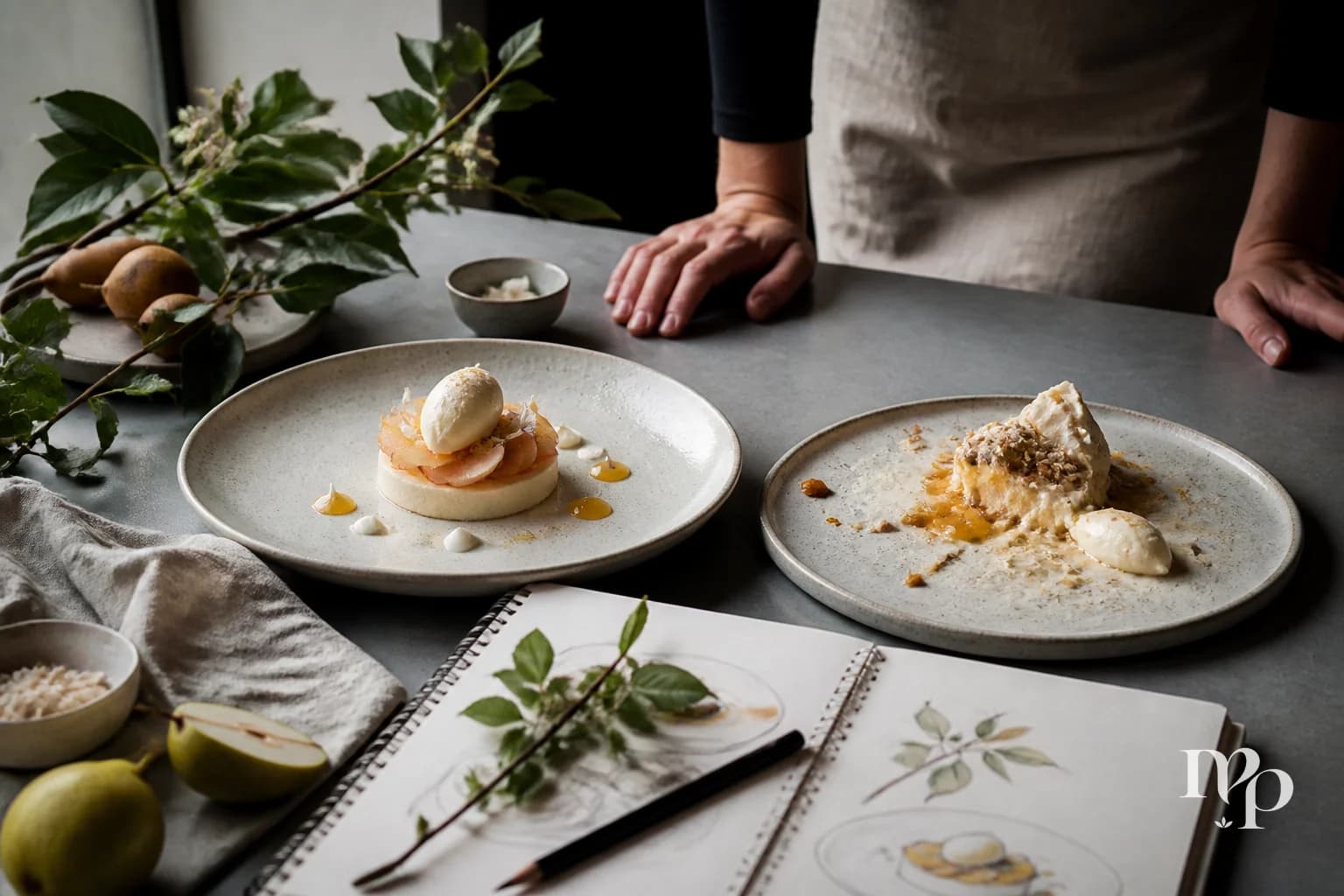
A dessert can look composed and still feel borrowed. It may have polish, height, shine, a clean plate, and still feel as if it could be lifted into another dining room without losing anything.
That is usually the sign that it has not gone far enough.
Signature dessert development is not about making the loudest object on the menu. It is about giving the final course enough identity that it feels inevitable in this restaurant, at this table, after this meal.
What the dessert should know about the room
A restaurant dessert has to listen before it speaks.
It should know the pace of the room, the appetite of the guest, the weight of the preceding courses, the way the menu uses acidity, bitterness, spice, fruit, fat, warmth, and restraint. It should know whether the room asks for generosity, precision, quiet, surprise, or release.
A signature dessert that ignores those cues may still be pleasant. It may even be technically careful. But it will feel detached. The guest senses when the last course has been placed on the menu because dessert was required, not because the meal had something left to say.
We often find that the strongest restaurant desserts are not trying to perform pastry in isolation. They are continuing the restaurant's language in another register. If a restaurant is still searching for that accent, Why every restaurant needs its own dessert language is a useful companion.
Before the spoon reaches the table
The final course enters the meal at a strange moment. The guest may be full, curious, tired, celebratory, or quietly finished. Dessert has to respect that condition.
This is where hospitality becomes design. A dessert is not only flavor and form. It is timing, temperature, portion, service rhythm, and the way the table feels when the plates arrive.
For some restaurants, the right final course should refresh the palate after smoke, fat, or heat. For others, it should slow the table down. A small, precise dessert can feel more generous than a large one if it arrives with clarity. A warm element can change the emotional temperature of the table. A bitter note can keep sweetness from closing too heavily.
The question is not simply what tastes good. The better question is what the guest is ready to receive.
The choices that make it belong
A signature dessert becomes specific through a series of edits.
The main flavor should be legible. If citrus is the point, it should not be buried under cream, sugar, garnish, and distraction. If chocolate is the point, bitterness, salt, temperature, and texture can give it shape without forcing it to become heavy. If fruit leads, the fruit should still taste like itself.
Texture should have intention. Crispness can wake up a soft dessert. Creaminess can calm acidity. Chew can make a small portion feel more complete. The goal is not to add more elements. The goal is to create contrast that the guest can actually feel.
Proportion matters as much as flavor. Too much sauce can blur a dessert. Too much crunch can make it feel nervous. Too much sweetness can flatten origin and season. Too many ideas can make the plate feel like a meeting instead of a course.
The broader shape of this work sits beside How to design a signature dessert that belongs to the restaurant, but the heart is simple: the dessert should become more itself as you remove what does not belong.
Where signature desserts go thin
Many signature desserts fail by trying too hard to be recognizable.
They borrow a visual code from another restaurant. They chase drama without asking whether the room can hold it. They turn garnish into costume. They confuse height with importance. They use rare or expensive ingredients without giving those ingredients a clear role.
Another common mistake is treating the dessert like a logo. A restaurant identity is not something to stamp onto a plate. It has to move through flavor, texture, proportion, and service. No guest wants to decode a mission statement from mousse.
The most damaging mistake may be excess. More components do not automatically create more interest. Often they make the dessert less memorable because the guest cannot name what mattered.
A signature dessert should not need an explanation before the first spoonful. The server can add context, but the dessert should already carry its own logic.
Questions for the final course
Before a restaurant commits to a signature dessert, a few questions are worth asking slowly.
- What should the guest remember after the table is cleared?
- Does this dessert feel connected to the rest of the menu, or attached at the end?
- Which flavor leads, and which flavors are only supporting it?
- Is the portion generous in the right way for this room?
- Does the texture change from first bite to last?
- Can the team serve it with calm and consistency?
- What would be lost if one element were removed?
- What makes this dessert specific to this restaurant?
The last question is the one that usually tells the truth. If the dessert could appear unchanged in five different restaurants, it may be polished, but it is not yet specific.
A quieter checklist
A restaurant does not need a complicated process to judge whether a signature dessert is moving in the right direction. It needs clear criteria.
- The main flavor is easy to name.
- The sweetness supports the ingredient instead of covering it.
- The textures create contrast without clutter.
- The portion respects the guest's appetite at the end of the meal.
- The plate feels connected to the restaurant's identity.
- The service team can describe it without forcing a speech.
- The final bite feels intentional, not accidental.
- The dessert leaves a memory that belongs to the room.
This kind of checklist is not meant to make the dessert rigid. It keeps the work honest.
From the studio
At Mistoura Pastry, we think about signature dessert development as a design conversation, not a pastry exercise performed in isolation.
Our perspective is shaped by Togo, France, and the United States, but not as a collage of references. What matters is attention: how an ingredient carries origin, how restraint can make flavor clearer, how a final course can hold warmth without becoming heavy, how a restaurant's identity can be expressed without being announced.
In our work, the best version is often quieter than the first idea. Less garnish. Fewer competing textures. A clearer main flavor. A plate that gives the guest enough to remember and enough space to feel it.
The course that leaves without noise
A signature dessert does not have to dominate the meal. It has to belong to it.
When it is right, it feels like the restaurant had been moving toward that final spoon all along. Not because the dessert explains everything, but because it closes the experience with clarity.
If your restaurant, cafe, hotel, or hospitality project is shaping a dessert that should feel unmistakably its own, Mistoura Pastry can help design the final course with intention.
Studio note
Mistoura Pastry approaches dessert as culinary design. The goal is not more sweetness or more decoration. The goal is a final course with flavor, restraint, and intention.