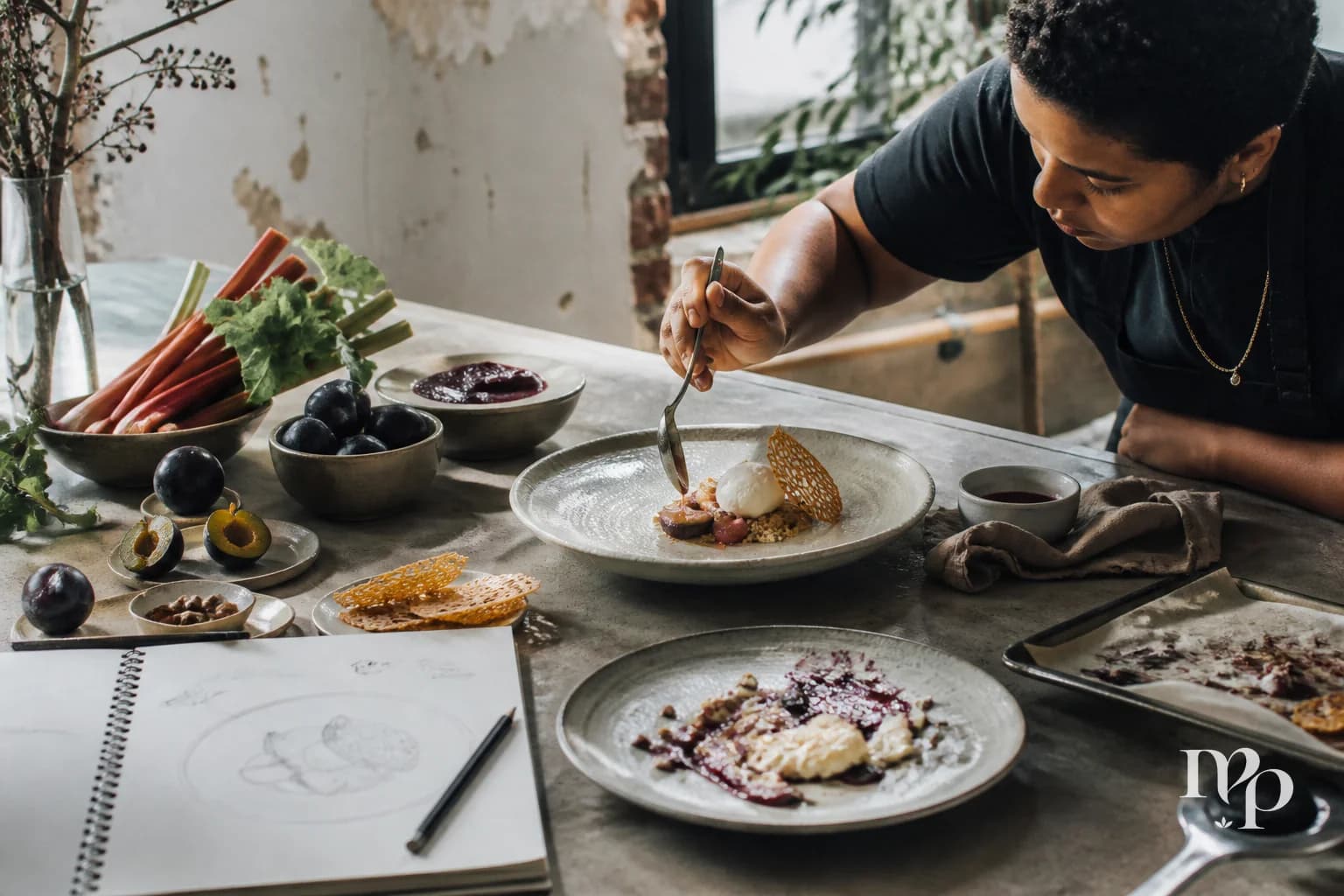
A plated dessert can look resolved in a quiet room and fall apart the moment service begins.
Not because the idea is weak. Because the dessert has no working life. It was designed for the photograph, the tasting spoon, or the first flush of excitement, but not for the pace of a dining room, the limits of a station, the appetite of the guest, or the memory the restaurant wants to leave behind.
A signature dessert has to be more than distinctive. It has to be repeatable without becoming flat, expressive without becoming fragile, and specific enough that another version from another restaurant would feel wrong.
The dessert has to survive the room
Restaurant dessert lives under pressure. It arrives after decisions have already been made: wine, pacing, portion size, mood, conversation, fatigue. By the time the guest reaches the final course, appetite is not blank. It has a shape.
That is why signature dessert development should begin with the room, not with decoration. Is the restaurant quiet and composed, or generous and loud? Does service move quickly, or does the meal invite a slower finish? Is the dessert meant to refresh, settle, provoke, or comfort?
The strongest answer is rarely the largest plate. Often it is the dessert with the clearest rhythm: one main flavor, one supporting note, one texture that interrupts, one finish that lingers without coating the whole evening in sugar.
If a dessert cannot hold its identity under actual service conditions, it is not ready to become the restaurant's own.
What development really means
Developing a signature dessert is not choosing a flavor and adding a dramatic form. It is a sequence of edits.
The first edit is appetite. A dessert for a tasting menu, a cafe dinner service, a hotel restaurant, and a private event do not carry the same weight. The question is not only what tastes good. The question is what the guest can receive at that moment.
The second edit is structure. Cream, sponge, fruit, crisp, sauce, frozen element, nut, chocolate, herb, spice, acidity. Each part needs a reason to be there. More elements do not automatically create more interest. Sometimes they only create noise.
The third edit is service. Can the plate be finished with care when the dining room is full? Does the frozen component wait well enough? Does the garnish soften too quickly? Does the sauce land cleanly? Can the team explain the dessert in one grounded sentence without sounding rehearsed?
That last point is easy to overlook. A signature dessert should give service language, not a script. If the team cannot describe why it belongs, the guest may feel the gap.
For a related look at that service layer, see The dessert service can carry.
Decoration is not the point
A common mistake is to make the dessert recognizable by making it louder. A taller garnish. A brighter color. A more unusual mold. A flourish that photographs well but says very little at the table.
Decoration can be beautiful, but it should not have to do all the work. Composition is different. Composition asks how the parts relate: where the spoon enters, when acidity appears, whether the crisp element breaks before or after the cream, whether the final bite feels generous or tired.
A dessert can be quiet and still be unmistakable. A clean slice, a warm sauce, a precise bitterness, a fruit used at the right point in the season. These choices can carry more identity than ornament, especially when they belong to the restaurant's pace and point of view.
This is where restraint becomes practical. It protects the ingredient. It protects service. It protects the guest from having to decode a plate that only looks confident.
Questions before the dessert becomes the signature
A useful conversation starts before sketching the plate.
What should the guest remember after the last spoonful?
Should the dessert extend the meal's mood, or change it?
Which ingredient, technique, or texture already feels natural to the restaurant?
What can the kitchen execute with consistency on a full night?
Where does the dessert need restraint: sweetness, size, garnish, temperature, explanation?
What would make this dessert feel as if it could only belong here?
These questions keep development from drifting into novelty. They also protect the restaurant from adopting a dessert that is admired once and then becomes awkward to keep.
A signature dessert is not a trophy for the menu. It is a living part of the restaurant. We wrote more about that distinction in The signature dessert is not a trophy.
A quieter checklist
Before a dessert is ready to carry the house, we often look for a few simple signs.
The main flavor is clear without needing a long explanation.
The sweetness has been edited so aroma, acidity, bitterness, dairy, fruit, spice, or grain can come forward.
The texture contrast is intentional, not decorative.
The portion respects the meal that came before it.
The plate can be finished during real service, not only during a calm tasting.
The staff can speak about it naturally.
The dessert feels connected to the restaurant's identity, but not trapped by a concept.
None of this removes beauty. It gives beauty somewhere to stand.
From the studio
In our work, the most promising signature desserts often become simpler as they develop. Not smaller in feeling. More legible.
A fruit note may be sharpened instead of multiplied. A cream may become lighter. A garnish may disappear because the plate breathes better without it. A spice may move from the center to the finish. The change can be subtle, but the guest feels it as clarity.
The goal is not to make dessert safe. It is to make the idea strong enough to be served again and again without losing its edge.
A final course should leave the table with a sense of intention. Not a forced ending. Not a sugar-heavy apology. Something composed, hospitable, and particular to the place that served it.
If your restaurant, cafe, hotel, or event team is thinking through a signature dessert with a working life beyond the first tasting, Mistoura Pastry can help shape the brief and the final course.
Studio note
Mistoura Pastry approaches dessert as culinary design. The goal is not more sweetness or more decoration. The goal is a final course with flavor, restraint, and intention.