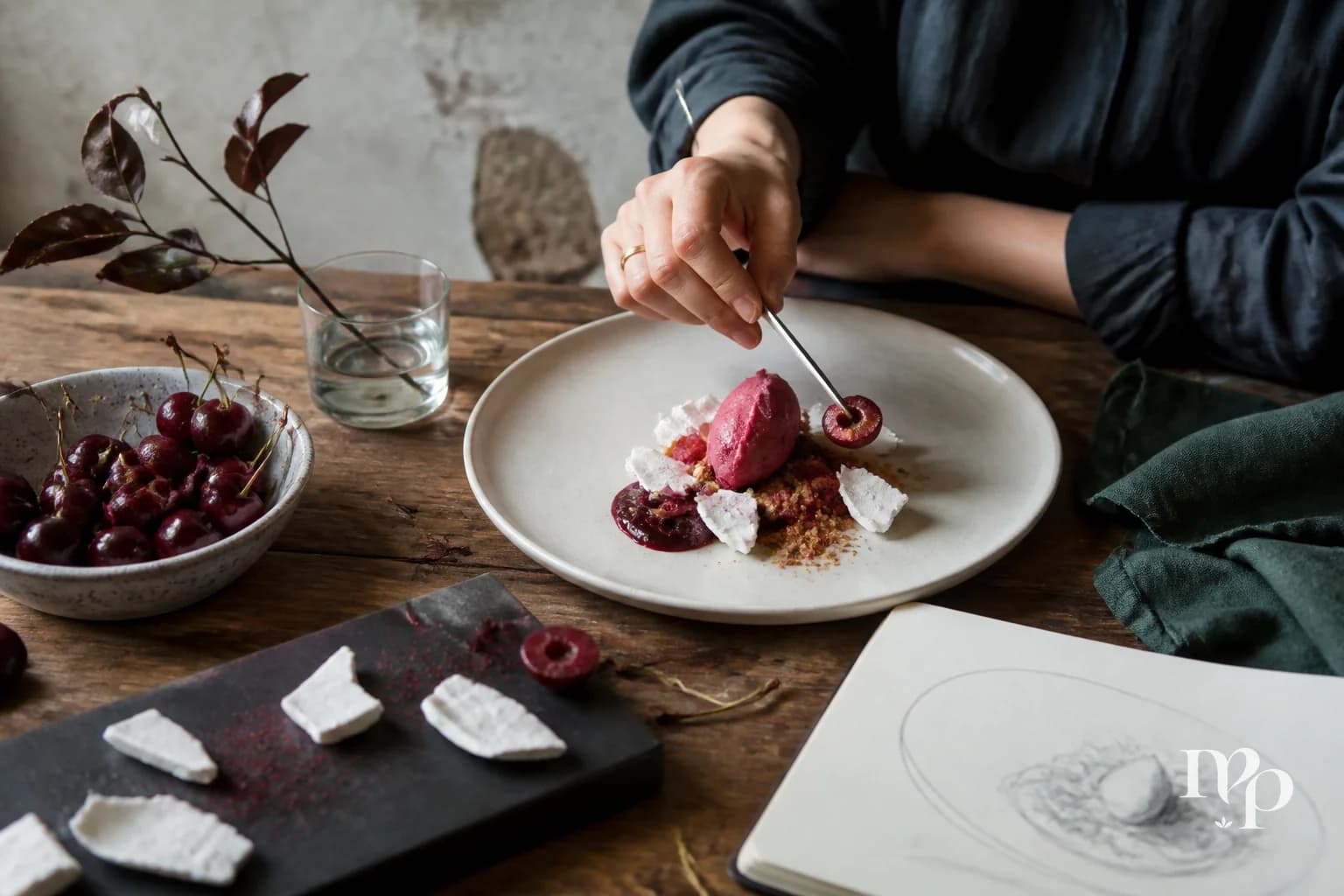
The last plate arrives after the room has already spoken.
The guest has heard the menu, read the light, followed the rhythm of service, felt the weight of the tableware, and made small decisions all evening. Dessert does not enter a blank space. It enters a room with memory.
That is why a final course needs table manners. Not politeness in the decorative sense. Manners as awareness. It should understand when to speak, how much to offer, and what kind of finish the meal can honestly carry.
The room has already done some work
Hospitality experience design often gets treated as something broad: atmosphere, service, music, lighting, pacing. In pastry, it becomes very specific. It sits in the size of a quenelle, the bitterness of a sauce, the temperature of a cream, the way a crisp element holds for service, and the amount of sweetness a guest can welcome after a full meal.
The final course is not only a dish. It is part of the exit.
A quiet restaurant may not need a dessert that performs. A lively brasserie may need something direct enough to survive noise, movement, and conversation. A tasting menu may need a finish that releases the guest instead of asking for more attention. A hotel dining room may need clarity across many kinds of guests, not a private joke only the kitchen understands.
The useful question is not, "What dessert would impress?" It is, "What kind of ending belongs in this room?"
We have written before about The dessert service can carry, because even the most thoughtful idea has to survive the dining room. Hospitality lives in that survival.
Sweetness is not the whole gesture
A dessert can be warm without being soft, generous without being large, restrained without feeling cold.
Sugar is only one form of welcome. Acidity can refresh. Bitterness can lengthen the finish. Salt can make fruit feel more vivid. A clean texture can give the palate a place to rest. A small aromatic note can keep the final bite from disappearing too quickly.
What people often get wrong is assuming hospitality means abundance. More sauce, more garnish, more height, more explanation. But a guest at the end of a meal may not be asking for more. They may be asking for coherence.
A good final course can say, in its own quiet way, you were considered.
That consideration might show up as a portion that respects appetite, a texture that does not tire the palate, or a flavor that connects back to the restaurant without repeating the savory menu too literally. The dessert should feel designed for the guest who has just eaten here, not for a photograph detached from service.
Choices the guest can feel
The design choices that shape hospitality are often small, but they are not minor.
Temperature changes the mood. A cold dessert can refresh a heavy meal, but it can also feel abrupt in a room built around warmth. A warm element can comfort, but too much richness can make the final minutes feel slow.
Texture carries attention. Crispness gives lift. Cream gives calm. Chew gives length. Sponge gives softness. Too many textures can make the guest work when the meal should be settling.
Proportion decides whether a dessert feels graceful or demanding. A strong flavor does not need a large footprint. A delicate fruit may need space around it. Chocolate may need bitterness, salt, or acidity to keep it from becoming a full stop too soon.
Service matters as much as composition. Can the dessert arrive at the right pace? Does it hold if the table pauses? Can the front of house describe it without turning the moment into a lecture? Does the plate make sense from the guest's seat, not only from above?
A dessert with table manners knows that the guest experiences all of this at once.
Where the gesture gets heavy
The common mistakes are rarely about skill. They are about misreading the room.
A dessert can be too elaborate for a restaurant whose strength is ease. It can be too sweet for a menu that spent the evening building balance. It can be too fragile for the pace of service. It can carry a cultural reference so thinly that it becomes decoration instead of expression. It can look expensive while saying very little.
Another mistake is treating the final course as a rescue mission. If the menu has no clear dessert language, the solution is not to add a dramatic signature and hope it creates identity by force. The dessert should grow from the house: its ingredients, restraint, rhythm, and point of view.
There is also the opposite mistake, making dessert so safe that it disappears. Vanilla, chocolate, citrus, cream, fruit, caramel, spice: familiar ingredients can still carry identity when the proportions are specific. Familiar does not have to mean anonymous.
For a related thought, see The dessert that respects the appetite. Appetite is one of the most overlooked design constraints in dessert.
Questions before the spoon
Before changing a dessert menu or commissioning a house dessert, a restaurant can ask a few grounded questions.
What has the guest already experienced before dessert arrives?
Does the room call for comfort, brightness, surprise, quiet, or a clean release?
Where is sweetness useful, and where would acidity, bitterness, salt, or texture do better work?
Can the dessert be served consistently on a busy night, not only when the kitchen is calm?
Will the front of house understand the dish well enough to carry its intention simply?
Does the final bite feel connected to the restaurant, or could the same dessert belong anywhere?
These questions are not meant to make dessert cautious. They make it more exact.
A quieter checklist
A last course with table manners usually has a few things in place:
- A clear role in the meal, not just a place on the menu
- A portion that respects the appetite at the end of service
- A flavor structure with contrast, not only sweetness
- Textures that create interest without crowding the plate
- A form that service can repeat with care
- A description guests can understand without being instructed
- A connection to the restaurant's identity that feels natural
- A final bite that leaves memory rather than fatigue
The checklist is simple. The judgment is in the edit.
From the studio
At Mistoura Pastry, we look at dessert as part of the hospitality experience, not as an isolated sweet course. The work is not to make a restaurant louder. It is to make the ending more intentional.
Sometimes that means removing an element. Sometimes it means lowering sweetness so fruit, spice, dairy, chocolate, or grain can speak more clearly. Sometimes it means changing the shape because the dining room needs speed, warmth, or a more generous rhythm.
Dessert should not be an afterthought. But it also should not arrive as if it has not noticed the meal before it.
The last small courtesy
The final course does not need to explain the whole restaurant. It needs to leave with the right weight.
A spoonful can be bright. A crust can be quiet. A cream can cool the table. A bitter edge can keep sweetness honest. When those choices belong to the room, dessert becomes more than a finish. It becomes the last small courtesy of the meal.
If your restaurant, cafe, hotel, or event team is thinking through a more intentional final course, Mistoura Pastry can help shape the dessert language with you.
Studio note
Mistoura Pastry approaches dessert as culinary design. The goal is not more sweetness or more decoration. The goal is a final course with flavor, restraint, and intention.