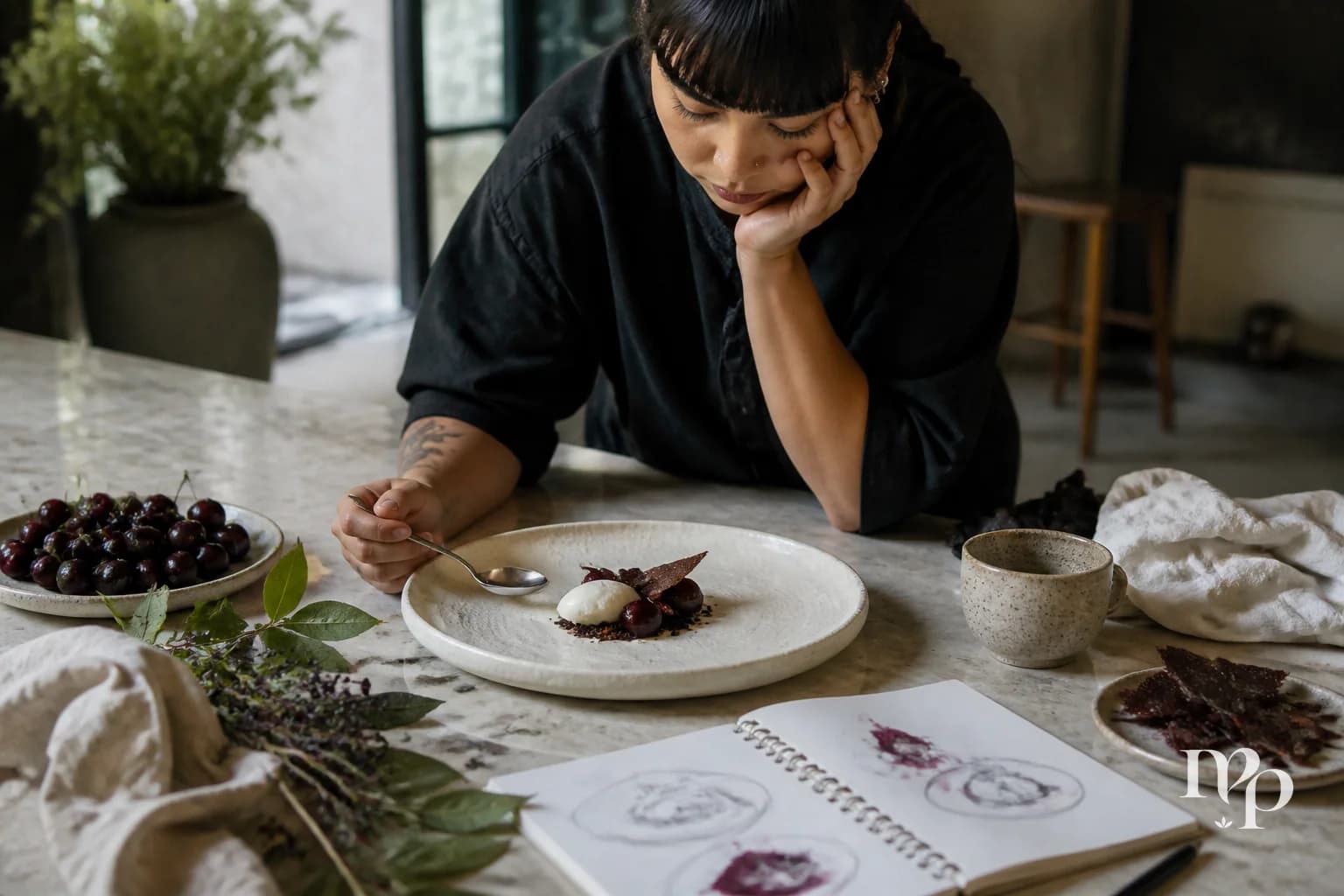
Some desserts are built to win the first glance. Fewer are built for the second order.
That is where signature dessert development becomes serious work. A restaurant does not need a pastry monument at the end of the meal. It needs a dessert with enough clarity to be remembered, enough restraint to be finished, and enough connection to the house that it could not be mistaken for someone else's idea.
A signature dessert is not a trophy plate. It is a repeatable gesture of hospitality, close to what guests sometimes mean when they ask for a dessert on the house: not free, but unmistakably of this house.
The second order is the harder one
The first order can be driven by curiosity. A name sounds interesting. A server describes a detail well. A guest sees the plate cross the room.
The second order asks for more. It means the dessert left a clean enough memory that a guest wants to return to it. Not because it shouted. Not because it had more parts than the rest of the menu. Because the flavor made sense, the texture stayed with them, and the ending felt right for that room.
In our work, this is often the more useful test. A signature dessert should have presence, but it should not exhaust the guest. It should be distinctive, but not so narrow that only one type of diner can understand it. It should carry craft, but the craft should serve the experience rather than announce itself.
That kind of dessert usually begins with editing.
A clear idea before the garnish
Many signature desserts lose their shape before the first test batch because the conversation starts with appearance. Height, color, garnish, plating drama. Those things can matter, but they are not the spine.
The stronger starting point is a clear sentence: what should this dessert express about the restaurant?
For one place, the answer may be restraint and warmth. For another, acidity, smoke, and a sharper finish. A coastal room may need something bright and saline at the edge. A late night dining room may need bitterness, cream, and something crisp enough to wake the palate. The point is not to decorate an idea after the fact. The point is to let the idea choose the ingredients, textures, temperature, and proportion.
This is where composition matters more than decoration. A curl of chocolate, a quenelle, a shard, a flower, or a sauce line does not make a dessert composed. Composition happens when every element has a reason to be there. We wrote more about that distinction in When dessert decoration becomes composition.
What the room asks from dessert
A signature dessert has to belong to service, not only to the pastry bench.
If the dining room moves quickly, the dessert cannot require a long explanation or fragile timing at every table. If the menu before it is generous and savory, the final course may need lift rather than weight. If the restaurant has a quiet, minimal rhythm, a crowded plate may feel like it wandered in from another address.
Hospitality is not only how the dessert tastes. It is how it arrives, how easily it can be described, how it sits in the guest's appetite, how it behaves during a busy turn, and how the last spoonful changes the final memory of the meal.
This is why a signature dessert needs both imagination and discipline. A good idea that service cannot carry becomes a problem. A beautiful plate that slows the room at the wrong moment asks the staff to protect the dessert instead of serving the guest. For a closer look at that service pressure, see The dessert service can carry.
Choices that give the dessert a spine
A signature dessert usually becomes stronger when a few decisions are made early.
Sweetness should have a job. It can soften bitterness, frame acidity, deepen fruit, or create comfort. It should not flatten the whole plate into sugar.
Texture should create rhythm. Cream needs interruption. Crunch needs somewhere to land. A crisp element should stay crisp long enough to matter. A soft element should not collapse into sameness after two bites.
Temperature should be intentional. Cold can sharpen and refresh. Warmth can slow the table and make aroma more generous. Mixing temperatures can be beautiful, but only when timing and service can protect the contrast.
Seasonality should edit the dessert rather than decorate it. A seasonal fruit or spice is not automatically a concept. The question is what the season changes: brightness, color, acidity, aroma, appetite, or mood.
And proportion decides whether the guest finishes with pleasure or obligation. The last course should know the meal that came before it.
Where signature desserts get heavy
What people often get wrong is adding importance by adding more.
More components. More technique. More garnish. More explanation. The dessert begins to carry the anxiety of being special. Guests can feel that. So can service.
Another mistake is copying the shape of recognition. A dramatic plated dessert may look like a signature because it photographs well, but the restaurant still has to live with it. Can the kitchen repeat it cleanly? Can the server describe it in one calm sentence? Does it taste connected to the menu, or only to the pastry trend of the moment?
There is also the opposite risk: making the signature too safe. Familiarity can be generous, but if the dessert has no point of view, it becomes interchangeable. A signature dessert should not feel like a generic ending with a house garnish placed on top.
The work is to find the narrow path between spectacle and anonymity.
Questions before the first test batch
A useful conversation with an operator might begin here:
What should the guest remember ten minutes after leaving?
What part of the restaurant's identity has not yet appeared by dessert?
Does the final course need to refresh, comfort, surprise, or settle the table?
How much explanation can service realistically give without interrupting the rhythm of the room?
Which ingredients already belong to the restaurant's language?
What textures are missing from the meal before dessert arrives?
What should never be compromised, even on a busy night?
These questions are not romantic extras. They prevent expensive confusion later. They also keep the dessert from becoming a separate performance instead of the final movement of the meal.
A quieter checklist
Before a signature dessert is ready to hold its place, it should pass a few plain tests:
- The idea can be described in one sentence.
- The main ingredient still tastes like itself.
- Sweetness supports the flavor rather than covering it.
- At least one texture creates contrast with purpose.
- The portion respects the appetite at the end of the meal.
- The plate can be repeated without losing its character.
- Service can carry the story without a script.
- The dessert feels connected to the room, not only to the chef.
- Removing any element would change the meaning, not just the look.
A checklist will not design the dessert. It will show where the design is still vague.
From the studio
Studio note: when we develop a signature dessert, we often look for the quietest element that can carry the most meaning.
Sometimes that is a fruit treated with restraint. Sometimes it is a bitter note placed at the edge of sweetness. Sometimes it is a texture the guest hears before they fully taste it. The strongest version is not always the most elaborate one. It is the one where the choices feel inevitable once they reach the table.
Mistoura's perspective is shaped by Togo, France, and the United States, but not as a collage of references. What matters is attention: how an ingredient holds its origin, how technique can clarify rather than disguise, and how a dessert can be generous without becoming heavy.
The memory should still have air
A signature dessert should give the meal an ending, not a final obstacle.
It should leave enough room for conversation, coffee, a pause, the small silence that follows a good last bite. Guests may not name every component. They may not remember the exact garnish. But they should remember how the dessert made the restaurant feel more itself.
That is the point worth developing toward.
If your restaurant is shaping a final course with a clearer identity, Mistoura Pastry can help think through the dessert before it becomes a plate.