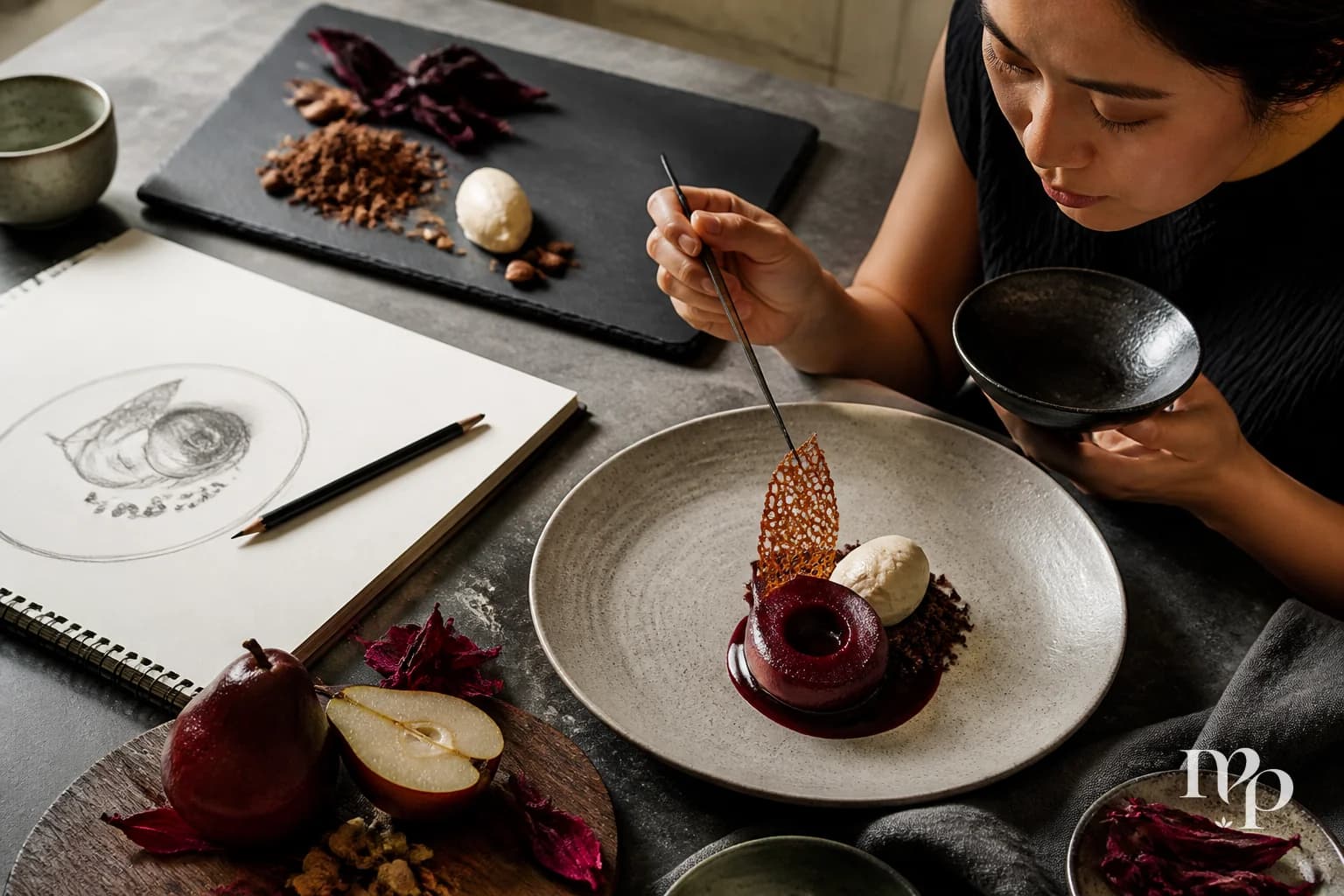
A dessert menu can reveal a restaurant’s confidence before anything reaches the table. Three choices may feel complete. Seven may feel thin. The difference is rarely size. It is whether the menu has a point of view.
A strong dessert menu does not try to please every possible craving. It gives the guest enough range to choose with ease, while keeping the final course inside the restaurant’s language. Sweetness is only one part of that work. Texture, temperature, portion, season, service rhythm, and memory all carry weight.
The menu is smaller than the appetite
Guests often arrive at dessert with less appetite than curiosity. They may want one more taste, a shared finish, something bright after a rich meal, or a quiet reason to stay at the table. A dessert menu should recognize that state instead of fighting it.
This is where restaurant dessert strategy becomes different from pastry display. A restaurant does not need to prove how many techniques it knows. It needs to offer endings that make sense after the food that came before them.
One dessert may be generous and familiar. One may be lighter, sharper, or fruit led. One may carry the identity of the house more directly. The strongest menu is not necessarily the longest one. It is the one where every choice has a role.
That role should be visible to the guest and workable for the team. If a server cannot describe why a dessert belongs on the menu, the guest will feel that hesitation.
Range without noise
Range matters, but range is not the same as variety for its own sake. Chocolate, citrus, cream, fruit, spice, caramel, nuts, frozen elements, pastry, custard, crunch, and sauce can all be useful, but a menu becomes cluttered when every dessert tries to contain too many of them.
A useful dessert menu usually gives contrast across the page. Not every plate needs contrast inside itself.
If one dessert is warm, deep, and slow, another can be cool and lifted. If one is built around richness, another can leave more air in the meal. If the restaurant’s savory menu is restrained and precise, the desserts should not suddenly become decorative theatre.
The question is not only, what desserts do we like? It is, what sequence of choices makes the guest feel held at the end of this meal?
That is why menu strategy often begins before development. In our work, we often look at the whole restaurant first: the room, the pace of service, the style of plating, the check average, the kitchen’s capacity, and the kind of memory the restaurant is already building. A dessert can only complete what it understands.
For a related view on longevity, see The dessert the menu can keep.
The sweetness should have somewhere to go
Sugar can flatten a menu when it becomes the main gesture. More sweetness may make a dessert read quickly, but it can also erase fruit, dairy, chocolate, spice, grain, and acidity.
A better dessert menu gives sweetness direction. It lets bitterness sharpen chocolate. It lets acid lift cream. It lets salt widen caramel. It lets fruit taste like fruit instead of a color on the plate.
This is not an argument for austere desserts. Pleasure matters. Generosity matters. But sweetness should carry flavor, not cover it.
Texture works the same way. A crisp element is not useful because every dessert needs crunch. It is useful when it changes the pace of eating. A soft custard, a brittle wafer, a tender cake, a cold cream, a warm sauce: each one changes how the guest moves through the final course.
Dessert menu strategy lives in those decisions. Not only what is offered, but how each option eats.
Where menus go thin
Many dessert menus lose their shape in predictable ways.
One mistake is building around personal favorites without asking what the restaurant needs. A beautiful dessert can still feel wrong if it speaks a different language from the rest of the meal.
Another is adding options to create a feeling of abundance. More choices can make the guest work harder, especially at the end of dinner. A tight menu with clear contrast often feels more generous than a long menu with small variations on the same idea.
A third mistake is treating garnish as identity. A dessert does not become distinctive because it has more objects on the plate. Decoration should serve the idea. If the garnish disappears and the dessert loses nothing, it was probably not doing enough.
There is also the operational mistake: designing a menu the kitchen cannot repeat with grace. A dessert that depends on too many fragile steps, narrow timing, or one person’s touch may be impressive in development and difficult in service. The final course should not punish the team for offering it.
For that side of the work, The dessert service can carry is a useful companion.
Questions before the menu changes
Before changing a dessert menu, a restaurant can ask better questions than what should we add?
What does the savory menu leave the guest wanting: freshness, comfort, contrast, quiet, warmth, or surprise?
How many desserts can the team prepare and serve with consistency during a full service?
Is there a clear difference between the options, or are several desserts answering the same craving?
Does the menu include a dessert that belongs unmistakably to this restaurant, not just to the category?
Are portions designed for the way guests actually order: individual, shared, after wine, after a tasting menu, after a heavy main course?
Does seasonality change the structure of the menu, or only the fruit on top?
Can the servers describe each dessert in a way that feels natural, specific, and brief?
These questions do not make the menu less creative. They give creativity a place to stand.
A quieter checklist
A dessert menu with a point of view usually has:
- A clear range of moods, not a pile of similar pleasures
- At least one dessert that feels rooted in the restaurant’s identity
- A balance of richness, acidity, temperature, and texture across the menu
- Portions that respect the end of the meal
- Seasonal changes that affect flavor, not only decoration
- Desserts the kitchen can execute with consistency
- Language the service team can carry without strain
- A final memory that feels intentional rather than leftover
The list is simple. The editing is the work.
From the studio
At Mistoura Pastry, we think of a dessert menu as a small composition inside the larger restaurant experience. It has to belong to the kitchen, the dining room, the guest, and the pace of service at the same time.
That means restraint is not a lack of ambition. It is a design choice. A short menu can feel expansive when each dessert has a different temperature, texture, weight, and reason for being there. A longer menu can still feel narrow when everything leans sweet, soft, and decorative.
The strongest dessert menus leave room for the guest. They do not shout at the end of the meal. They offer a final choice that feels considered, pleasurable, and specific to the house.
A restaurant does not need a dessert menu that says everything. It needs one that knows what to say last.
If your restaurant is shaping a dessert menu or rethinking the final course, Mistoura Pastry develops desserts with identity, restraint, and service in mind. Begin with the studio.
Studio note
Mistoura Pastry approaches dessert as culinary design. The goal is not more sweetness or more decoration. The goal is a final course with flavor, restraint, and intention.