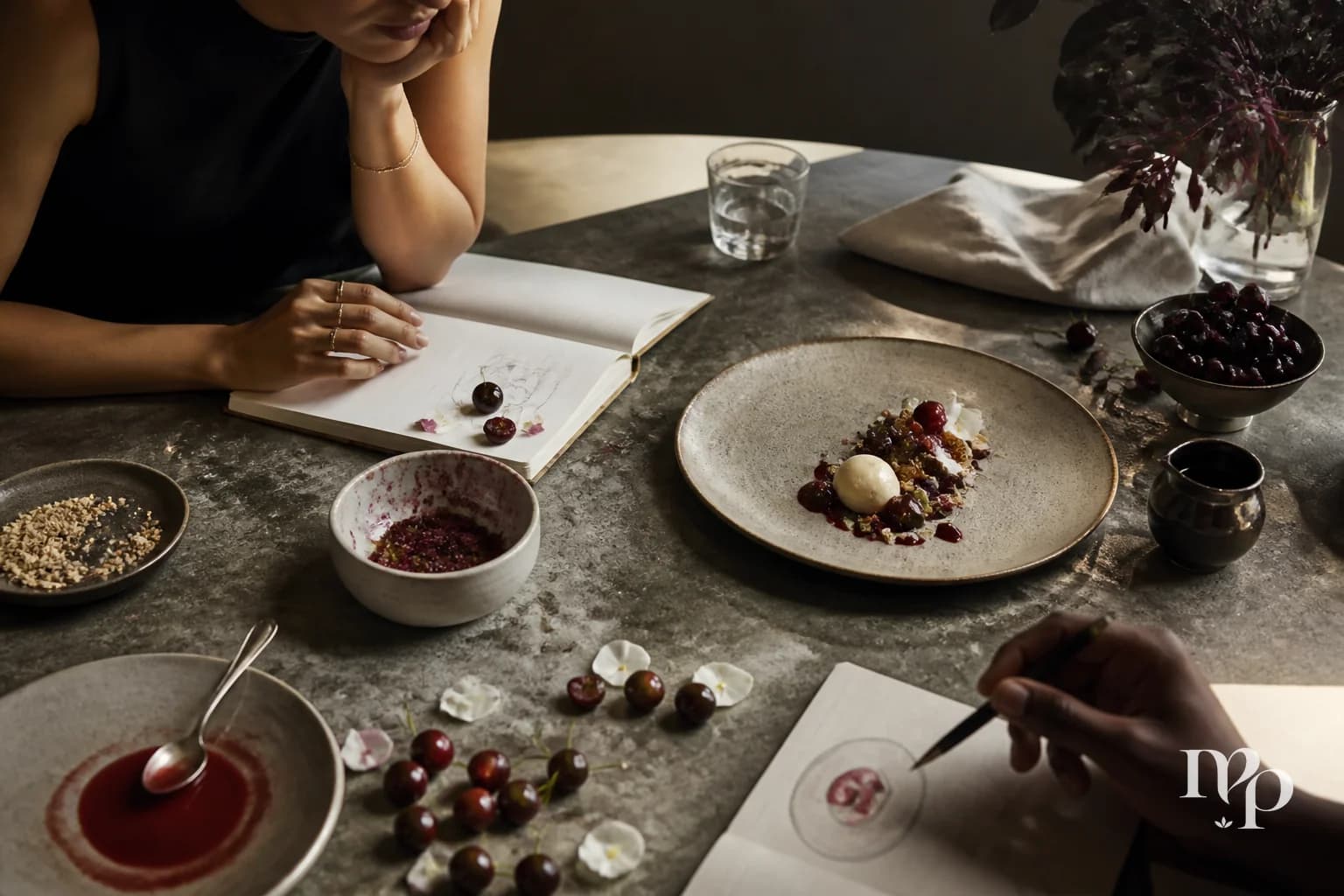
A dining room sounds different after the main course. Forks slow down. Glasses are half full. The table either opens into conversation or begins to fold itself toward departure.
Dessert enters that moment. Not as decoration for the meal, and not as a final attempt to impress. It enters a room that already has a rhythm, a temperature, and a guest who may be full, curious, tired, pleased, distracted, or not quite ready to leave.
That is where hospitality experience design becomes pastry.
What the room remembers
A restaurant dessert is often discussed as a plate. Flavor, garnish, portion, price, photo. Those decisions matter, but they are not the whole assignment.
The stronger question is what the dessert asks the room to feel next.
Should it refresh after a long savory sequence. Should it bring warmth after a restrained meal. Should it create a shared moment for a table that has been speaking across wine and noise for two hours. Should it land quietly, almost like a closing sentence.
Dessert has unusual power because it arrives when the guest is already forming the memory of the visit. The meal is no longer only being consumed. It is being edited in the mind. A clumsy dessert can blur that memory. A thoughtful one can give it shape.
This does not mean every restaurant needs a dramatic final course. More often, the better move is a precise one: less sugar, clearer flavor, a texture that changes the pace, a portion that respects appetite, service that does not make the guest work.
The last course is part of the room
Hospitality experience design is not only furniture, lighting, music, or service language. It is also the way a spoon moves through cream, the temperature of citrus against a rich dinner, the pause created by a shared tart, the comfort of something warm arriving at the table without fuss.
A dessert can either belong to the room or sit on top of it.
In a small restaurant with close tables and direct service, the final course may need intimacy. One clean composition, a familiar ingredient treated with restraint, a texture that does not require explanation. In a hotel dining room, the dessert may need to travel through a larger service system and still arrive with composure. In a cafe that moves from morning into evening, the dessert language may need to bridge pastry case, plated service, and the guests who use the room in different ways.
This is why dessert cannot be designed only from appetite. It has to be designed from the room.
We often find that the right dessert is the one that understands the difference between attention and interruption. It gives the guest something to notice without forcing the table to stop being itself.
For more on service as part of the design, we have written about The dessert service can carry. The plate is only one part of the work. The rest happens between kitchen, server, table, and timing.
Before the spoon reaches the table
The design choices are practical before they are poetic.
Portion is one of the first signals. Too large, and dessert becomes a burden after a generous meal. Too small, and it can feel like a gesture without enough substance. The right portion depends on the menu that came before it, the length of the meal, the style of service, and whether the dessert is meant to be individual, shared, or both.
Sweetness is another signal. Sugar can soften bitterness, round acidity, and carry aroma, but it can also flatten a dessert into one note. Less sugar is not automatically more refined. The point is not austerity. The point is allowing fruit, chocolate, dairy, spice, nuts, grain, or caramelization to remain legible.
Texture decides pace. Crisp elements wake up the palate. Cream slows it. Ice resets it. Cake absorbs. Meringue disappears. A good dessert understands how these textures behave in sequence, not just how they look together on a plate.
Temperature changes the emotional register. Warm desserts feel generous. Cold desserts can feel clean and sharp. Room temperature desserts often need stronger composition because they cannot rely on contrast alone.
Then comes service. Can the dessert hold for the realities of a dining room. Can it be plated consistently by the team on a busy night. Can a server describe it in one calm sentence. Can it reach the table without losing the reason it was designed.
These details are not small. They are the hospitality.
Where the ending gets noisy
The common mistake is trying to make dessert carry every idea the restaurant has not yet expressed.
A plate gets too many textures, too many garnishes, too many colors, too many references. The result may look complete, but it often eats without focus. The guest tastes effort instead of intention.
Another mistake is confusing novelty with memory. A strange dessert may be remembered, but not always for the right reason. A memorable dessert usually has a clear center: a fruit at its best moment, a contrast that feels inevitable, a flavor that speaks in the restaurant's voice, a gesture that suits the room.
Decoration can also become a distraction. A flower, tuile, sauce line, quenelle, or dusting should earn its place. If it does not change the eating experience or clarify the idea, it may only be adding noise.
The final mistake is ignoring the exit. Dessert is close to the bill, the goodbye, the last sip, the walk outside. If the final course is heavy in the wrong way, late in the wrong way, or awkward to share, it can make the meal feel less graceful than it was.
We think about this as the house speaking one more time. Not louder. More clearly. That thought sits close to The house before the dessert, where the restaurant's identity comes before the plate.
Questions for the final course
A useful set of questions can keep the dessert tied to hospitality instead of spectacle.
What state is the guest likely in when dessert arrives: hungry, satisfied, lingering, rushed, celebratory, quiet.
What should the final course change in the room: energy, temperature, conversation, attention, comfort.
Which ingredient deserves to be remembered, and what would get in its way.
Should this dessert be individual, shared, or offered in both forms.
How much explanation does it require, and is that explanation welcome at this point in the meal.
Can the service team carry the dessert without apology, improvisation, or a long script.
Does the plate feel like it belongs to this restaurant, or could it appear anywhere.
These questions are not meant to make dessert cautious. They make it more exact.
A quieter checklist
Before adding a dessert to the menu, look for these signs:
- The main flavor is clear before the garnish speaks.
- Sweetness supports the ingredient rather than covering it.
- Texture has a reason: crisp, soft, cold, warm, dense, light.
- The portion respects the meal that came before it.
- The plate can survive real service, not only a calm tasting.
- The server can describe it without sounding rehearsed.
- The dessert changes the ending of the meal in a way the restaurant actually wants.
If several of these are missing, the dessert may not need more development. It may need a stronger brief.
From the studio
Studio note: In our work, we do not begin by asking what dessert will look impressive. We begin by asking what the room needs at the end of the meal.
Sometimes the answer is brightness. Sometimes it is warmth. Sometimes it is a controlled bitterness, a soft cream, a piece of fruit left almost alone, a pastry that brings structure without heaviness. The strongest version may be quiet, but quiet is not the same as forgettable.
A final course can be generous without being large. It can be expressive without being loud. It can be simple without being thin.
What matters is that it understands the guest, the table, and the restaurant that brought it there.
Dessert should not trail behind the meal like an afterthought. It should close the experience with the same care that opened it.
If your restaurant is shaping a dessert language that belongs to the room, Mistoura Pastry can help think through the final course with intention. Begin with Mistoura Pastry.