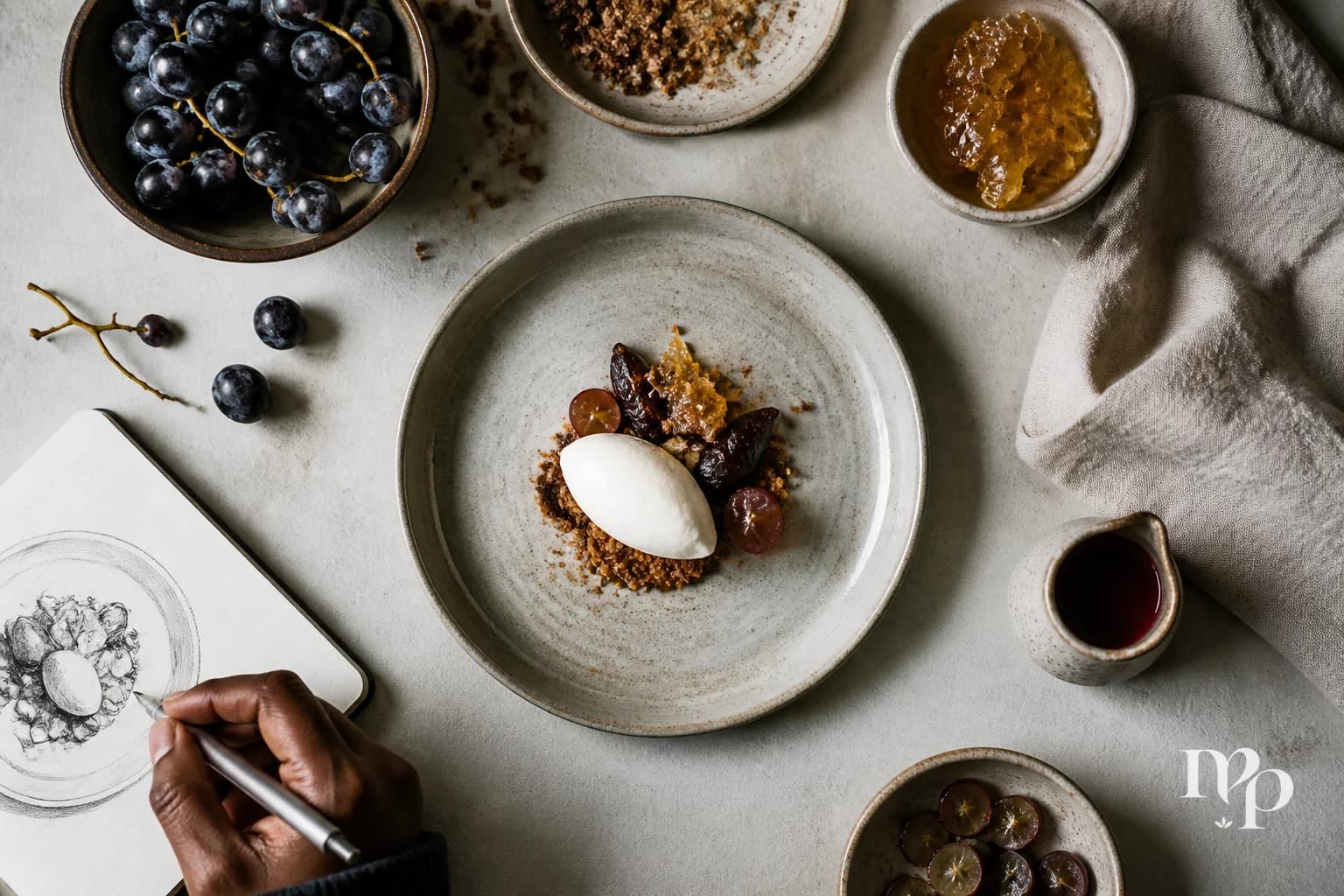
Some guests decide on dessert before they see the menu. Others decide against it before the server ever asks.
By the time the last course appears as an option, the room has already made half the decision. The pace of the meal, the generosity of the savory courses, the weight of the wine, the language of service, the noise level, the hour, even the size of the table all shape whether dessert feels like a natural continuation or a polite burden.
That is where hospitality experience design enters pastry. Not as theater. Not as decoration around the plate. As the careful shaping of how dessert is invited into the meal.
The order is not the beginning
A restaurant dessert does not begin with the printed menu or the first spoonful. It begins with appetite.
If the meal has been heavy, dessert may need lift: citrus, tea, cultured dairy, herbs, bitterness, ice, something with air in it. If the menu has been lean and bright, the final course can carry more warmth, more cream, more toasted depth. If the room is built around sharing, a plated dessert that demands private concentration may feel out of step. If the restaurant is quiet and precise, a sprawling dessert for the table may interrupt the rhythm.
The point is not to make dessert smaller or safer. The point is to make it aware.
Hospitality experience design asks a plain question: what condition is the guest in when dessert arrives? That condition should shape sweetness, portion, temperature, texture, and service. It should also shape how the dessert is described. A guest who has just finished a long tasting menu does not need a speech. A guest at a lively table may need something easy to understand across conversation.
What service already knows
Service can usually feel dessert before pastry sees it.
The server knows which tables are slowing down, which ones are celebrating, which guests are curious, and which guests are looking for a clean exit. The dining room hears hesitation in a way a menu cannot. It knows when a dessert needs to be offered as a gentle close, a shared gesture, or a reason to stay a little longer.
This is why a dessert cannot live only in the kitchen. It has to survive the handoff.
A composed plate may be technically strong and still fail if service cannot explain it without sounding rehearsed. A dessert may be beautiful and still feel wrong if it lands too late, too large, or too sweet for the room. We have written about this more directly in The dessert service can carry, because service is not a delivery system. It is part of the dessert's form.
The strongest restaurant desserts give service something clear to say. Not a list of components. A reason. Something like: this is our lighter finish, this is built around roasted fruit, this has a bitter edge, this is made to share, this is quiet after a rich meal.
That kind of language helps the guest choose without feeling managed.
Choices the guest can feel
Designing dessert for hospitality is often a matter of proportion.
A spoonful of acidity can make cream feel generous instead of heavy. A crisp element can wake up a soft dessert without adding noise. A bitter note can make sweetness taste more deliberate. A warm sauce can slow the table down. A frozen element can refresh it.
These are not abstract choices. They affect the guest's body at the end of the meal.
Temperature matters because the final course often arrives when the palate is tired. Texture matters because softness alone can make dessert feel sleepy. Sugar matters because sweetness that arrives without contrast closes the palate too quickly. Portion matters because abundance can become pressure when the guest is already full.
Decoration has to earn its place here. A garnish that photographs well but adds no flavor, texture, aroma, or service clarity is not hospitality. It is extra handling. More elements do not automatically create more interest. Often they create more distance between the guest and the idea.
A useful dessert language is felt before it is admired.
Where desserts lose the room
Restaurants often lose the last course in a few familiar ways.
They make dessert too separate from the rest of the menu. The savory food speaks with restraint, smoke, acidity, and seasonal vegetables, then dessert arrives as a generic chocolate construction with no relation to the house.
They build for the first photo instead of the last bite. The plate looks composed for ten seconds, then eats as repetition.
They ask service to explain too much. If a dessert needs a paragraph to become interesting, the idea may not be clear enough.
They confuse generosity with size. A large dessert can be right, especially for sharing, but size alone is not care. Care is proportion, pacing, and the feeling that the restaurant understood what the table needed next.
They change dessert without changing the experience around it. A new dessert menu may still fail if the sequence, language, service timing, and appetite have not been considered. A dessert begins as a decision long before it becomes a dish, which is why When a dessert begins as a decision remains a useful companion to this conversation.
Questions before the menu changes
Before adding or replacing desserts, an operator can ask better questions than what should we put on the menu?
What does the room feel like by the time dessert is offered?
Are guests usually full, still curious, rushed, settled, celebratory, or ready to leave?
Does the dessert menu repeat the restaurant's voice, or does it borrow a voice from somewhere else?
Can service describe each dessert in one clear sentence?
Is there a lighter finish that still feels designed?
Is there a deeper, more comforting finish that still has contrast?
Which dessert belongs to the house, not just to the pastry section?
What should the guest remember after the last bite: freshness, warmth, restraint, pleasure, surprise, calm?
These questions are not meant to flatten creativity. They protect it from becoming detached from the room.
A quieter checklist
For a restaurant dessert to work as part of hospitality, it should be able to answer a few simple tests.
- It fits the appetite left by the savory menu.
- It has one clear reason to exist.
- It uses sweetness with contrast, not as the whole idea.
- It gives service language that feels natural.
- It can be executed consistently during real service.
- It respects the table's pace.
- It tastes like it belongs to this restaurant.
- It leaves a final memory rather than a final weight.
A checklist will never design the dessert. But it can show where the idea is drifting.
From the studio
In our work, we often look at the room before we look at the plate.
Not because the plate is unimportant. Because the plate is the last visible decision. By then, the dessert has already been shaped by the restaurant's identity, its guests, its service rhythm, its menu, its sense of restraint, and the kind of ending it wants to offer.
A dessert can be quiet and still be memorable. It can be generous without being heavy. It can be simple without being plain. The difference is intention.
The last spoonful should know where it is
The final course is not a separate performance at the end of dinner. It is part of the meal's hospitality.
When dessert understands the room, it does not have to insist on itself. It arrives with the right weight, the right clarity, and the right amount of invitation. It lets the guest leave with something complete.
For restaurants and hospitality teams shaping a dessert language of their own, Mistoura Pastry works on the final course as part of the whole experience, not as an afterthought.
Studio note
Mistoura Pastry approaches dessert as culinary design. The goal is not more sweetness or more decoration. The goal is a final course with flavor, restraint, and intention.