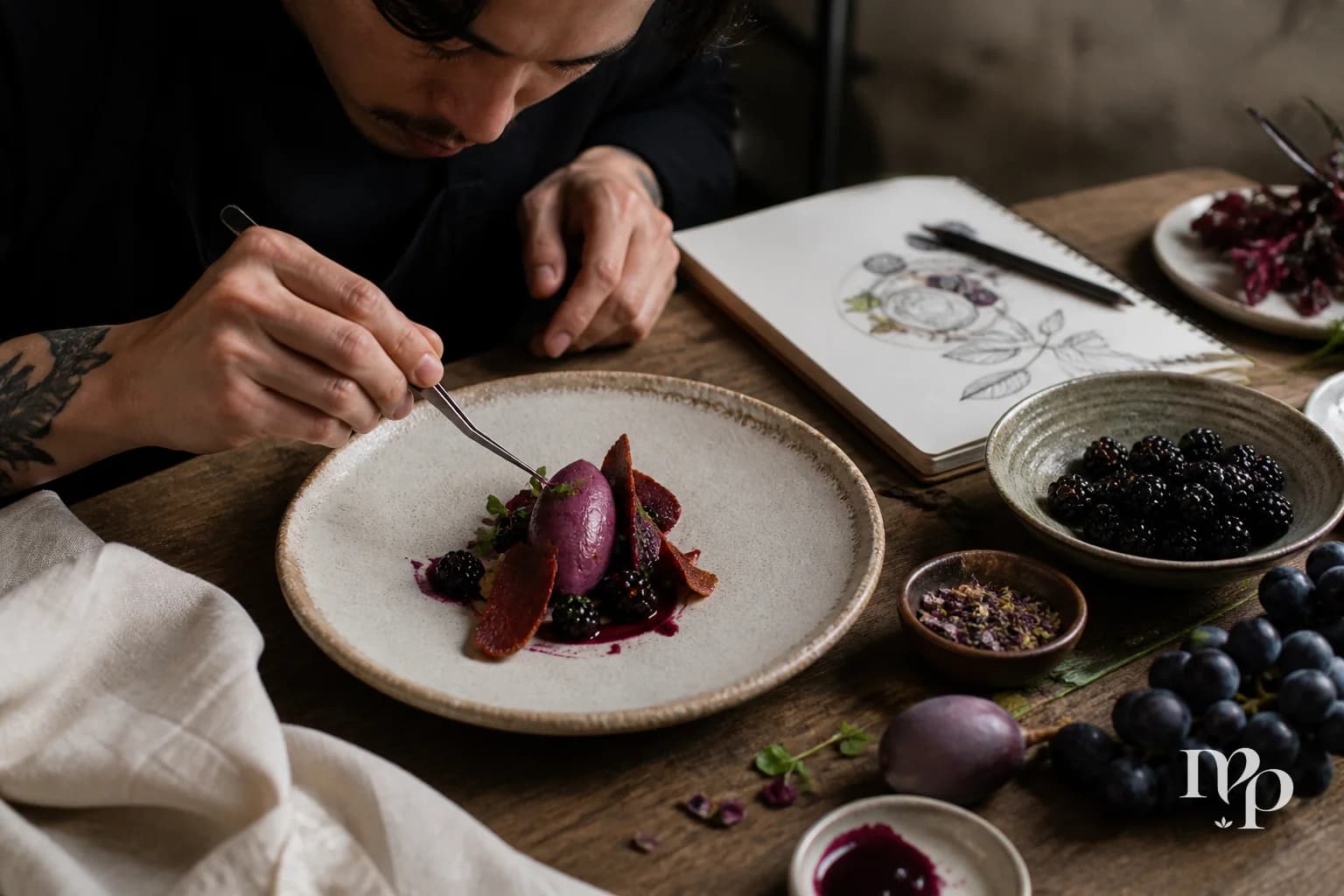
The table often tells you what dessert should do before anyone says the word dessert.
A room can be loud after a long service. A guest can be full but not finished. A menu can move through salt, smoke, acid, fat, heat, and still need one last gesture that makes the evening feel complete. That gesture is not always large. It is not always sweet in the obvious way. Sometimes it is a cooler temperature, a cleaner line, a sharper fruit note, a spoonful of cream held back by something bitter.
Dessert should not be an afterthought because the end of the meal has a different kind of power. It can rush people out, weigh them down, or give them one more reason to sit in the room with attention.
What the room has already given
A restaurant dessert begins with what happened before it.
If the menu has been generous and savory, the final course may need air. If the room is formal, dessert may need warmth without becoming cute. If the cooking has been direct and elemental, a highly ornamental plate can feel like it came from another restaurant entirely.
This is where hospitality experience design becomes a culinary question, not a mood board. What does the guest need at this point in the meal? More richness, or relief? More theatre, or calm? A familiar flavor, or a small turn they did not expect?
The strongest restaurant desserts understand that appetite is not only physical. By the last course, guests are also responding to time, conversation, lighting, pacing, glassware, service rhythm, and the emotional temperature of the table. Pastry sits inside all of that.
We have written before about The dessert service can carry, because a dessert that looks thoughtful but collapses in service is not hospitality. It is pressure passed to the dining room.
Sweetness is a pacing decision
Sugar is not the point. It is one of the materials.
Used without restraint, sweetness can flatten the end of a meal. It covers acidity, dulls bitterness, softens texture, and makes one bite feel much like the next. Used with judgment, sweetness can carry aroma, frame fruit, temper spice, or make bitterness feel generous rather than severe.
A dessert that changes the pace often uses sweetness as a line, not a blanket. A little caramel depth against citrus. A cream element that softens a sharp fruit. A crisp layer that breaks the quiet. A sorbet that resets the mouth before the last spoonful.
The point is not to make dessert austere. Guests did not come to the final course to be punished by restraint. But pleasure has structure. A dessert can be generous and still edited.
Before texture becomes decoration
Texture is one of the clearest ways to change the rhythm of a table.
A soft dessert slows the guest down. A brittle element wakes the mouth. A chilled component can lift a heavy sequence. A warm sauce can make the table lean in for a moment. These choices affect how the dessert is eaten, not just how it photographs.
What people often get wrong is treating texture as a list. Creamy, crunchy, chewy, frozen, crisp, all on one plate. More elements do not automatically create more interest. They can create noise.
Composition asks a stricter question: what does each texture make possible? If a crisp element is present, does it sharpen the cream or simply announce itself? If there is a sauce, does it connect the plate or drown it? If fruit is used, does it still taste like fruit, or has it become a color accent?
Decoration should serve the idea. A garnish that does not change flavor, aroma, rhythm, or meaning is asking for space it has not earned.
Where good intentions go flat
Many restaurant desserts fail from generosity without editing.
A chef wants to give guests abundance, so the plate becomes crowded. A restaurant wants a memorable ending, so the dessert becomes theatrical in a way the rest of the menu never was. A team wants a signature, so they add complexity before they have clarified the role of the dish.
There is also the quiet mistake of repetition. If the savory menu has already been rich, buttery, and deep, a dense chocolate finish may not feel indulgent. It may feel like the room forgot to open a window. If the meal has been bright and coastal, a heavy final course can pull the guest out of the place the restaurant spent two hours building.
None of this means chocolate, cream, pastry, or richness should be avoided. It means they need proportion. The question is not whether an ingredient is beautiful. The question is what it does at this exact moment in this exact room.
For restaurants thinking about a house dessert, When one dessert speaks for the house explores why recognition depends on clarity, not volume.
Questions before the spoon reaches the table
A useful dessert conversation can start with quieter questions than most menus allow.
What should guests feel ten minutes after the last bite?
Should the dessert extend the mood of the meal, or create contrast?
Does the room need warmth, lift, freshness, bitterness, softness, or a clean finish?
Can the service team describe the dessert without performing a speech?
Will the plate survive the pace of a full dining room?
Does the dessert belong to this restaurant, or could it sit unchanged on any menu in the city?
These questions keep the work grounded. They move dessert away from novelty and toward hospitality.
A quieter checklist
Before adding a dessert to a restaurant menu, we often look for a few simple signs:
- The dessert has a clear role in the meal.
- Sweetness is balanced by acidity, bitterness, salt, temperature, or texture.
- Every visible element changes the eating experience.
- The plate can be served consistently during a busy service.
- The portion respects what came before it.
- The description sounds natural in the dining room.
- The dessert feels connected to the restaurant’s identity without becoming a slogan.
- The final bite leaves a clean memory, not fatigue.
This checklist is not about making dessert smaller or quieter by default. It is about making sure the dessert knows why it is there.
From the studio
In our work, we often begin by listening to the pace of the restaurant before sketching the dessert itself. The dining room gives clues: how guests order, how long they linger, how the savory menu builds, where the service has room to breathe, where it does not.
A dessert for a hotel restaurant may need a different kind of generosity than a dessert for a small chef driven room. A cafe dessert may need to carry daytime ease, while an event dessert may need to hold its shape across timing, movement, and many hands. The design changes because the hospitality changes.
Mistoura Pastry is interested in that relationship. Flavor, texture, and composition are not separate from service. They are part of how the guest understands care.
The last minutes of the table
The end of a meal does not need to explain itself loudly.
Sometimes the most memorable dessert is the one that changes the air at the table by a few degrees. It gives contrast where the meal has been dense. It gives softness where the room has been sharp. It gives one precise flavor enough space to be remembered.
Sweetness can close a meal. It can also change its pace, gently, if it is designed with attention.
If your restaurant is considering a dessert that needs to carry more than sweetness, Mistoura Pastry can help shape the idea with restraint and clarity. Begin with Mistoura Pastry.
Studio note
Mistoura Pastry approaches dessert as culinary design. The goal is not more sweetness or more decoration. The goal is a final course with flavor, restraint, and intention.