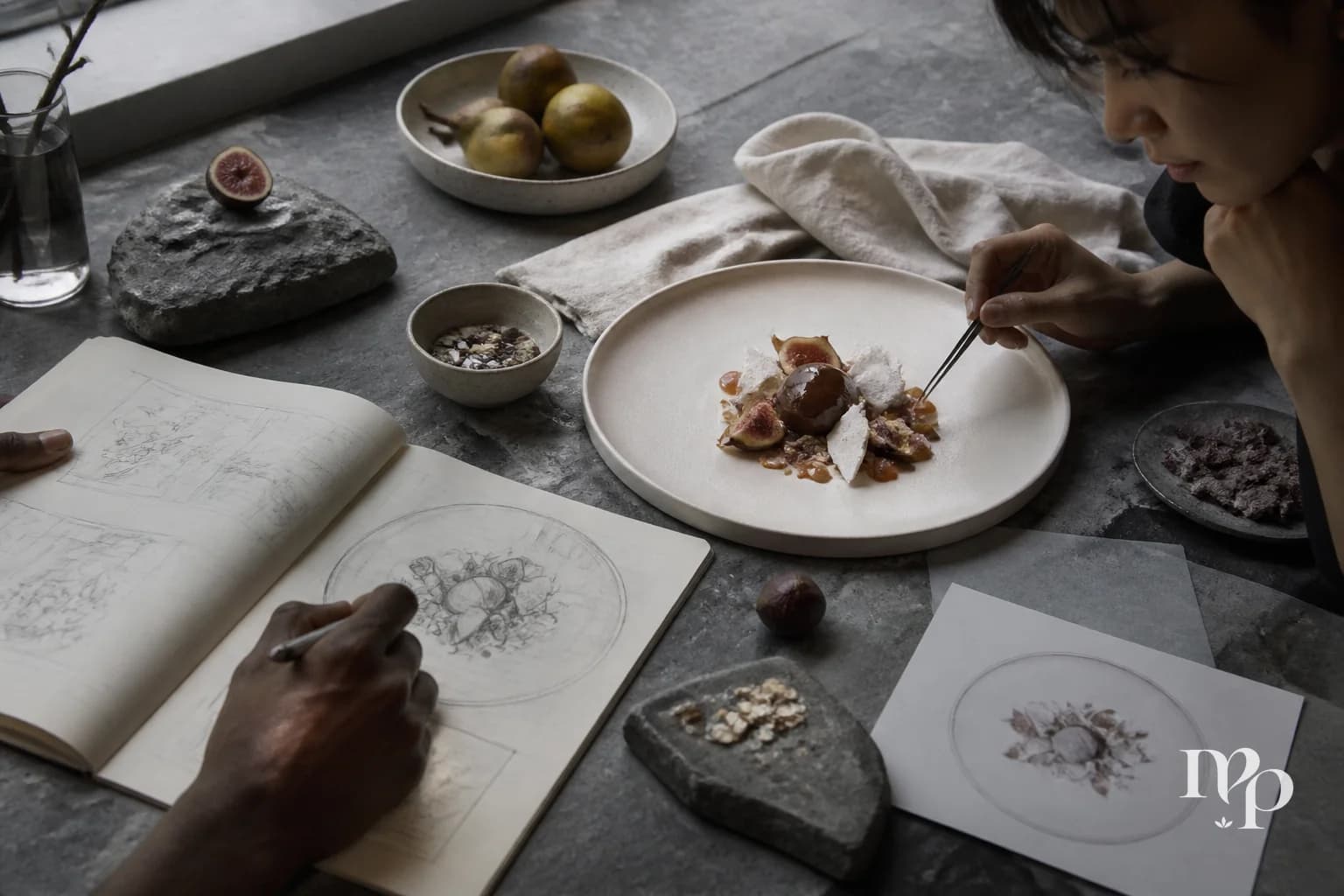
A signature dessert often gets discussed too late, after someone can already picture the plate. The garnish appears. The sauce has a shape. The spoon has somewhere to go.
But by then, some of the more important decisions may already have been missed.
For a restaurant, the plate is not the first decision. The first decision is what the dessert is being asked to carry.
What the last course is being asked to hold
A restaurant dessert is not only a sweet finish. It holds the weight of the meal that came before it.
If the menu is generous and rich, the final course may need lift. If the room is quiet and precise, the dessert may need restraint. If the restaurant is built around fire, spice, acid, smoke, fermentation, or produce, the dessert cannot behave as if it wandered in from another address.
Signature dessert development begins with this kind of listening. Not passive listening. Specific listening.
What does the restaurant already say clearly? Where does the menu build energy? Where does it slow down? What does the guest still have appetite for by the final course? What would feel like a continuation, and what would feel like a costume?
A useful signature does not try to summarize the whole restaurant. That usually creates a crowded plate. It chooses one clear thread and gives it form.
Before sweetness takes over
Sugar is one of the easiest ways to make a dessert feel finished, and one of the fastest ways to flatten it.
In signature dessert development, sweetness should be placed, not poured over the idea. A bitter note can make fruit taste more alive. Salt can clarify dairy. Acidity can keep caramel from becoming heavy. A toasted flavor can make sweetness feel warmer without making the dessert larger.
The strongest version may not be the sweetest version. It may be the one where each ingredient still tastes like itself.
That matters in restaurants because the guest arrives at dessert with a changed palate. They have moved through salt, fat, heat, wine, conversation, and time. A dessert that would be charming at four in the afternoon can feel blunt after eight courses or a full dining room rush.
The question is not how to impress the guest with more. It is how to leave them with enough clarity to remember the ending.
The room has a say
A signature dessert belongs to a room before it belongs to a photograph.
That means service matters. Plate architecture matters. Temperature matters. The number of movements at the pass matters. The way a server describes the dessert matters. The gap between ordering and delivery matters.
A composed dessert that collapses in thirty seconds may work in a controlled tasting and fail in a busy dining room. A frozen element may be beautiful, but if the restaurant cannot protect its timing, the idea starts to soften before the guest understands it. A fragile garnish may read as refinement in development and become frustration on a Saturday night.
This is why we often think of dessert as part of hospitality, not only pastry. The dessert has to meet the guest, but it also has to respect the people serving it.
For a deeper look at that side of the work, see The dessert service can carry.
The choices that give a dessert its shape
Once the role is clear, the plate can begin to take form.
Texture is usually one of the first serious decisions. Softness alone can become sleepy. Crunch without purpose can feel decorative. Cream, crispness, chew, ice, syrup, crumb, and fruit all change the pace of eating. The design should decide where the spoon slows down and where it breaks through.
Temperature is another quiet tool. Warmth can make a dessert feel generous. Cold can make it feel clean. A contrast between the two can create attention, but only if the kitchen can serve it with consistency.
Proportion is where many desserts lose their nerve. Too much sauce. Too many accents. Too large a base. Too many small ideas competing for attention. More elements do not automatically create more interest. Often they create more noise.
A signature dessert needs a center. Not always visually, but conceptually. The guest should be able to understand what the dessert is about after the first few bites, even if the details continue to unfold.
Where signature desserts go wrong
The most common mistake is designing for recognition instead of belonging.
A dramatic shape may be recognizable. A rare ingredient may be noticeable. A technical flourish may show skill. None of that means the dessert belongs to the restaurant.
Another mistake is confusing decoration with composition. Decoration sits on top of an idea. Composition organizes the idea. A flower, shard, powder, tuile, or quenelle only earns its place if it changes flavor, texture, rhythm, aroma, or meaning.
There is also the temptation to make the signature dessert carry too much story. A restaurant with layered influences does not need every influence on one plate. A founder perspective, a place, a memory, or an ingredient origin can guide the work, but the dessert still has to eat well. Meaning does not excuse a heavy spoonful.
We wrote more about that distinction in When dessert decoration becomes composition.
Questions before the sketch
Before drawing a plate, an operator might ask:
What should the guest feel at the end of the meal: refreshed, settled, surprised, comforted, sharpened?
How much appetite does the average guest realistically have left?
Does the dessert need to work after a tasting menu, an à la carte meal, or both?
Which ingredients already belong to the restaurant language?
What textures are missing from the menu as a whole?
Can the kitchen execute the dessert during the hardest service of the week?
Can the service team describe it without sounding rehearsed or confused?
Would the dessert still make sense if one decorative element disappeared?
Does the final bite leave clarity, or just sweetness?
These questions are not meant to make the process stiff. They protect the idea from becoming vague.
A quieter checklist
A signature dessert is ready to move forward when it can answer a few simple demands.
It has a reason to exist on this menu.
It respects the appetite left at the table.
It has a clear flavor center.
Its textures create rhythm, not clutter.
Its sweetness is balanced by acid, bitterness, salt, spice, fruit, dairy, grain, or another grounding element.
Its form can survive real service.
Its description feels natural in the mouth of the staff.
Its details support the idea instead of decorating around it.
It leaves a memory that belongs to the restaurant, not to pastry in general.
From the studio
In our work, we often begin signature dessert development with constraints rather than sketches. The room size. The menu structure. The equipment. The service rhythm. The ingredients that already feel native to the restaurant. The kind of ending the owner does not want.
Constraints are not a lack of imagination. They are how the dessert finds its edge.
A plate can always be made prettier. It is harder, and more useful, to make it more exact.
The final course should not feel like a performance added after the meal is over. It should feel like the restaurant had one more thing to say, and knew how softly to say it.
If your restaurant is considering a signature dessert with a clearer sense of place, service, and memory, Mistoura Pastry develops final courses with that kind of restraint and intention. Visit Mistoura Pastry to begin the conversation.
Studio note
Mistoura Pastry approaches dessert as culinary design. The goal is not more sweetness or more decoration. The goal is a final course with flavor, restraint, and intention.