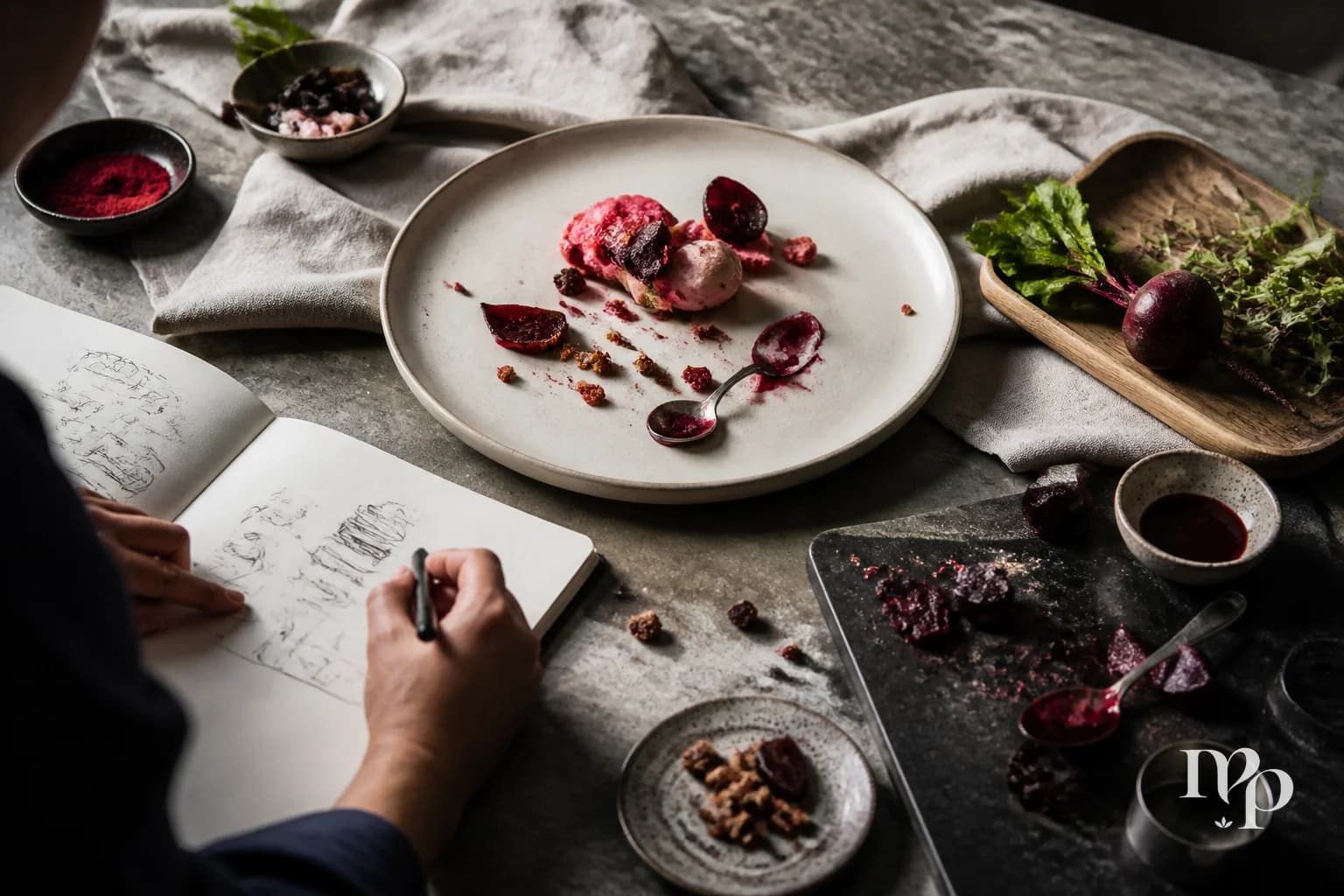
A signature dessert usually gets asked to arrive too late. The menu is set, the room has a rhythm, the service has its limits, and then someone asks for a dessert that will be remembered.
That is not impossible. It is just a tighter brief than most people admit.
A restaurant signature dessert should not begin as a plate looking for applause. It should begin as an answer to a quieter question: what should the guest carry from this table after the last spoonful?
The brief before the garnish
The strongest signature desserts are not built from decoration first. They are built from a brief.
Not a corporate document. Not a mood board full of borrowed plates. A working brief that understands the restaurant as it is: the food before dessert, the pace of service, the check average, the room temperature, the guest's appetite, the way the team plates under pressure, and the kind of memory the restaurant wants to leave.
In our work, signature dessert development starts by reducing the noise. What does this dessert need to do that the rest of the menu cannot do? Should it refresh, deepen, soften, surprise, or settle the meal? Should it feel generous or precise? Should it carry a seasonal ingredient, a house technique, a cultural reference, or a textural idea?
Without that brief, the dessert often becomes a collection of attractive parts. Cream, crunch, fruit, sauce, garnish. Each one may be good. Together, they may say very little.
We wrote more about this foundation in The brief beneath a signature dessert.
When the room has a say
A dessert does not land in a blank space. It lands in a room with lighting, noise, pace, table size, guest expectation, and servers moving between decisions.
A small restaurant with a narrow kitchen does not need the same final course as a hotel dining room. A cafe with loyal regulars may need a dessert that can be recognized over time. A tasting menu may need a final gesture that feels inevitable rather than extra. An event setting may need something composed enough to travel, hold, and still feel intentional when it reaches the guest.
This is where signature dessert development becomes hospitality work, not just pastry work.
The question is not only what tastes good. The question is what can be served clearly, consistently, and with a sense of belonging. If a dessert requires a long explanation to justify itself, the plate may be doing too much of the wrong work. If service has to apologize for fragility, timing, or confusion, the idea has not been fully designed.
The room always has a vote.
Choices that give the dessert a spine
A signature dessert needs structure before it needs flourish.
Flavor comes first, but flavor is not only sweetness. Acidity can sharpen the memory of fruit. Bitterness can make chocolate feel more adult. Salt can steady caramel. Fat can soften intensity. Warmth can make spice feel present without shouting. Less sugar can make an ingredient taste more like itself.
Texture gives the dessert rhythm. A spoon needs resistance, then relief. Crisp against cream. Tender against cold. Something that breaks, something that melts, something that holds. Without texture contrast, even a beautiful dessert can feel flat after two bites.
Composition decides where the guest enters the plate. The first spoonful should make sense. The last one should not feel like leftovers. Decoration has to serve the idea, not sit on top of it. A garnish that adds color but no flavor, aroma, texture, or meaning is usually asking for attention it has not earned.
Proportion is the quiet discipline. Too much sauce can drown clarity. Too much richness can punish the end of the meal. Too many elements can blur the point. Restraint is not minimalism for its own sake. It is the edit that lets the dessert speak in one voice.
Where signature desserts get heavy
The most common mistake is treating the signature dessert as a trophy.
That usually leads to height, shine, rare ingredients, dramatic plating, and a long list of components. None of those are wrong by themselves. The problem begins when they are used to prove importance instead of create experience.
Another mistake is designing the dessert away from the kitchen that has to produce it. A dessert can look strong in a test kitchen and still be wrong for a restaurant if it slows service, needs too many last minute touches, or depends on one person being present every night.
There is also the borrowed identity problem. A restaurant sees a dessert elsewhere, admires the confidence of it, then asks for its own version. But confidence cannot be copied cleanly. What worked in one room may feel costume-like in another.
A signature dessert should feel specific, not decorative. It should belong so clearly that removing it from the restaurant would weaken it.
For another angle on this, see When a signature dessert has a job to do.
Questions before the first test
Before a restaurant asks what the dessert should be, it helps to ask what the dessert is responsible for.
What has the guest already eaten by the time dessert arrives?
Is the final course meant to refresh the palate, extend the richness of the meal, or create contrast?
Should this dessert feel seasonal, permanent, or slowly adaptable?
Can the service team describe it in one clean sentence without sounding rehearsed?
Does the plate depend on decoration, or does every element change the eating experience?
Can the kitchen execute it on a busy night without turning the station into theater no one asked for?
What ingredient, texture, or gesture makes it unmistakably connected to this restaurant?
These questions do not make the dessert smaller. They make the work sharper.
A quieter checklist
A useful signature dessert does not need to satisfy every idea. It needs to satisfy the right ones.
Before moving from test to menu, we often look for a few signals:
- The dessert has one clear reason to exist.
- The main ingredient still tastes like itself.
- Sweetness supports flavor instead of covering it.
- Texture changes across the bite without becoming busy.
- The portion respects the appetite at the end of the meal.
- The plate can be served with consistency by the actual team.
- The dessert can be described simply and remembered easily.
- The final spoonful feels intentional, not accidental.
If one of these points fails, the dessert may not need more. It may need an edit.
From the studio
At Mistoura Pastry, we think of signature dessert development as a form of translation.
A restaurant has a voice before dessert enters the conversation. It may be quiet, generous, exacting, relaxed, ceremonial, restrained, or playful. The final course should not interrupt that voice. It should carry it into another register.
Our perspective is shaped by pastry discipline, restaurant awareness, and a layered sense of place across Togo, France, and the United States. That does not mean forcing references onto a plate. It means paying attention to how ingredients, memory, technique, and restraint can meet without turning into performance.
The strongest version is rarely the loudest one. It is the one with enough clarity to be recognized and enough depth to be returned to.
The final memory should feel chosen
A signature dessert is not responsible for saving a meal. It is responsible for completing one.
When it works, the guest does not only remember sweetness. They remember temperature, texture, a small surprise, the way the plate arrived, the sense that the restaurant knew exactly where to leave them.
That kind of dessert takes more than a pretty sketch. It takes a brief, an edit, a service reality, and a clear point of view.
If your restaurant, cafe, hotel, or hospitality team is ready to shape a final course with intention, Mistoura Pastry can help develop the dessert language around it.
Studio note
Mistoura Pastry approaches dessert as culinary design. The goal is not more sweetness or more decoration. The goal is a final course with flavor, restraint, and intention.