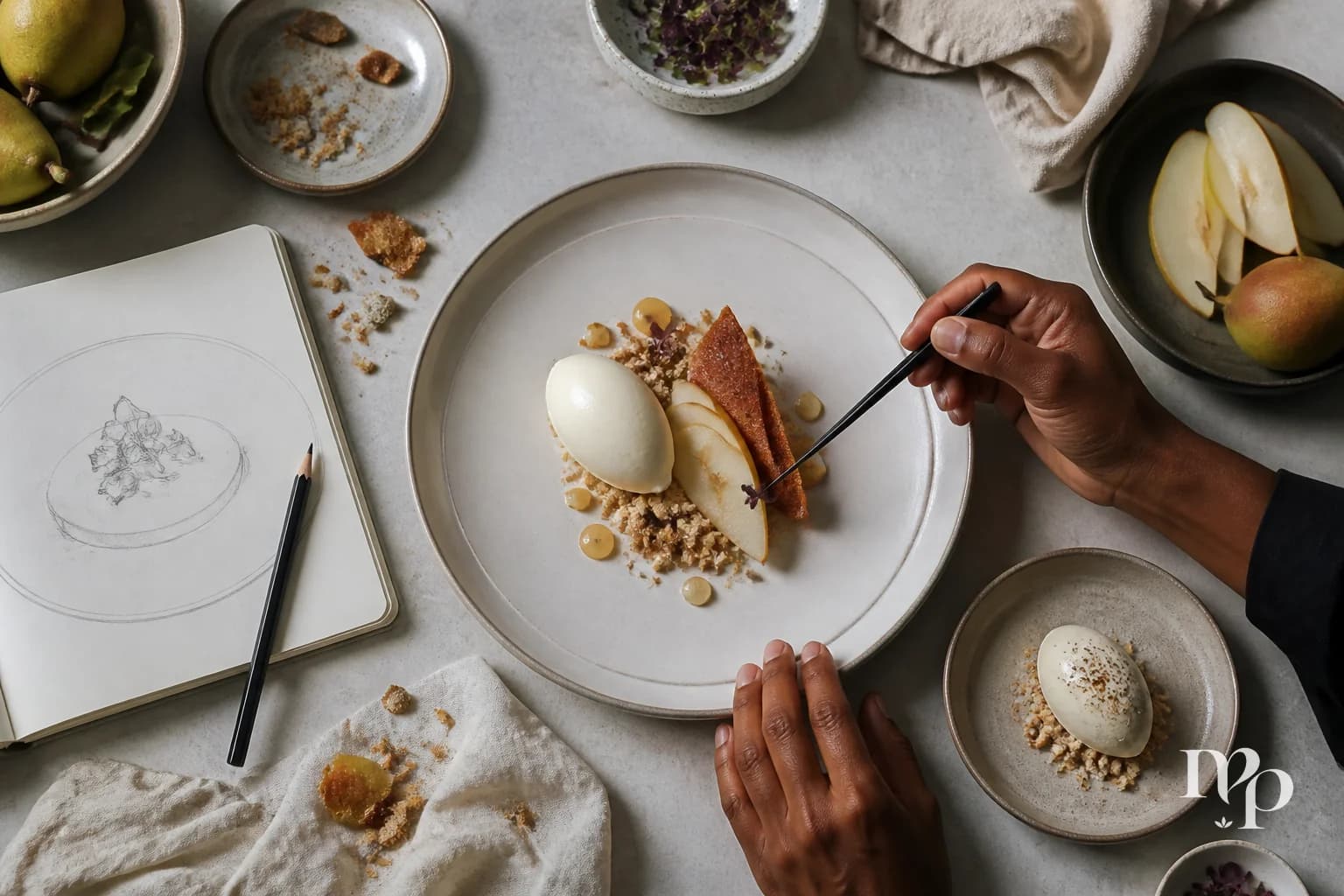
A server should not need to rescue a dessert with a paragraph.
There are restaurant desserts that look impressive in development and become strangely difficult once they reach the dining room. The idea is layered. The garnish has a reference. The shape means something. The flavor list is long enough to need punctuation. Then the plate arrives, and the guest still has one quiet question: what am I meant to taste first?
For signature dessert development, that question matters more than novelty. A dessert can be original and still unclear. It can be beautiful and still feel like work. The stronger version is usually easier to enter.
The first job is legibility
A signature dessert should not flatten the restaurant into a slogan, but it should give the table a way in.
That does not mean obvious. It means readable. The guest can understand the center of the dessert before the spoon breaks it open. A citrus dessert may begin with brightness, then move toward cream, bitter peel, or toasted grain. A chocolate dessert may lead with depth, then loosen itself with salt, fruit, smoke, coffee, or crunch. A fruit dessert may need less sweetness than people expect because ripeness already carries the point.
What people often get wrong is treating originality as the first requirement. Originality without clarity becomes private. It may satisfy the development conversation, but it does not necessarily serve the table.
In our work, a useful question is simple: could a thoughtful server describe this dessert in one calm sentence without sounding like they memorized a concept note?
If not, the dessert may not be ready. Not because service cannot learn it, but because the idea is still asking for protection.
Before the spoon reaches the table
A restaurant dessert lives inside hospitality, not on a pastry bench alone.
It arrives after appetite has changed. The guest may be curious, full, celebratory, tired, lingering, or ready to leave. The dessert has to meet that condition with proportion. Too large, and it turns generosity into burden. Too sweet, and the last memory of the meal becomes fatigue. Too delicate, and service begins to feel nervous around it.
This is where signature dessert development becomes more than flavor. It becomes pacing, temperature, plate choice, cut size, holding time, sound, and the way a server places the dish down. A final course is not just eaten. It is introduced, shared, paused over, and remembered.
We have written before about The dessert service can carry, because service is not a minor detail at the end. It is part of the design. If a dessert requires too much explanation, too many last second gestures, or too much anxiety from the room, the composition may be asking hospitality to compensate for it.
The design choices that make a dessert feel known
Clarity often comes from editing, not adding.
One main flavor needs the confidence to stand forward. The supporting elements should sharpen it, soften it, lengthen it, or create contrast. They should not compete for attention. A spoon should be able to gather the idea of the dessert without needing every garnish to be separately negotiated.
Texture is usually where a signature dessert becomes memorable. Cream needs interruption. Cake needs moisture or temperature contrast. Frozen elements need something that resists them. Crisp elements need protection from time. Softness can be generous, but too much softness makes the dessert disappear before the guest has formed a memory.
Sweetness should be treated as structure, not decoration. Less sugar does not automatically create better pastry, but excessive sweetness can cover origin, acidity, bitterness, dairy, fruit, spice, and grain. If an ingredient is worth naming, it should still taste like itself.
Shape matters too. A dessert should look intentional from the guest side of the table, not only from above in development. Height, negative space, sauce placement, and portion all affect how approachable the dish feels. Decoration should serve the idea. If the garnish is only there to signal effort, it is probably making the dessert less precise.
For a broader view of belonging, How to design a signature dessert that belongs to the restaurant looks at the relationship between the dish and the house around it.
Where signature desserts lose their nerve
The most common mistake is too many references on one plate.
A restaurant wants a dessert to feel distinctive, so the development process gathers everything: a childhood memory, a regional ingredient, a house cocktail, a texture trend, a dramatic garnish, a tableside finish, a familiar comfort, and a surprising accent. Each part may be reasonable alone. Together, they blur.
Another mistake is designing for the photograph before designing for the spoon. A dessert can have a striking silhouette and still eat badly. If the guest has to chase dry crumbs across a plate, cut through a frozen block with a spoon, or assemble the intended bite with architectural care, the dish is asking too much.
There is also the mistake of confusing richness with satisfaction. Butter, cream, chocolate, caramel, nuts, and pastry can create depth, but they need air, acidity, bitterness, salt, temperature, or fruit to keep the experience alive. Without contrast, richness closes the meal heavily.
And sometimes the name carries more pressure than the dessert. If the dish is positioned as the signature, it will be expected to hold more than appetite. It has to express the restaurant without becoming a monument to itself.
Questions for the final course
Before developing or changing a signature dessert, restaurant owners and operators can ask a few grounded questions:
- What should the guest remember after the last spoonful?
- Which ingredient, texture, or temperature gives the dessert its center?
- Can service describe the dish naturally in one sentence?
- Does the portion respect the meal that came before it?
- Is the sweetness helping the flavor, or covering it?
- What part of the dessert would we remove first if the plate felt crowded?
- Can the kitchen execute it calmly during a full service?
- Does this dessert sound like this restaurant, or like a dessert that could travel anywhere?
None of these questions reduce ambition. They protect it. A clearer brief usually gives the dessert more room to become itself.
A quieter checklist
A signature dessert is closer when it has:
- One clear flavor direction
- A texture contrast the guest can feel immediately
- A portion that leaves appetite intact
- A name that does not overexplain
- A plate composition that supports the spoon
- A service description that feels human
- A preparation rhythm the kitchen can repeat
- A reason to belong to this restaurant and not another
The checklist is not meant to make every dessert quiet. Some desserts should be dramatic. Some should be playful. Some should arrive with heat, smoke, height, or ceremony. The point is not restraint for its own sake. The point is control.
From the studio
At Mistoura Pastry, we often begin signature dessert development by listening for the restaurant before sketching the dessert. The room gives clues. So does the menu, the service style, the appetite of the guests, the pace of the evening, and the kind of memory the restaurant wants to leave behind.
Our perspective is shaped by pastry as design: flavor, texture, proportion, and identity working together. The strongest dessert is not always the most complex one. It is the one that can be placed on the table and understood without losing its depth.
A final course should not need to defend itself. It should invite the guest in, clearly and generously, then let the last bite do the quieter work.
If your restaurant is developing a dessert that needs to feel unmistakably its own, Mistoura Pastry works with hospitality teams on final course identity, composition, and service clarity. Begin with Mistoura Pastry.
Studio note
Mistoura Pastry approaches dessert as culinary design. The goal is not more sweetness or more decoration. The goal is a final course with flavor, restraint, and intention.