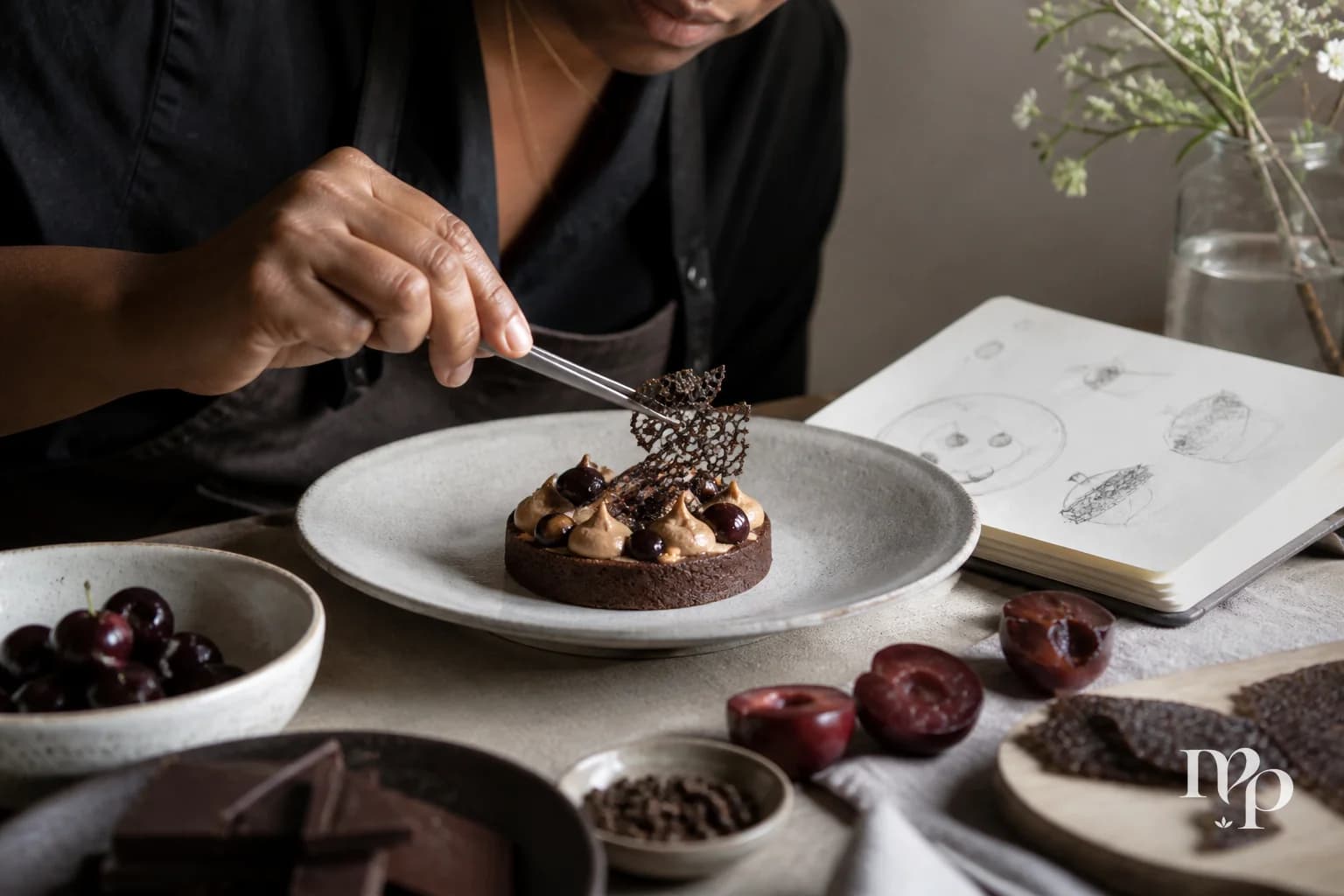
A dessert menu can look full and still feel thin.
Five options, all sweet in the same way. Three plates, all soft. A chocolate dessert, a fruit dessert, something frozen, and yet no real point of view. The guest sees choice, but not direction.
In restaurant dessert strategy, the question is not only how many desserts belong on the menu. The better question is what each dessert is there to hold.
Enough choice, not more choice
A generous dessert menu is not always a long one. Length can create confidence, but it can also blur the final course until nothing feels chosen with care.
We often find that a smaller menu with clear contrast gives the guest more freedom than a crowded menu built from repetition. One dessert may carry depth and warmth. Another may bring acidity, fruit, or freshness. Another may be quiet, creamy, and familiar enough to soften the end of the meal.
The work is not to cover every possible craving. It is to create a small field of meaningful choices.
A dessert menu should let different guests find themselves without making the restaurant lose its voice. That is the tradeoff. Too narrow, and the menu feels rigid. Too broad, and the final course starts sounding like it belongs anywhere.
The room has already set the pace
Dessert does not arrive into silence. It arrives after the dining room has taught the guest how to feel.
A long, layered tasting menu asks something different from dessert than a busy cafe service. A coastal lunch room may need a final course with lift and salt. A low lit restaurant with slow pacing may be able to hold bitterness, depth, or a warmer finish. A hotel lobby dessert menu may need to work across several moods at once: a business conversation, a late arrival, a guest alone with tea.
This is why dessert menu strategy belongs to hospitality as much as pastry. The dessert list is not a separate island. It has to understand the room, the service rhythm, the staff, the table size, and the kind of memory the restaurant wants to leave.
We wrote more about service capacity in The dessert service can carry, because a dessert that looks thoughtful on paper still has to survive the night.
Range is a design decision
A useful dessert menu usually has contrast across several lines: temperature, texture, sweetness, acidity, richness, and familiarity.
If every dessert is chilled, the menu may feel flat. If every plate depends on crunch, the gesture becomes predictable. If every option is built around chocolate, chocolate stops feeling intentional and starts feeling like a reflex.
Range does not mean forcing one of everything onto the list. It means asking how each dessert changes the experience of choice.
One plate might be structured around creaminess, citrus, and a clean finish. Another might use roasted fruit, pastry, and gentle bitterness. Another might be spare and direct: a custard, a sauce, a single crisp element, all in proportion.
What matters is the relationship between the desserts. They should not compete for the same role.
Where menus go dull
Restaurant dessert menus often lose strength through polite accumulation. A dish is added because someone likes it. Another stays because it has always been there. A seasonal idea appears, but nothing leaves. Soon the menu has options, but no edit.
Another common mistake is treating dessert as a set of categories instead of a set of experiences. Chocolate, fruit, frozen, cheese, pastry. Categories can help, but they do not make a menu interesting on their own.
A chocolate dessert can be bright, bitter, smoky, soft, dense, chilled, or architectural. A fruit dessert can be spare or generous, sharp or mellow, fresh or cooked down into something darker. The ingredient is not the strategy. The treatment is.
Decoration can also confuse the issue. Garnish may make a plate look finished, but it cannot give the dessert a reason to exist. Composition has to come first: what the guest tastes, how the textures move, where sweetness sits, and how the last bite lands.
For a related view on purpose before form, see When a dessert begins as a decision.
Questions before the menu changes
Before changing a dessert menu, a restaurant can ask a few grounded questions.
What does the savory menu leave the guest wanting: freshness, softness, warmth, lift, bitterness, calm?
Which dessert currently feels most like the restaurant, and why?
Are several desserts doing the same job under different names?
Is sweetness being used as the main source of pleasure, or are texture, aroma, temperature, and acidity carrying their share?
Can the kitchen repeat the dessert with the same clarity on a quiet Tuesday and during a full dining room?
Does the menu give the service team a clear way to describe each option without reciting ingredients like a list?
These questions are not meant to make dessert less creative. They protect the creative work from becoming vague.
A quieter checklist
A dessert menu with room to breathe usually has:
- A clear role for each dessert
- Contrast in texture, temperature, and weight
- At least one option with freshness or acidity
- Sweetness that supports flavor instead of covering it
- A level of complexity the kitchen can repeat
- Names and descriptions that help the guest understand the choice
- A relationship to the restaurant, not only to pastry trends
- Enough restraint that each dessert can be remembered
The list does not need to be dramatic. It needs to be legible.
From the studio
In our work, dessert menu strategy often begins with subtraction. Not because less is automatically better, but because a menu needs air before its shape can be seen.
When we remove a redundant texture or question a repeated flavor profile, the stronger desserts become easier to read. The menu starts to breathe. The guest has fewer distractions. The final course feels less like a separate decision and more like the last part of the restaurant’s language.
That is the aim: not a louder dessert menu, but a clearer one.
A restaurant does not need to end with spectacle every night. Sometimes it needs a final course that understands proportion, holds its place, and leaves the table with something clean enough to remember.
For restaurants, cafes, hotels, and hospitality teams shaping a more intentional dessert menu, Mistoura Pastry works as a culinary design studio for the final course.
Studio note
Mistoura Pastry approaches dessert as culinary design. The goal is not more sweetness or more decoration. The goal is a final course with flavor, restraint, and intention.