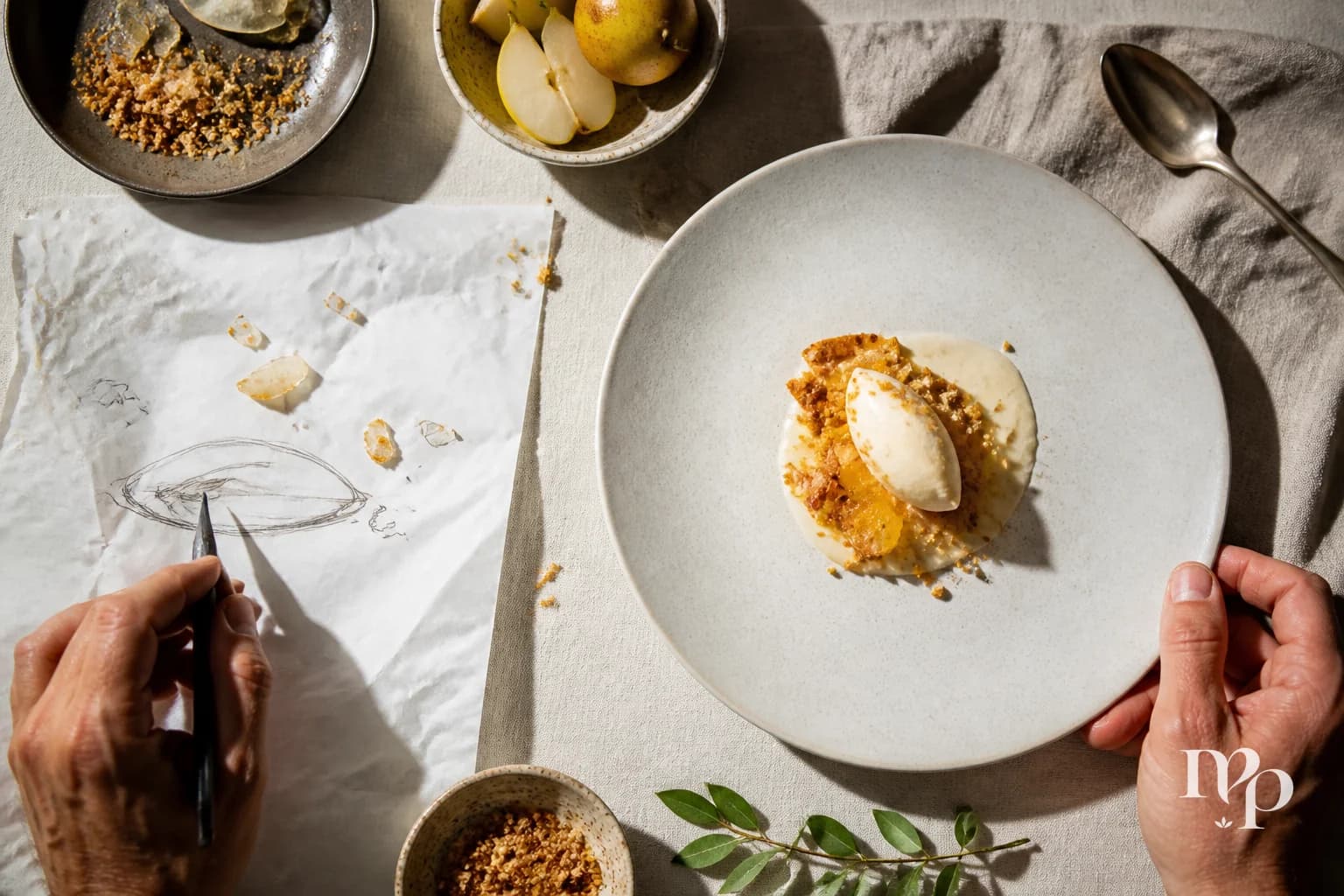
A guest may not remember every garnish on the plate. They may remember something colder than expected, a toasted edge, a clean bitterness after a rich meal, the quiet pleasure of a dessert that arrived at the right size. One dessert speaks for the house when those choices feel specific enough to belong nowhere else.
That is the work of a house dessert. Not a dessert that tries to impress from across the room, but one that feels inevitable once it reaches the table.
A house dessert is not a trophy
Signature dessert development often gets treated as a search for the most photogenic plate. That is usually where the trouble starts.
A restaurant does not need a dessert that looks important in isolation. It needs a dessert that belongs after its food, in its dining room, at its pace of service, with its particular guests. A polished object can still feel borrowed. A quieter dessert can feel unmistakable if its proportions, ingredients, and rhythm are right.
The strongest house desserts tend to have a clear point of view. They know what they are carrying. Maybe it is smoke and acidity after a menu built around fire. Maybe it is a cool, herbal finish after a generous meal. Maybe it is something spare and fruit led because the restaurant has already given the guest enough weight.
More elements do not automatically create more identity. Sometimes they create a plate that has forgotten what it came to say.
Before the spoon reaches the table
Dessert does not arrive into an empty moment. It arrives after ordering, waiting, eating, talking, drinking, and deciding whether there is still room.
That context changes everything.
A final course for a fast, high energy restaurant cannot behave the same way as one designed for a long hotel dinner. A dessert meant for a wine driven room has different responsibilities than one following a spice forward menu. The question is not only what tastes good. The question is what the guest can still receive.
Service matters too. Can the team describe the dessert without apologizing for it? Can it be plated consistently on a busy night? Does it hold its temperature long enough to reach the table as intended? Does the portion invite a final spoonful, or does it ask too much after the meal has already made its case?
For a broader look at this language across the menu, see Why every restaurant needs its own dessert language.
The choices that make it recognizable
A memorable house dessert is usually built from a small number of decisions made with conviction.
The first is the anchor. One ingredient or sensation needs to lead. It might be citrus, chocolate, coffee, sesame, mango, cultured cream, caramelized grain, or something more local to the restaurant's identity. The anchor should still taste like itself. If the main ingredient disappears under sugar, foam, cream, crunch, and decoration, the dessert has lost its center.
Texture gives the dessert its pace. Cream alone can feel flat. Crunch alone can feel dry. A warm element beside something cold can create attention without adding clutter. The goal is not contrast for its own sake. The goal is a spoonful that keeps changing just enough to stay alive.
Proportion is where many signature desserts are won or lost. A bitter note can sharpen the finish. Too much bitterness becomes a lecture. A sweet sauce can bind the plate. Too much sauce turns the dessert vague. A garnish can clarify the idea. Too many garnishes make the guest work through a list instead of eating a dessert.
This is also where restraint around sugar becomes useful. Sweetness should support flavor, not flatten it. We have written more about that in Why less sugar can create more flavor.
Where house desserts lose their nerve
Some operators ask for a signature dessert and then remove every specific choice that would make it one.
They want it familiar, but also distinctive. Easy to execute, but visually dramatic. Broadly appealing, but unlike anything nearby. Those tensions are real. Ignoring them produces a dessert that feels safe on paper and anonymous on the table.
The common mistakes are not mysterious. Copying a popular format and changing the garnish. Adding height because the idea feels thin. Using decoration to cover weak composition. Making the portion too large because value is being confused with generosity. Giving the dessert a vague name that says nothing about flavor, place, or feeling.
There is also the operational mistake: designing a plate that only works when one person is present. A house dessert has to survive service. It can be refined, but it cannot be so fragile that it collapses under normal restaurant pressure.
The tradeoff is simple. The more recognizable a dessert becomes, the more disciplined its development has to be. Distinction is not a pile of unusual parts. It is a clear edit repeated with care.
Questions before development begins
Before sketching the plate, a useful set of questions can calm the process:
- What should the guest feel at the end of this meal: refreshed, comforted, surprised, settled, sharpened?
- Which ingredient or flavor already belongs to the restaurant's point of view?
- What has the savory menu already given the guest in weight, spice, acidity, richness, and temperature?
- How much appetite is honestly left by the time dessert arrives?
- Can the service team describe the dessert in one clear sentence?
- What part of the dessert must remain consistent every night?
- Where can seasonality enter without making the identity disappear?
- What should be removed before anything else is added?
These questions do not make the dessert less creative. They protect the idea from drifting.
A quieter checklist
A house dessert is ready to test when it can answer yes to a few simple things:
- It has one clear flavor center.
- The sweetness leaves room for the ingredient to speak.
- The texture changes across the spoonful without becoming busy.
- The portion respects the appetite at the end of the meal.
- The plate can be executed during real service.
- The name helps the guest understand what is coming.
- The dessert feels connected to the restaurant rather than imported from another menu.
- Removing one element would not improve it.
That last point is often the hardest. It is also the most useful.
From the studio
In our work, signature dessert development rarely begins with a finished plate in mind. It begins with the room, the menu, the guest, and the final memory the restaurant wants to leave behind.
Mistoura Pastry is a culinary design studio, so the work sits between flavor and identity. We are not trying to make dessert louder. We are trying to make it more exact.
A dessert can be generous without being heavy. Distinctive without shouting. Refined without becoming cold. The strongest version usually feels calm because the decisions behind it were not casual.
A restaurant's final course does not need to explain the whole house. It should give the guest one last clear reason to remember it.
If your restaurant, cafe, hotel, or hospitality project is thinking through a dessert that should feel specific to the room, Mistoura Pastry can help shape that final course.
Studio note
Mistoura Pastry approaches dessert as culinary design. The goal is not more sweetness or more decoration. The goal is a final course with flavor, restraint, and intention.