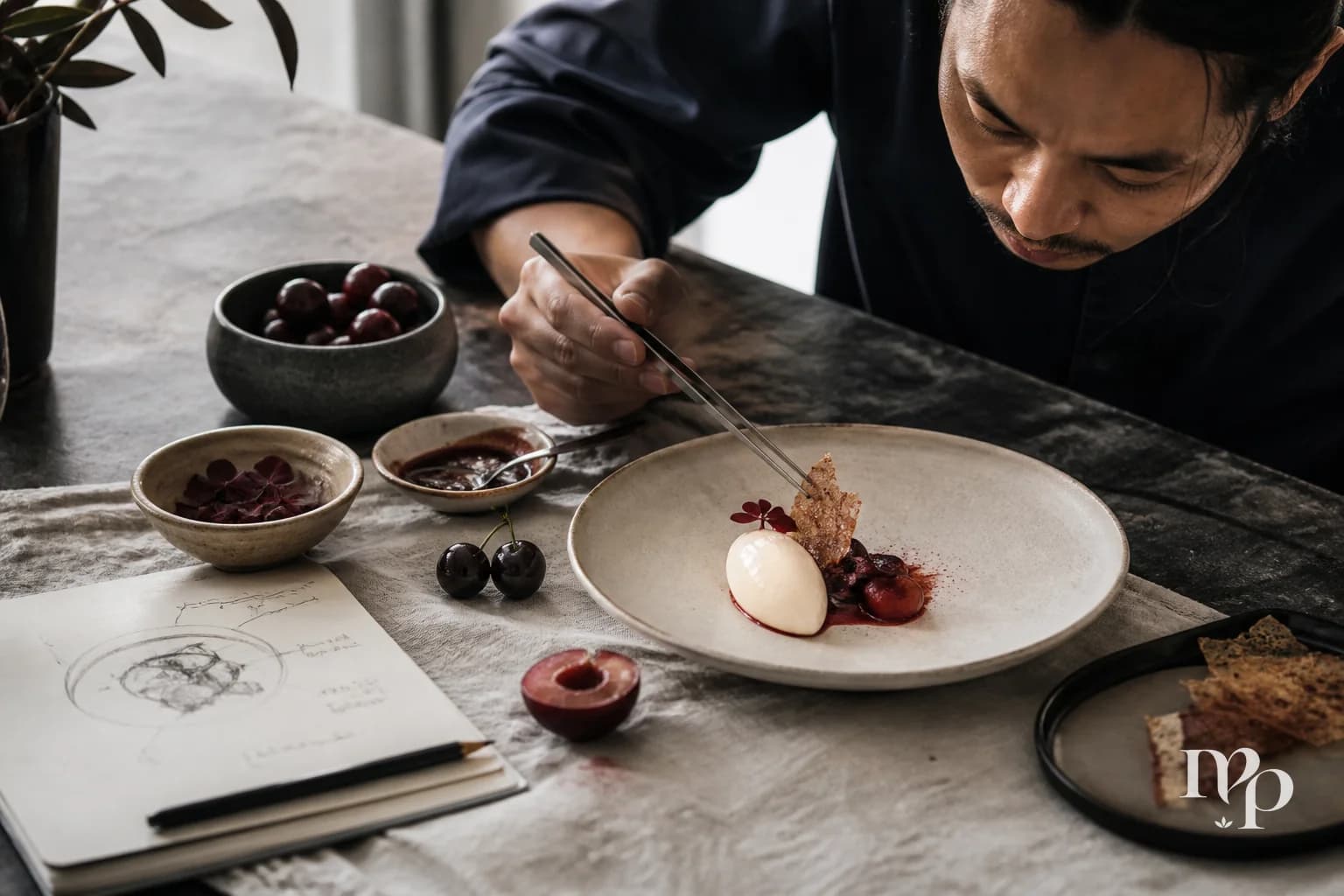
A dessert can be beautiful and still not be ready to carry the restaurant's name. Before a dessert carries that kind of weight, it has to prove that its flavor, proportion, and service rhythm belong to the house.
That is the part people rush. They want the recognizable plate, the photographed finish, the item guests ask for by name. But a signature dessert does not become signature because it is elaborate. It earns that role because it belongs so clearly to the restaurant that it would feel slightly wrong anywhere else.
A name is not a garnish
Putting a name on a dessert gives it weight. It tells the guest, quietly or directly, that this plate represents something the restaurant wants to be known for.
That does not mean the dessert has to be loud. In our work, the strongest version is often controlled, specific, and edited. One flavor direction. One clear textural idea. One reason for the dessert to exist in that room.
A restaurant can call something signature too early. A familiar format with a new sauce. A dessert copied from the visual language of another place. A plate built to impress the camera before it considers the table. None of those choices are automatically wrong, but they rarely create ownership.
A useful question is simple: if the restaurant name disappeared from the menu, would the dessert still point back to the house?
We wrote about this larger relationship between identity and dessert in How to design a signature dessert that belongs to the restaurant. This piece sits closer to the moment before that dessert earns its name.
What the table has already carried
The final course never arrives into an empty room.
By then the guest has moved through salt, heat, acidity, fat, conversation, timing, lighting, service, and appetite. The dessert enters after all of that. It can settle the meal, sharpen it, extend it, or quietly undo it.
This is why signature dessert development is not only a pastry question. It is a hospitality question. The dessert has to understand the meal that came before it.
For a small restaurant with a focused savory menu, the right signature may need restraint. For a hotel dining room, it may need clarity across many types of guests and occasions. For a cafe, it may need to work earlier in the day without feeling like a plated restaurant dessert in disguise. For an event professional, it may need to carry identity while surviving service conditions and pacing.
The same idea cannot simply be moved from one context to another. A dessert that feels generous in one room can feel heavy in another. A detail that feels refined on a tasting menu may feel fussy after a casual dinner. The table tells the truth.
The choices that give the dessert a spine
A signature dessert needs a spine before it needs decoration.
That spine may come from an ingredient: citrus with bitterness left intact, chocolate used for depth rather than weight, tropical fruit treated with precision instead of perfume. It may come from texture: a cool cream against a brittle edge, a soft center interrupted by something toasted, a spoonful that changes as it warms.
It may also come from proportion. This is where many desserts lose their way. Too much cream and the fruit disappears. Too much crunch and the dessert becomes noise. Too much sweetness and the guest stops tasting detail.
An ingredient should still taste like itself. Decoration should serve the idea. More elements do not automatically create more interest.
The plate also has to be served, not merely designed. A signature dessert should respect the speed of the room, the skill required to finish it consistently, and the way it will arrive at the table on a busy night. A fragile idea can be beautiful in development and unkind in service.
Where the idea gets crowded
The most common mistake is trying to make the dessert prove too much.
It wants to show technique, heritage, seasonality, nostalgia, luxury, surprise, and restraint all at once. The result is often a dessert with no center. Every element has an explanation, but the guest still cannot remember what it was about.
Another mistake is treating visual recognition as identity. A dramatic shape, a quenelle, a mirror finish, a shard, a dusting, a gold detail, a special plate: these can all have a place. But they are not the idea. If the decoration is removed and the dessert loses its meaning, the design may be leaning on costume.
There is also the risk of borrowing another restaurant's rhythm. A dessert that works in a French dining room, a modern American bistro, a coastal hotel, or a West African inspired concept may not work the same way elsewhere. Influence is natural. Copying atmosphere is thinner.
We think often about the job a named dessert must do. More on that thread lives in When a signature dessert has a job to do.
Questions before the spoon reaches the table
Before a restaurant gives a dessert signature status, a few questions are worth asking slowly.
- What should the guest remember first: the flavor, the texture, the gesture, or the feeling of the ending?
- Does this dessert belong to the whole restaurant, or only to the pastry station?
- Is the level of sweetness serving the ingredient, or covering it?
- Can the dessert be executed with the same care on a quiet night and a full room?
- Does it make sense after the savory menu, or does it feel imported from another meal?
- Is there one clear idea, or several ideas competing for attention?
- If the garnish disappeared, would the dessert still hold?
- Would the staff know how to describe it without leaning on adjectives?
These questions are not meant to make the dessert safer. They are meant to make it more exact.
A quieter checklist
A dessert may be ready to carry the restaurant's name when:
- The core flavor is clear in one sentence.
- The texture has contrast without clutter.
- The portion respects appetite at the end of the meal.
- The plating supports the idea rather than performing around it.
- The dessert connects to the restaurant's identity without explaining itself too hard.
- The service team can speak about it naturally.
- The guest can remember it the next day without needing a photograph.
That last point matters. Memory is not built from excess alone. Often it comes from one detail handled with conviction.
From the studio
Studio note: at Mistoura Pastry, we do not think a signature dessert should begin with the question, "What will stand out?" It should begin closer to, "What should this restaurant never have to borrow?"
That difference changes the work. It moves the dessert away from novelty and toward identity. It asks for restraint before expansion. It gives every component a reason to stay.
A final course can be quiet and still leave a mark. It can be generous without being heavy. It can carry origin, craft, and point of view without turning the plate into a speech.
The dessert earns the name when it stops trying to announce itself and starts sounding like the room.
If your restaurant is considering a dessert that should feel unmistakably its own, Mistoura Pastry can help shape the idea with restraint and clarity. Start with the studio.