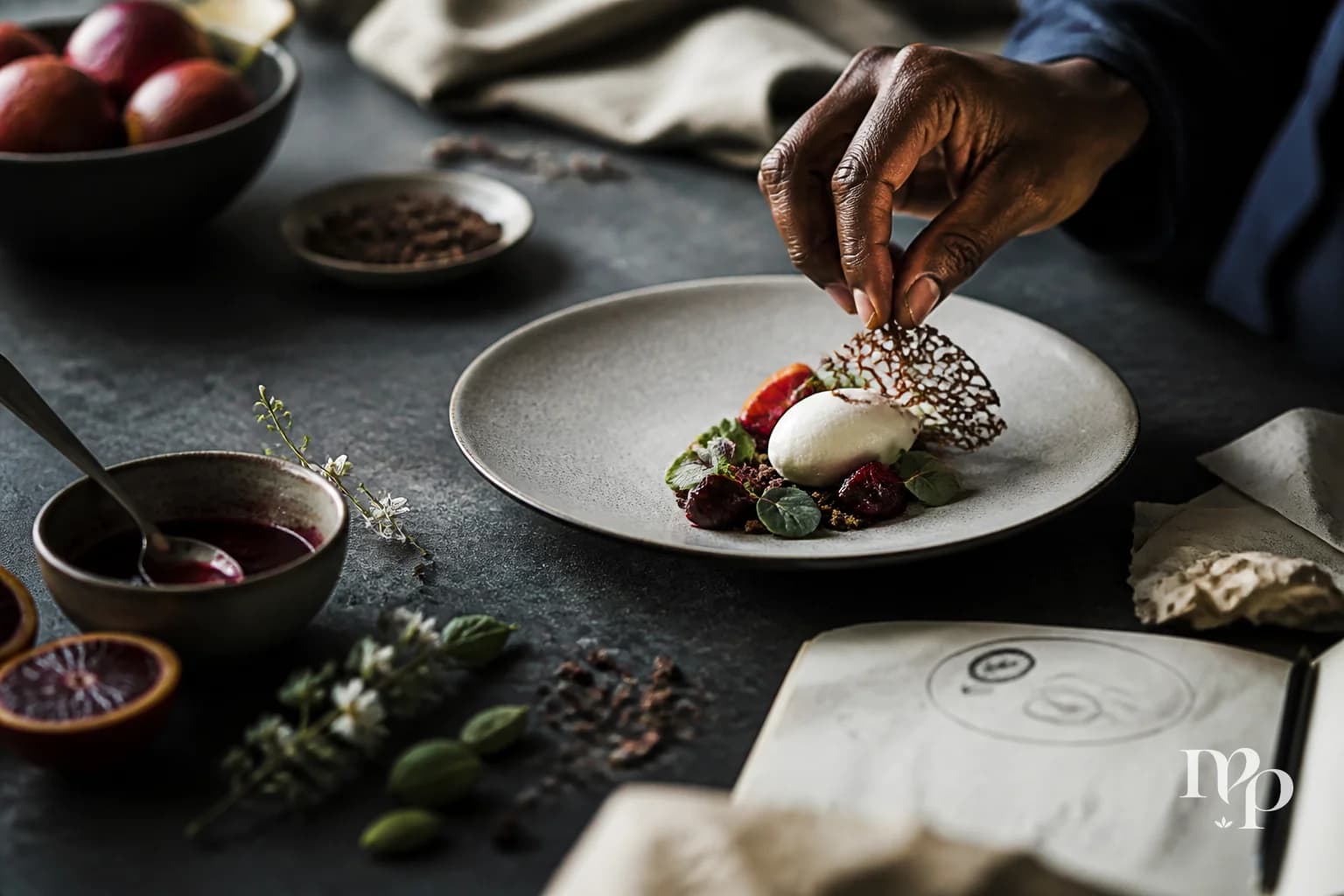
A dessert can arrive looking finished and still say almost nothing.
It may have height, shine, garnish, a quenelle placed with care. It may photograph well. But if the guest cannot feel why it belongs at that table, in that restaurant, after that meal, the dessert is only polished. It is not yet distinctive.
Signature dessert development begins there. Not with a shape. Not with a list of fashionable ingredients. With a point of view.
What a point of view tastes like
A dessert with a point of view makes a choice and protects it.
It might choose bitterness over comfort. It might let fruit stay sharp instead of softening it into sweetness. It might place cream in the background so toasted grain, citrus peel, or cacao can carry the memory. It might end a rich meal with something narrow and clean rather than broad and generous.
The point is not to be strange. Strange is easy. The harder work is clarity.
In our work, we often find that the strongest signature desserts are not built from many ideas. They are built from one idea with enough discipline around it. A flavor has a role. A texture has a reason. A garnish is not a costume. The plate knows what it is refusing.
That refusal matters. More elements do not automatically create more interest. Sometimes they only make the dessert harder to understand.
For a wider look at how dessert identity works across a menu, see Why every restaurant needs its own dessert language.
Before the spoon reaches the table
A signature dessert is part of the room before it is part of the plate.
It has to live inside the rhythm of service. It has to follow the kitchen's savory language without imitating it. It has to respect appetite, timing, staff explanation, table size, and the kind of attention guests still have at the end of the meal.
A dessert that works in a quiet tasting menu may feel precious in a lively restaurant. A generous shared dessert may feel wrong after a delicate sequence. A dramatic table side finish may suit one dining room and interrupt another.
Hospitality is not only warmth. It is proportion. It is knowing how much presence the final course should have.
A useful question is not, will guests notice this dessert. Of course they may. The better question is, what kind of notice does the restaurant want? Surprise, recognition, relief, curiosity, pleasure, restraint. Each creates a different ending.
The choices that shape memory
Signature dessert development asks for decisions at several levels.
Flavor comes first, because flavor is what remains when the plate is gone. The main ingredient should still taste like itself. If mango is the center, it should not disappear under sugar, cream, spice, and decoration. If chocolate is the center, its bitterness, fruit, roast, or depth should be legible.
Texture gives the dessert its pace. A crisp layer can wake up a soft cream. A cool element can slow down a warm sauce. A tender cake can become dull if every other component is also tender. Contrast should not feel like a checklist. It should feel like movement.
Composition decides what the guest understands first. The eye does not need to see everything at once. Sometimes the most confident plate gives the main idea room and lets the rest support it quietly.
Service decides whether the dessert survives contact with the room. Can it be plated consistently? Can it be explained in one clear sentence? Does it hold long enough without losing its structure? Does the final gesture feel natural for the staff, or does it demand theater the restaurant does not actually want?
For a related view on signature work, read How to design a signature dessert that belongs to the restaurant.
Where signature desserts lose their nerve
One common mistake is trying to make the dessert represent everything.
A restaurant may want its final course to show heritage, seasonality, technical skill, comfort, surprise, visual drama, and broad appeal. That ambition is understandable. It is also how desserts become crowded.
Another mistake is confusing decoration with identity. A recognizable shape, a gold accent, a piped detail, or a dramatic finish can be useful, but none of them can carry a weak idea. Decoration should serve the dessert, not distract from its uncertainty.
There is also the trap of making the dessert too safe. A signature dessert does not need to challenge every guest, but it should not feel interchangeable. If the same plate could sit comfortably on ten other menus, it may be pleasant, but it is not doing signature work.
The final mistake is ignoring the back of house reality. A dessert can be beautiful in development and frustrating in service. If it needs too many fragile components, too much last minute handling, or a level of precision the service rhythm cannot protect, the idea will suffer at the table.
Questions for the final course
Before naming a dessert as a signature, an operator can ask a few sharper questions.
What should the guest remember: a flavor, a contrast, a feeling, a gesture, a sense of place?
Does the dessert belong to this restaurant's savory menu, or only to the pastry imagination?
Is the sweetness carrying the idea, or covering it?
Can the staff describe it without sounding rehearsed or apologetic?
What happens to the dessert when the room is busy, the kitchen is tired, and the last table orders it late?
Would removing one element make the dessert weaker, or clearer?
These questions are not meant to flatten creativity. They protect it from becoming decorative noise.
A quieter checklist
A signature dessert does not need a long brief, but it does need a disciplined one.
- One clear central idea
- A main ingredient that remains legible
- Sweetness held in proportion
- Texture contrast with purpose
- A composition that guides the eye
- A service rhythm the team can repeat
- A short explanation that feels natural
- A reason it belongs to this restaurant and not just any restaurant
The checklist is simple. The work is in the edit.
From the studio
Studio note: when we think about signature dessert development, we are not looking for a mascot for the menu. We are looking for an ending with identity.
That identity may be quiet. It may come through roasted pineapple and clean acidity, a bitter cocoa note against cream, a restrained citrus dessert after a rich meal, or a texture that changes just enough with each spoonful. The form depends on the restaurant. The discipline does not.
A final course should not feel like an afterthought, but it also does not have to announce itself loudly. Some of the most memorable desserts are calm because every choice has been considered.
The guest may not name all those choices. They may simply pause, take another spoonful, and understand that the meal knew how to end.
If your restaurant is shaping a dessert that should feel unmistakably its own, Mistoura Pastry can help develop the idea with restraint, clarity, and service in mind.