A dining room sounds different near the end of service. Chairs soften against the floor. Wine glasses sit lower. Conversation either opens up or starts to drift toward coats, rides, and the next place.
Dessert enters that moment. It does not arrive into a neutral room.
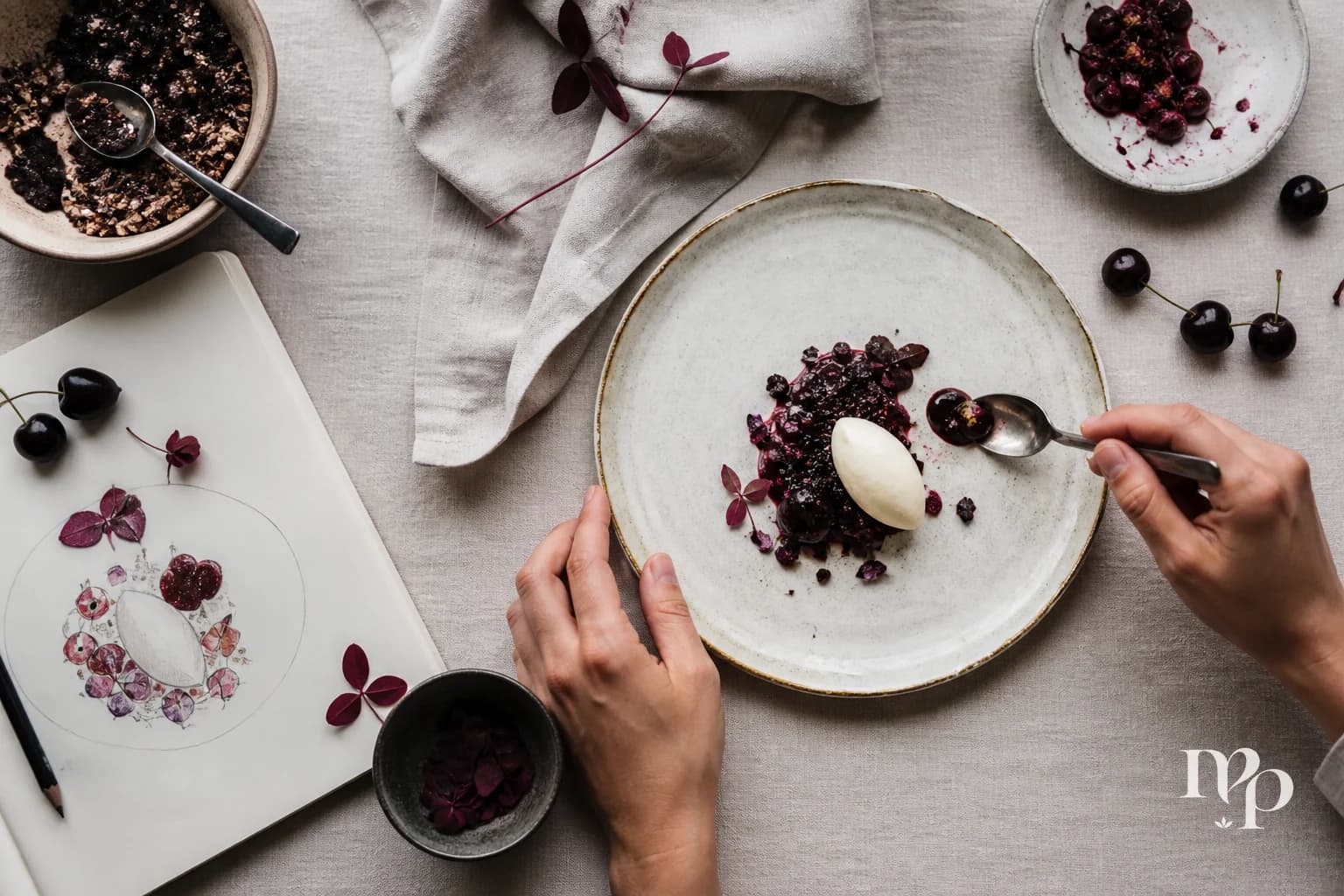
The final course can steady the table, wake it gently, or send it away with noise. That is why dessert design for restaurants is not only about flavor. It is about reading the room and deciding what kind of ending the meal deserves.
What the last course remembers
A good restaurant dessert carries what came before it.
Not literally. It does not need to repeat the savory menu or echo every ingredient from dinner. But it should understand the weight of the meal: the richness, the acidity, the temperature, the pacing, the level of ceremony, the way the room feels by the time the guest reaches the last spoonful.
After a long tasting menu, a heavy chocolate construction may feel less generous than a citrus cream with bitter peel and something crisp. After a sharp, mineral, seafood driven meal, a dessert with too much dairy and sugar can feel like someone changed the subject too loudly. After a warm, generous, fire cooked dinner, a spare plated dessert may feel correct if it keeps that sense of restraint instead of trying to compete with it.
What matters is not whether the dessert is light or rich. What matters is whether it knows where it has landed.
When sweetness changes the pace
Sweetness affects time.
Too much of it can make the last course feel short, even when the plate is full. The palate closes. The guest takes two bites, understands the whole idea, and stops being curious.
Restraint gives dessert more distance to travel. Acid can keep the spoon moving. Salt can sharpen the edges. Bitterness can make sweetness feel adult without making the plate severe. Texture can slow the guest down in a useful way: a crisp layer under cream, a chilled element against something warm, a soft fruit held by a clean biscuit or a quiet crumble.
This is where composition matters. A final course is not a pile of pleasant parts. It is a sequence. The first bite, the middle bites, and the last bite should not all feel identical.
We often find that the strongest restaurant desserts leave a little space inside the idea. They do not explain themselves all at once. For more on that kind of restraint, read Why less sugar can create more flavor.
The room is part of the plate
Hospitality has a rhythm, and dessert can either support it or interrupt it.
In a busy cafe, the last course may need to be clear, fast to serve, and familiar enough that guests understand it without a long explanation. In a hotel restaurant, dessert may need to hold a little more ceremony, especially when guests are lingering. In a small dining room with a focused menu, the final course can be quieter, more edited, and more tied to the identity of the kitchen.
Service matters here. A dessert that requires a long speech may be wrong for a room where servers are moving quickly. A fragile frozen element may be beautiful in development and frustrating in service. A plate with five delicate components may look thoughtful at the pass and feel confused at the table if the guest cannot understand how to eat it.
The room does not forgive design that ignores operations.
That does not mean dessert should be simplified into something generic. It means the idea should survive the real conditions of service: timing, temperature, staffing, plating space, glassware, table size, lighting, and the guest’s attention at the end of the meal.
Where the ending gets noisy
Restaurants often make dessert harder than it needs to be.
One mistake is adding drama because the course is last. Height, garnish, sauce, crunch, quenelle, powder, flower, tuile, and a final pour can all be useful. Together, they can also turn into static.
Another mistake is treating nostalgia as a shortcut. A familiar dessert can be powerful, but only if the restaurant has a point of view about it. Otherwise, it becomes borrowed emotion.
A third mistake is designing for the photograph before designing for the spoon. Dessert can be beautiful, of course. But if the structure collapses into sweetness after the first bite, the visual promise was too thin.
More elements do not automatically create more interest. A dessert with three clear decisions often carries more memory than one with eight decorative gestures.
For a related note on clarity and restraint, see When dessert decoration becomes composition.
Questions before the final spoon
A useful dessert conversation starts with the room, not the garnish.
Ask what the guest has just experienced. Was the meal long or direct? Rich or bright? Casual or composed? Did the savory menu build slowly, or did it move with energy? Is the dining room intimate, loud, polished, relaxed, seasonal, theatrical, restrained?
Then ask what the guest should feel at the end. Rested. Surprised. Cleansed. Warmed. Grounded. Curious. Not all at once.
The strongest answer is usually specific. A citrus dessert for a seafood restaurant is not automatically interesting. Chocolate in a steakhouse is not automatically wrong. The question is how the ingredient behaves in that particular room.
Does the citrus feel clean or sharp? Does the chocolate feel heavy or composed? Does the cream soften the finish or blur it? Does the crunch serve the bite or decorate the edge? Does the plate belong to the restaurant, or could it move anywhere?
A quieter checklist
Before a dessert joins the menu, we would rather test a few grounded questions than chase a bigger gesture.
- Can the guest understand the main idea in one or two bites?
- Does sweetness leave room for flavor, acidity, bitterness, salt, or aroma?
- Is there enough texture contrast to keep the spoon engaged?
- Does the dessert fit the pace of service on a full night?
- Will the strongest version still work under real temperature and timing conditions?
- Does the plate feel connected to the restaurant’s identity?
- Is anything present only because dessert is expected to look decorated?
- Does the final bite feel intentional, or simply finished?
A checklist will not design the dessert. But it can remove the noise around it.
From the studio
At Mistoura Pastry, we think about dessert as the final expression of hospitality, not a separate sweet department at the end of the menu.
In our work, that means paying attention to proportion, service, room energy, ingredient clarity, and the memory a guest carries after leaving the table. Sometimes the right answer is generous and familiar. Sometimes it is sharp, quiet, and almost spare. Sometimes the menu needs one strong dessert rather than several polite ones.
The tradeoff is real. A dessert that holds the room may not be the loudest plate. It may not be the one with the most visible technique. It may be the one that knows when to stop.
That kind of restraint can feel risky because it leaves fewer places to hide. But it also gives the final course a cleaner voice.
The last course does not need to rescue the meal. It should not apologize for the meal either. It should gather what the restaurant has been saying and let the guest leave with a clear final note.
If your restaurant, cafe, hotel, or hospitality team is shaping a dessert menu with more intention, Mistoura Pastry can help think through the final course with clarity and restraint: visit Mistoura Pastry.
Studio note
Mistoura Pastry approaches dessert as culinary design. The goal is not more sweetness or more decoration. The goal is a final course with flavor, restraint, and intention.