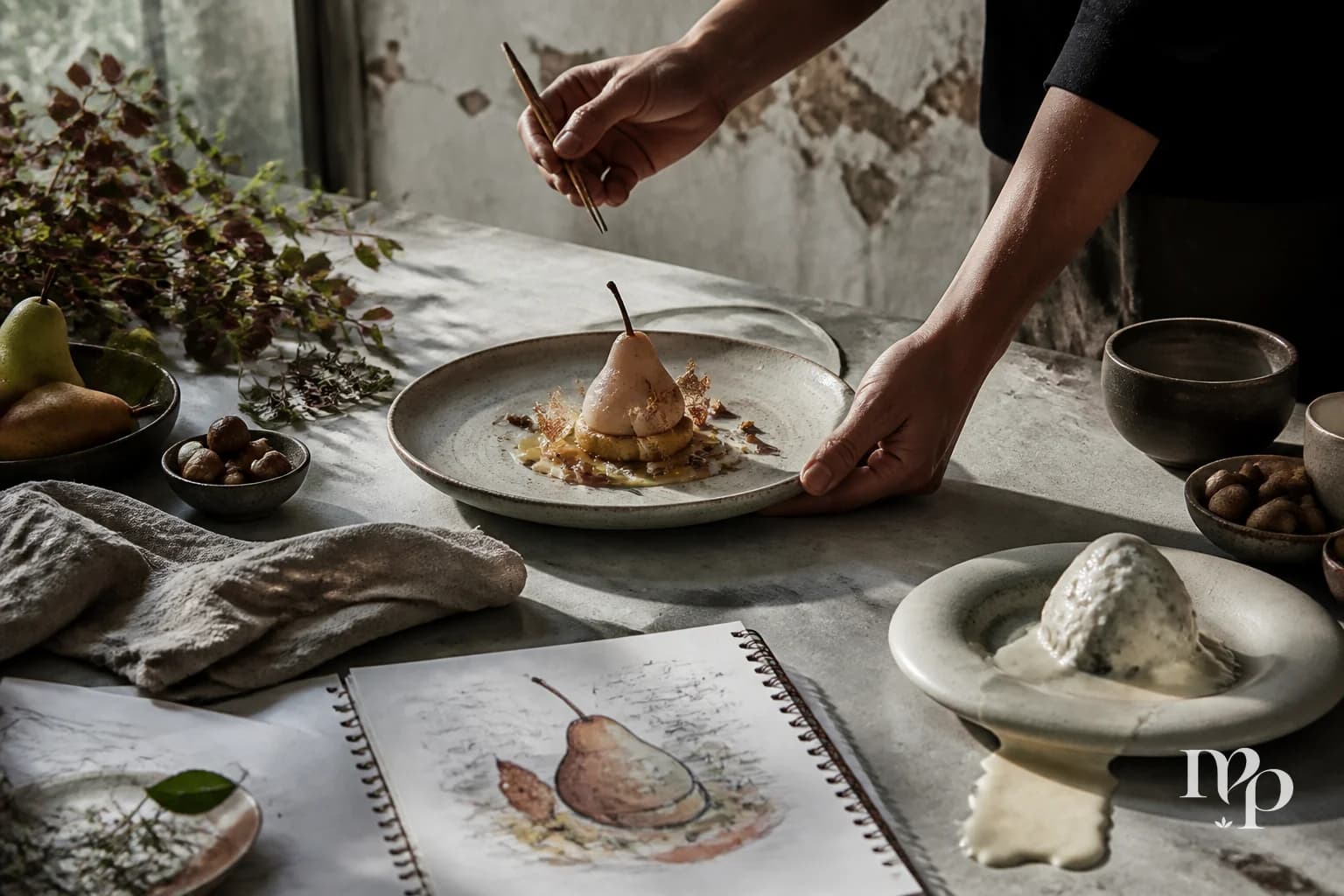
A dessert can look finished and still feel unresolved.
A leaf, a shard, a dusting, a curl of chocolate, a flower placed at the last second. None of these are wrong by themselves. The question is whether they belong to the dessert or merely sit on top of it.
In restaurant pastry, decoration becomes composition when it changes the way the guest experiences the final course. It should affect flavor, texture, proportion, temperature, aroma, pace, or memory. If it does none of those things, it may be decoration in the weakest sense: a visual reflex.
The garnish should earn its silence
A composed dessert does not need every element to announce itself. Some of the strongest choices are quiet. A thin crisp can bring needed fracture to a soft custard. A small bitter note can pull sweetness back into focus. A restrained sauce can connect two textures without turning the plate into a painting.
What matters is not whether the plate looks sparse or abundant. What matters is whether each decision has a job.
We often find that decoration is added when a dessert feels unfinished in the wrong way. The plate has too much empty space, so something is placed there. The color feels flat, so something bright appears. The dessert lacks contrast, so a decorative crisp is added after the fact.
That can work for a photograph. It rarely works for the guest.
The spoon does not read the plate the way a camera does. It moves through temperature, resistance, aroma, sweetness, bitterness, acidity, cream, crunch, and pause. A garnish that does not participate in that movement becomes visual noise.
Composition begins before plating
Dessert composition starts long before the final gesture.
It begins with the role of the dessert on the menu. Is this course meant to cool the table after heat and spice? Extend a savory theme with fruit, grain, herb, or smoke? Offer generosity after a restrained meal? Bring brightness after richness? The answer changes the plate.
A citrus dessert may not need five decorative signals of freshness. It may need one clean acidic line, one creamy counterweight, and one texture that breaks cleanly. A chocolate dessert may not need height and gloss. It may need bitterness, salt, and a shape that slows the guest down.
Decoration becomes composition when it grows from the same idea as the dessert itself.
This is where restaurant identity matters. A coastal dining room, a small wine bar, a hotel restaurant, and a vegetable led menu should not all finish with the same visual language. The dessert should feel like it came from the same house as the rest of the meal. We have written more about that in Why every restaurant needs its own dessert language.
What restaurants often get wrong
The common mistake is confusing more detail with more intention.
A plate can have ten components and still lack composition. It can also have three and feel complete. More elements do not automatically create more interest. Sometimes they create indecision.
Another mistake is treating garnish as a separate category from flavor. Edible flowers, powders, tuiles, crumbs, gels, and sauces are not exempt from the logic of the dessert. They still need to taste like something. They still need to make sense with the ingredient at the center.
A flower that brings no aroma, no cultural context, no visual restraint, and no flavor contribution may be pretty, but pretty is not enough. A crumble that adds crunch but repeats sweetness without contrast may make the dessert busier, not better. A sauce that exists only to decorate the rim may interrupt the guest’s path through the plate.
The hardest edit is removing the thing that makes the dessert look more complete while making it eat less clearly.
The hospitality of a clean idea
Dessert composition is a form of hospitality because it respects the guest’s attention.
By the final course, the table has already moved through appetite, conversation, decisions, pacing, wine, salt, heat, and fullness. A dessert that asks too much can feel tiring. A dessert that gives too little can feel like an afterthought. The work is to create a final course with enough clarity to be remembered and enough generosity to feel worth staying for.
Decoration has a role in that. It can signal where to begin. It can create rhythm. It can make a familiar ingredient feel specific to the restaurant. It can soften austerity or bring restraint to abundance.
But it should not distract from the central pleasure of the dessert.
If the guest remembers the garnish and not the flavor, the plate may have lost its center.
Questions before the final gesture
Before adding another element, a useful question is: what changes if this disappears?
If the answer is only that the plate looks less busy, remove it. If the answer is that the dessert loses contrast, aroma, temperature, direction, or identity, keep it and refine it.
For restaurant owners, chefs, and hospitality teams, the better questions are often simple:
- Does this element change the way the dessert eats?
- Does it support the ingredient at the center?
- Does it belong to the restaurant’s larger menu language?
- Does it help the guest understand where to begin?
- Does it hold up in service, or only in a quiet test plate?
- Does it add clarity, or only effort?
- Would the dessert feel more confident without it?
These questions are especially useful when developing a dessert meant to become associated with the restaurant. A signature dessert does not need ornament for its own sake. It needs a point of view that can survive service. For a related note, see How to design a signature dessert that belongs to the restaurant.
A simple checklist
A simple way to review a dessert before it reaches the menu:
- Name the central idea in one sentence.
- Identify the primary flavor and the flavor that sharpens it.
- Check that texture changes from spoonful to spoonful without becoming chaotic.
- Remove any element that only fills space.
- Keep garnish edible, intentional, and proportionate.
- Make sure the final plate can be repeated during real service.
- Taste the dessert as the guest will eat it, not as separate components.
- Ask whether the last bite is clearer than the first.
The last point matters. A composed dessert does not simply begin well. It finishes with a memory that feels intentional.
From the studio
At Mistoura Pastry, we do not think of decoration as the final layer placed over dessert design. We think of it as part of the structure when it deserves to be there.
Sometimes the strongest plate needs a precise garnish. Sometimes it needs none. The decision depends on the ingredient, the room, the menu, the service rhythm, and the feeling the restaurant wants to leave behind.
Decoration should serve the idea. Composition should serve the guest.
And the dessert should still taste like itself.
If your restaurant is rethinking the final course, Mistoura Pastry works with hospitality teams to shape desserts with intention, restraint, and a clear sense of place. Start with Mistoura Pastry.
Studio note
Mistoura Pastry approaches dessert as culinary design. The goal is not more sweetness or more decoration. The goal is a final course with flavor, restraint, and intention.