Studio Note
This week circled one question from a few angles: what makes a dessert feel like it belongs to the house?
Not the tallest garnish. Not the longest menu description. Not the plate that looks most expensive under dining room lighting.
For restaurants, cafes, hotels, and hospitality teams, the better question is quieter: what should the guest remember after the final spoonful?
A signature dessert is often treated like a trophy. Something to display. Something to prove the kitchen can do pastry. That is where many final courses start to drift. They become technically busy but emotionally vague.
The stronger move is to design a dessert that the room can actually carry. It should match the pace of service, survive the walk from pass to table, and feel like a natural last sentence after the meal before it.
Dessert Strategy
A signature dessert needs a brief before it needs a garnish.
That brief does not have to be complicated. It can start with five decisions:
- What should the dessert make the guest feel: comfort, freshness, depth, surprise, calm, generosity?
- What should it avoid: heaviness, sweetness fatigue, too much explanation, plating stress?
- How fast does service need to finish it during a busy turn?
- What texture should carry the memory: crisp, cold, creamy, warm, chewy, airy?
- What part of the restaurant should it echo: the room, the cuisine, the wine list, the neighborhood, the season?
Most weak signature desserts skip those questions and go straight to effects. Chocolate plus citrus plus crunch plus something frozen plus a dramatic shape. That can become a plate, but it may not become a reason to return.
A dessert worth building around usually has restraint built into it. One clear flavor direction. One strong textural contrast. One service rhythm the team can repeat. One reason it belongs here and not anywhere else.
The tradeoff is real. A quieter dessert may not get the instant camera reaction. But it may get something more valuable: recognition. The guest tastes it and understands the restaurant more clearly.
Ingredient Study
This is where less sugar becomes more than a wellness line.
In a signature dessert, sweetness has a job. It should carry aroma, soften bitterness, support fat, and round sharpness. When it becomes the main event, the dessert gets flat fast.
A few ingredient directions that help a dessert feel memorable without shouting:
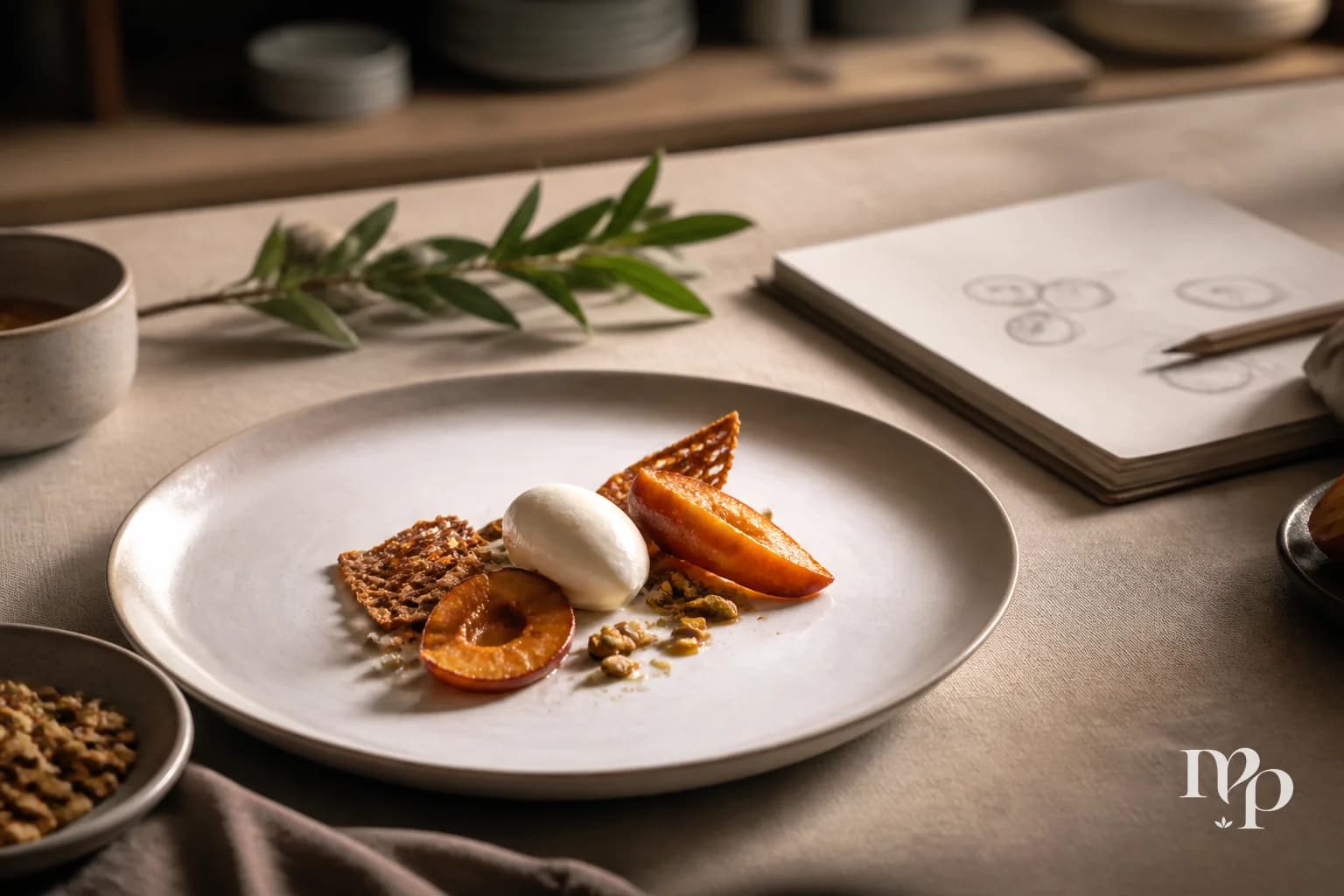
- Roasted fruit for depth instead of raw sweetness. Stone fruit, figs, pineapple, apple, and pear can bring caramel notes without making the plate clumsy.
- Fermented dairy like yogurt, labneh, crème fraîche, or cultured cream to cut richness and keep the final course awake.
- Bitterness from coffee, cacao nib, burnt honey, toasted sesame, chicory, citrus pith, or dark caramel. Used carefully, bitterness gives adults a reason to keep eating.
- Salted crunch to interrupt softness. A dessert with only cream, mousse, sponge, and sauce often dies halfway through the plate.
- Herbs used like seasoning, not decoration. Basil, mint, tarragon, shiso, bay, rosemary, and thyme can change the shape of a sweet course when they are built into the flavor, not sprinkled on top.
The point is not to make dessert austere. Guests still want pleasure. But pleasure does not have to mean sugar doing all the work.
From Mistoura Pastry
Recent journal pieces focused on signature dessert development from several operational angles:
- The signature dessert is not a trophy looks at why a memorable dessert should not become a performance piece detached from the restaurant.
- A dessert worth building around considers how a final course earns its place through clarity, restraint, and service rhythm.
- When a dessert begins as a decision argues for starting with intent before ingredients and effects.
- The dessert service can carry focuses on the practical side: pacing, plating, softness, movement, and the reality of the dining room.
- The brief beneath a signature dessert breaks down why a list of ingredients is not yet a dessert strategy.
- The dessert a room can recognize looks at recognition as a stronger goal than attention.
Design desserts that guests remember. Explore more at Mistoura Pastry.
Question of the Week
If your current dessert menu had to keep only one item as the house dessert, which one would survive?
Not the prettiest one. Not the one the kitchen likes making most. The one that tells the truth about the room.
If the answer is unclear, the menu may not need more options. It may need a stronger point of view.