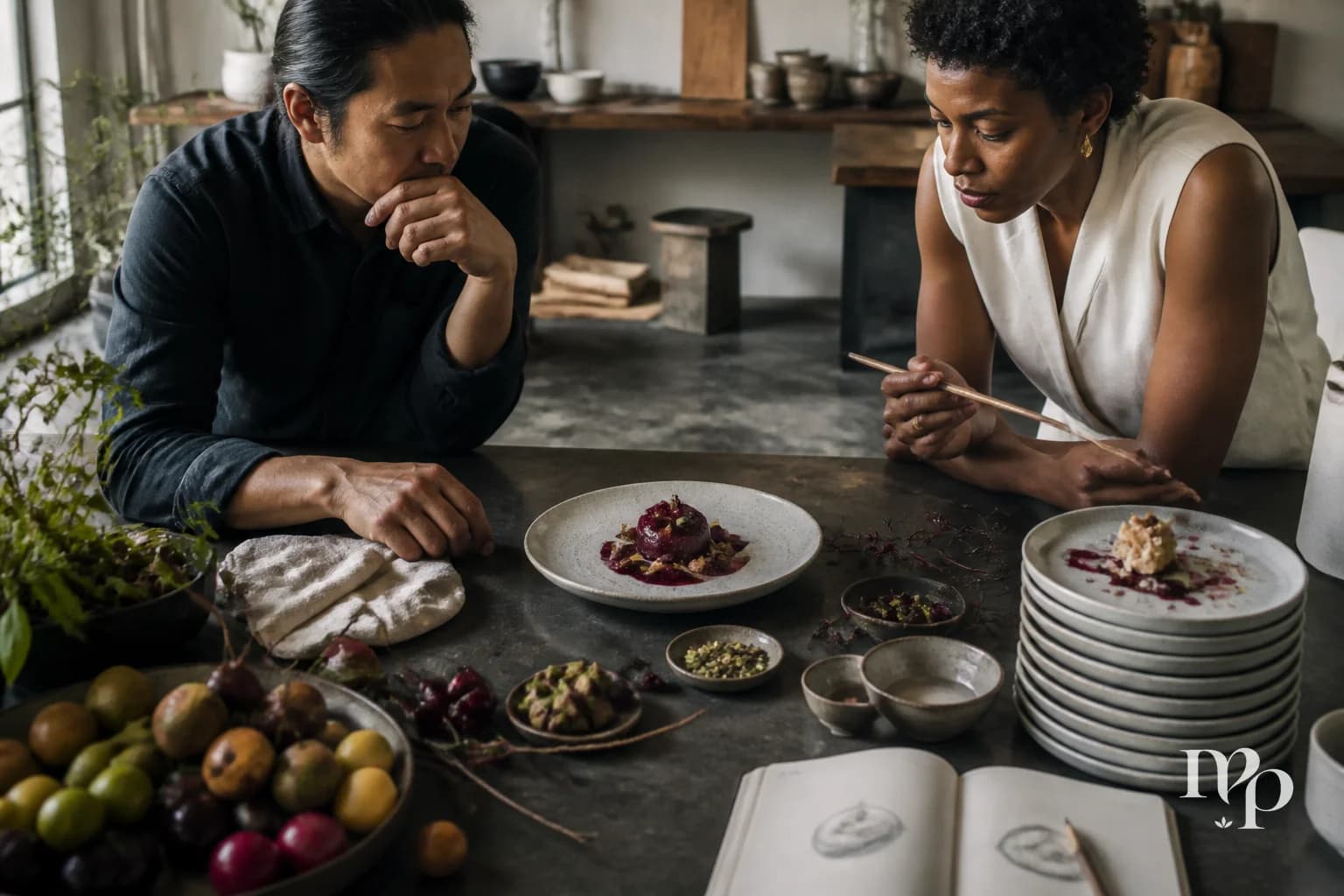
A signature dessert can become too aware of itself.
It arrives taller than it needs to be. It carries more garnish than the room can explain. It tries to announce importance before the guest has taken a bite.
That is usually when the dessert stops belonging to the restaurant and starts performing for the menu.
Signature dessert development is not about creating the loudest plate in the room. It is about making the final course feel specific, repeatable, and deeply connected to the way the restaurant already hosts people.
The dessert should have a reason to stay
A signature dessert earns its place over time. Not because it is difficult, expensive, or dramatic, but because it clarifies something about the house.
It may reveal the restaurant’s restraint. It may carry a flavor memory from the chef’s point of view. It may offer contrast after a savory menu that is smoky, acidic, rich, or mineral. It may give regular guests something to return to without making the rest of the dessert menu feel secondary.
What matters is that it has a job.
A dessert can be beautiful and still be generic. It can be technically impressive and still feel borrowed. The strongest signature desserts tend to feel inevitable. Once they exist, they make sense in the room.
For restaurants thinking through this more broadly, we often return to the idea that dessert needs its own language, not a copied vocabulary. We wrote more about that in Why every restaurant needs its own dessert language.
Before the spoon reaches the table
The signature dessert has to live inside service.
That sounds less romantic than flavor, but it shapes everything the guest receives. A dessert that collapses under dining room timing is not finished. A plate that requires too much last minute attention may work for one table and fail for six. A frozen element that needs precision, a sauce that must stay fluid, a garnish that wilts, a fragile tuile that breaks under pressure: none of these are wrong, but they have to be honest about the room.
Hospitality is not only what the server says. It is also whether the dessert arrives at the right temperature, in the right condition, with a clear reason for being there.
The guest does not need to know the internal choreography. They feel it anyway.
A signature dessert should give service confidence. It should be explainable without a speech. It should create anticipation without making the server apologize for complexity.
Flavor first, then architecture
A useful signature dessert usually begins with a narrow decision, not a pile of ideas.
One fruit at its best. One bitterness that needs cream. One nut with enough character to carry the base. One spice used with restraint. One temperature contrast that changes the pace of the final course.
From there, the architecture can develop.
The plate may need something crisp against something soft. It may need acidity to keep richness from becoming heavy. It may need salt, not as a trick, but as a way to sharpen the ingredient. It may need less sugar so the guest can taste fruit, dairy, chocolate, grain, coffee, citrus, or spice with more clarity.
More elements do not automatically create more interest. Often they create distance between the guest and the idea.
A signature dessert should be edited until each part has a reason. If an element only fills space, it probably does not belong. If a garnish does not change flavor, texture, aroma, temperature, or meaning, it is decoration trying to look like composition.
Where signature desserts go wrong
The first mistake is building the dessert around spectacle.
Fire, height, smoke, tableside movement, unexpected vessels, and intricate shapes can all work when they serve the idea. They become thin when they are used to cover a weak center.
The second mistake is copying a format from another restaurant. A dessert that made sense in one room may feel strange in another because the pacing, price point, service style, ingredients, and guest expectations are different.
The third mistake is confusing richness with generosity. A final course can be generous without exhausting the appetite. It can give pleasure without coating the whole meal in sugar and fat.
The fourth mistake is letting the dessert become untouchable. A signature should be recognizable, but not frozen in place. Seasonality, ingredient quality, staffing, and menu direction may ask for small adjustments. The identity can remain while the expression becomes sharper.
For a deeper look at how a restaurant specific dessert takes shape, see How to design a signature dessert that belongs to the restaurant.
Questions that keep the dessert honest
Before a restaurant names something a signature, the questions should be plain.
What does this dessert say about the restaurant that another dessert would not?
Can the kitchen execute it with care on a busy night?
Can service describe it in one or two sentences without sounding rehearsed?
Does the sweetness support the flavor, or bury it?
Is the texture doing enough work?
Does the portion respect the meal that came before it?
Would this dessert still make sense if the most decorative element disappeared?
Would a returning guest remember the flavor, or only the presentation?
These questions are not meant to make the dessert smaller. They make it more exact.
A quieter checklist
A restaurant signature dessert should have:
- A clear flavor center
- Texture contrast that can be felt, not just described
- Sweetness held in proportion
- A service rhythm the team can sustain
- A visual composition that supports the idea
- A reason to belong to this restaurant
- Enough flexibility to stay alive over time
- A final bite that feels intentional
The checklist is simple because the work is not about adding more. It is about removing what weakens the point.
From the studio
In our work, we often look for the moment when a dessert stops trying to impress and starts to belong.
That shift can be quiet. A sauce becomes less sweet. A crisp element moves from garnish to structure. A fruit is used at a better stage of ripeness. A plated shape becomes easier for service to carry. The name becomes less clever and more precise.
These are small decisions, but they change the guest’s memory.
A signature dessert does not need to dominate the table. It needs to close the meal with clarity. It should feel considered, generous, and unmistakably connected to the restaurant that serves it.
Not a trophy.
A final gesture with a reason.
If your restaurant, cafe, hotel, or hospitality project is thinking through signature dessert development, Mistoura Pastry can help shape a final course with intention. Visit Mistoura Pastry to begin the conversation.
Studio note
Mistoura Pastry approaches dessert as culinary design. The goal is not more sweetness or more decoration. The goal is a final course with flavor, restraint, and intention.