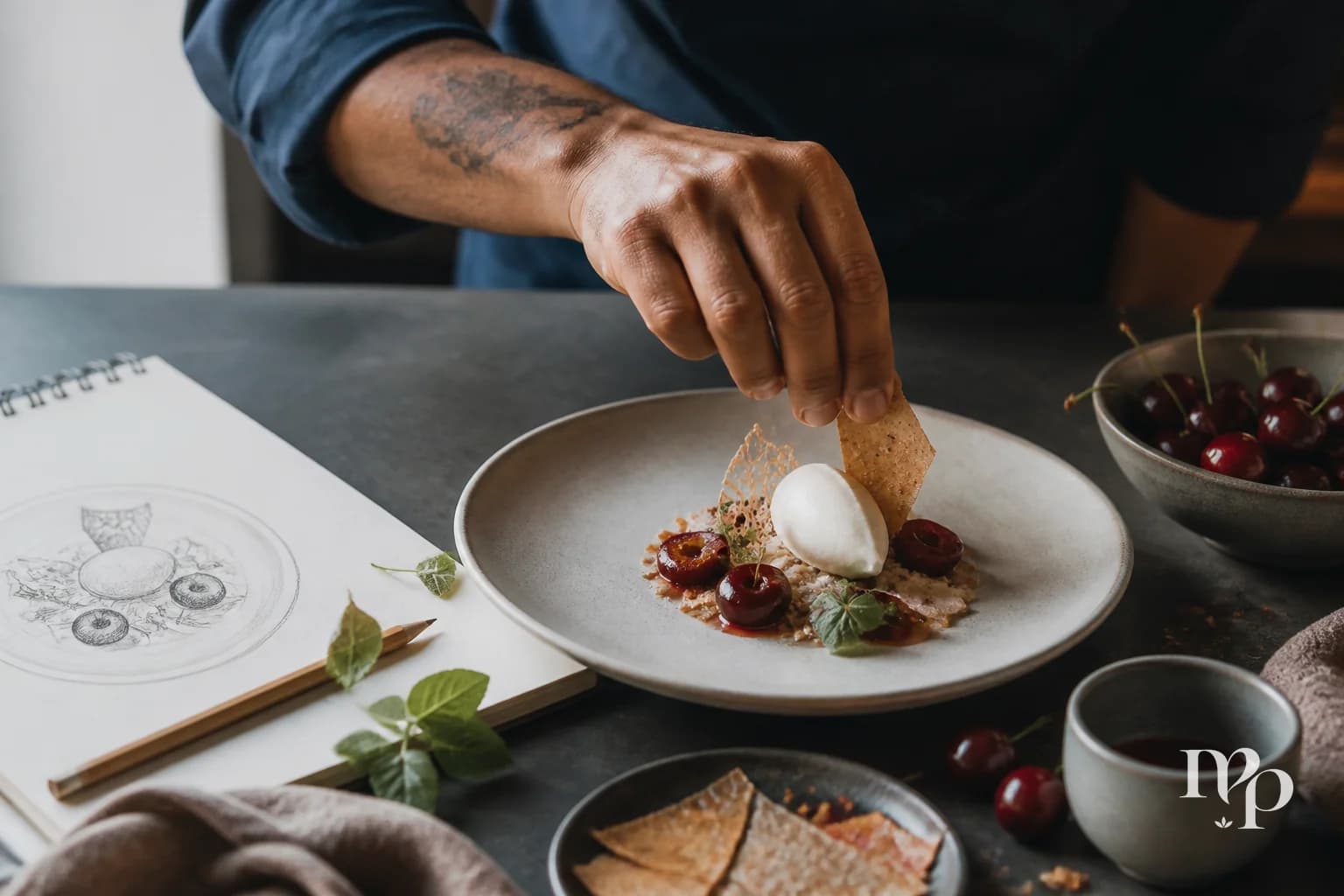
Most restaurant desserts are asked to behave politely. Fit the plate. Satisfy the sweet course. Avoid slowing service. Stay familiar enough to sell.
Signature dessert development asks for something more difficult: a final course with a reason to exist. Not louder. Not heavier. Not dressed in every garnish the kitchen can justify. A dessert worth building around has to feel inevitable for the restaurant and still alive at the table.
The dessert has to earn its place
A signature dessert is not automatically the most complex item on the menu. Complexity is easy to mistake for identity. More layers, more sauces, more textures, more references. The plate starts to explain itself too loudly.
What matters is a clear idea held with discipline.
For one restaurant, that idea may be restraint: a bitter chocolate, a quiet cream, a fruit note used like light instead of decoration. For another, it may be generosity: warmth, depth, a spoonable texture that keeps the table leaning in. For a hotel dining room, it may need to travel across different guests, different moods, and a longer service window without becoming anonymous.
A signature dessert should answer a simple question: why should this belong here, and not just anywhere?
That question sits close to the work of restaurant identity. We have written more about that in How to design a signature dessert that belongs to the restaurant, but the principle is worth repeating. The dessert should not borrow importance from decoration. It should carry its own reason.
Before the spoon reaches the table
Hospitality changes the way dessert is understood.
A guest does not meet the final course in isolation. They meet it after salt, heat, conversation, wine, pacing, fatigue, appetite, and whatever the room has already asked of them. By the time dessert arrives, the palate may want clarity more than abundance.
This is where signature dessert development becomes service design as much as pastry design. The strongest version may not be the richest version. It may be the dessert with the cleanest finish, the most deliberate contrast, or the most generous temperature shift.
A cold element can reset the meal. A warm sauce can soften the table. A crisp layer can wake up a quiet custard. Acidity can make sweetness feel more precise. Bitterness can give a dessert adult posture without making it severe.
The plate has to understand the room it enters.
Choices that make it belong
A dessert begins to feel specific when the choices are connected.
Flavor sets the first direction. Not just chocolate, citrus, spice, nut, cream, or fruit, but the role each one plays. Is the fruit the main expression, or is it there to sharpen the cream? Is the nut meant to add warmth, structure, or aroma? Is the chocolate deep and quiet, or bright and acidic?
Texture gives the dessert rhythm. One soft element without contrast can feel unfinished. Too many contrasts can feel restless. A useful composition often gives the guest a path: something clean, something yielding, something with resistance, something that fades well.
Proportion decides whether the idea survives the plate. A sauce can support or drown. A garnish can clarify or distract. A crumb can add texture or make the dessert eat dry. Decoration should serve the idea, not apologize for it.
Seasonality can help, but it should not become a costume. A summer dessert does not need every bright fruit in reach. An autumn dessert does not need to announce itself with spice. Sometimes the seasonal choice is a lighter cream, a sharper finish, or a smaller portion because the menu before it is already generous.
If the restaurant has a developed dessert language, these decisions become easier. If it does not, the signature dessert has to do too much work alone. That is why a broader point of view matters, not just one plate. See Why every restaurant needs its own dessert language for the larger frame.
Where signature desserts go flat
The first mistake is building for recognition instead of memory.
Recognition is fast. Guests know the form. They understand the reference. They can name the components before the spoon moves. That can be useful, but it is not enough. Memory comes from proportion, sequence, surprise, and how the dessert feels after the last bite.
The second mistake is confusing a signature with a showpiece. A dining room is not a pastry competition. The dessert has to survive real service, real timing, real hands, real guests. If it only works under ideal conditions, it may be a beautiful idea and a poor restaurant dessert.
The third mistake is letting the garnish make all the claims. Flowers, powders, shards, quenelles, dots, and height can create movement, but they cannot replace flavor logic. If the dessert needs decoration to look intentional, the composition probably needs editing.
The fourth mistake is ignoring appetite. A signature dessert should not punish the guest for reaching the end of the meal. It can be rich, but it still needs lift. It can be generous, but it still needs proportion.
Questions before the plate is drawn
Before a restaurant commits to a signature dessert, a few questions are worth asking slowly.
What should the guest feel in the last five minutes of the meal?
Which flavor belongs naturally to the restaurant, rather than to a general dessert menu?
Does the dessert continue the meal, contrast it, or quietly resolve it?
Can the kitchen repeat the dessert with consistency during actual service?
Can the service team describe it without sounding rehearsed?
Is there one element too many?
What would disappear if the garnish were removed?
Does the final bite leave sweetness, freshness, warmth, bitterness, acidity, or weight?
These are not decorative questions. They affect design, operations, and hospitality at the same time.
A quieter checklist
A signature dessert worth developing usually has a few qualities in common:
- a clear central idea
- a flavor structure that belongs to the restaurant
- contrast without clutter
- sweetness held in proportion
- texture that changes as the guest eats
- a service rhythm the kitchen can support
- a description that feels natural at the table
- a final bite that leaves a clean memory
The checklist is simple on purpose. If a dessert cannot pass through these points, more technique will not fix it. More elements do not automatically create more interest.
From the studio
Studio note: In our work, we often begin signature dessert development by removing things. Not because minimalism is automatically better, but because the first version usually contains evidence of every conversation that led to it.
The chef wants one idea. The owner wants another. The dining room needs reliability. The guest needs pleasure. The brand wants recognition. The plate starts carrying all of it.
Editing is not subtraction for its own sake. It is how the dessert starts to speak clearly.
Sometimes the strongest move is a sharper fruit note. Sometimes it is a warmer base. Sometimes it is making the portion smaller, the texture cleaner, or the service step less fragile. The aim is not to make the dessert quiet. The aim is to let the right part speak.
The memory it leaves
A signature dessert does not need to announce itself as important. It needs to arrive with confidence, sit naturally in the room, and leave the guest with something precise.
Not every restaurant needs a theatrical final course. Not every dining room needs a plated monument. But every restaurant that cares about its ending needs a dessert that knows what it is doing there.
That is the difference between a sweet finish and a final course with identity.
If your restaurant is shaping a dessert that should belong more deeply to the house, Mistoura Pastry can help think through the final course.