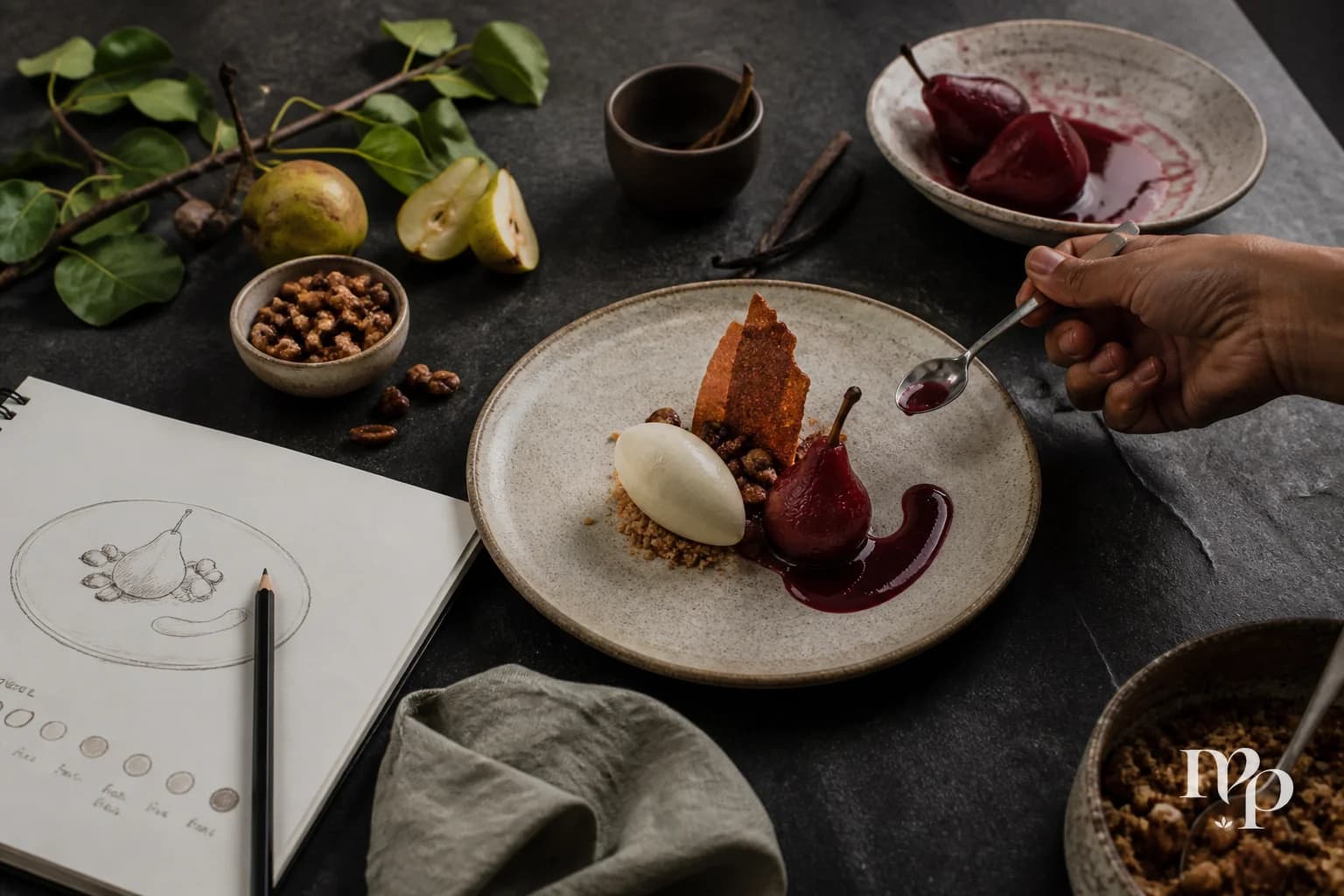
Some desserts arrive already crowded. A quenelle, a shard, a sauce, a dusting, a flower, a name that tries to explain too much. The plate is busy before the idea has had time to breathe. A better dessert begins when the restaurant chooses what the ending should mean.
A signature dessert should not begin as a collection of effects. It should begin as a decision. What should this restaurant leave behind at the end of the meal? Warmth, sharpness, quiet, generosity, surprise, restraint, comfort with an edge. Until that is clear, development tends to drift toward decoration.
For restaurants, cafes, hotels, and hospitality brands, signature dessert development is not about making the loudest plate on the menu. It is about giving the final course a reason to belong.
The decision beneath the sweetness
A strong signature dessert has a center. Not always a visual center, though that helps. A conceptual center.
It may begin with an ingredient the kitchen wants to treat with care. It may begin with a service need, such as a dessert that can land cleanly during a crowded evening without losing its shape. It may begin with the room itself: a quiet dining room asking for a composed final course, or a lively cafe that needs something direct, generous, and easy to understand without becoming ordinary.
What matters is that the dessert is not asked to do every job at once. It does not need to be nostalgic, architectural, seasonal, dramatic, and surprising in the same bite. More elements do not automatically create more interest. Often they create noise.
In our work, the strongest starting point is usually a simple sentence: this dessert should feel like the restaurant. Not in a vague branding sense, but in the way it uses flavor, proportion, temperature, texture, and service.
That sentence becomes the edit.
What the room can carry
A final course lives inside hospitality, not outside it. The plate may be beautiful in isolation, but it still has to move through a real dining room.
A dessert that suits a long tasting menu may not suit a fast evening service. A composed plate that needs heavy explanation may feel strained in a room built on ease. A dessert with fragile temperature contrast may ask too much from a service team already carrying the rhythm of the night.
Signature does not mean complicated. It means recognizable in spirit. The guest should feel that the dessert could not have been lifted from any other menu without losing something.
That is why signature dessert development sits close to menu strategy. The dessert must speak to the house, but it must also respect appetite, timing, and the guest's attention. A last course can be memorable without being heavy. It can be restrained without feeling thin. It can be generous without leaning on excess sugar.
For a broader view of how a restaurant's point of view becomes visible through dessert, read Why every restaurant needs its own dessert language.
Before the plate gets beautiful
The visual form should come after the decision, not before it.
If the core idea is citrus and smoke, the plate should protect that tension. If the idea is ripe fruit and cultured cream, the composition should leave space for softness and acidity. If the idea is cacao with bitterness and warmth, sweetness should be measured so the ingredient can still taste like itself.
A useful development path often moves through four choices.
First, the flavor line. What is the main impression, and what sharpens it? A dessert can have depth without becoming crowded. Bitterness, acidity, salt, warmth, fermentation, spice, and fat all change sweetness without shouting over it.
Second, texture. The spoon needs something to move through. Cream against crispness, tender against brittle, cold against room temperature. Texture gives the guest a pace.
Third, proportion. This is where many desserts lose their nerve. Too much sauce, too much crumble, too much garnish, too much explanation. Proportion is not only visual. It is how each bite behaves.
Fourth, service. Can the team carry it with confidence? Can the dessert arrive in the condition it deserves? Does it need a long speech, or can the first spoon make the point?
For a closer look at belonging rather than novelty, see How to design a signature dessert that belongs to the restaurant.
Where development gets distracted
What people often get wrong is treating signature status as a visual assignment. A dessert gets a dramatic shape, a rare ingredient, or a highly styled finish, but the eating experience stays vague.
Another mistake is borrowing too much from elsewhere. A familiar form can be useful, but if the reference is louder than the restaurant's own identity, the dessert feels imported. Guests may admire it and still not remember where they had it.
There is also the problem of sweetness used as cover. Sugar can make a dessert feel complete for a second, then flatten the finish. Less sugar is not a moral position. It is a design choice when the goal is clearer flavor.
The quieter mistake is keeping elements that once seemed interesting but no longer serve the plate. A garnish may be attractive. A crunch may be pleasant. A sauce may look composed. If it does not support the idea, it is asking the guest to pay attention to the wrong thing.
Questions before the first test
Before developing a signature dessert, an operator can ask a few grounded questions.
What should the guest remember after the final course: an ingredient, a feeling, a contrast, a gesture?
Where does this dessert sit in the arc of the meal? Does it refresh, settle, sharpen, or comfort?
What does the restaurant already express well, and how can dessert continue that expression rather than change the subject?
Which ingredient deserves the clearest voice?
What can be removed before anything new is added?
Can the service team carry the dessert naturally on a busy night?
Does the name help, or does it try to perform the work the plate should be doing?
These questions do not make the dessert smaller. They make the work more exact.
A quieter checklist
A signature dessert is ready to move forward when it has a few quiet strengths.
- One clear flavor direction
- A texture contrast that changes the pace of the spoon
- Sweetness measured enough for the main ingredient to remain legible
- A portion that respects the guest's appetite
- A form that supports the idea instead of decorating around it
- A service path the team can repeat with care
- A name that gives context without overexplaining
- No element kept only because it looks good
This kind of checklist is not meant to make every dessert plain. It is meant to protect the point of view.
From the studio
Studio note: At Mistoura Pastry, we often find that the first version of a signature dessert is too eager. It wants to prove itself. The better version usually arrives after subtraction. The flavor becomes clearer. The plate becomes calmer. The restaurant becomes more visible.
A signature dessert does not need to announce itself as important. It needs to belong so completely that the meal would feel less resolved without it.
If your team is shaping a final course with more intention, Mistoura Pastry can help think through the dessert as part of the whole hospitality experience.