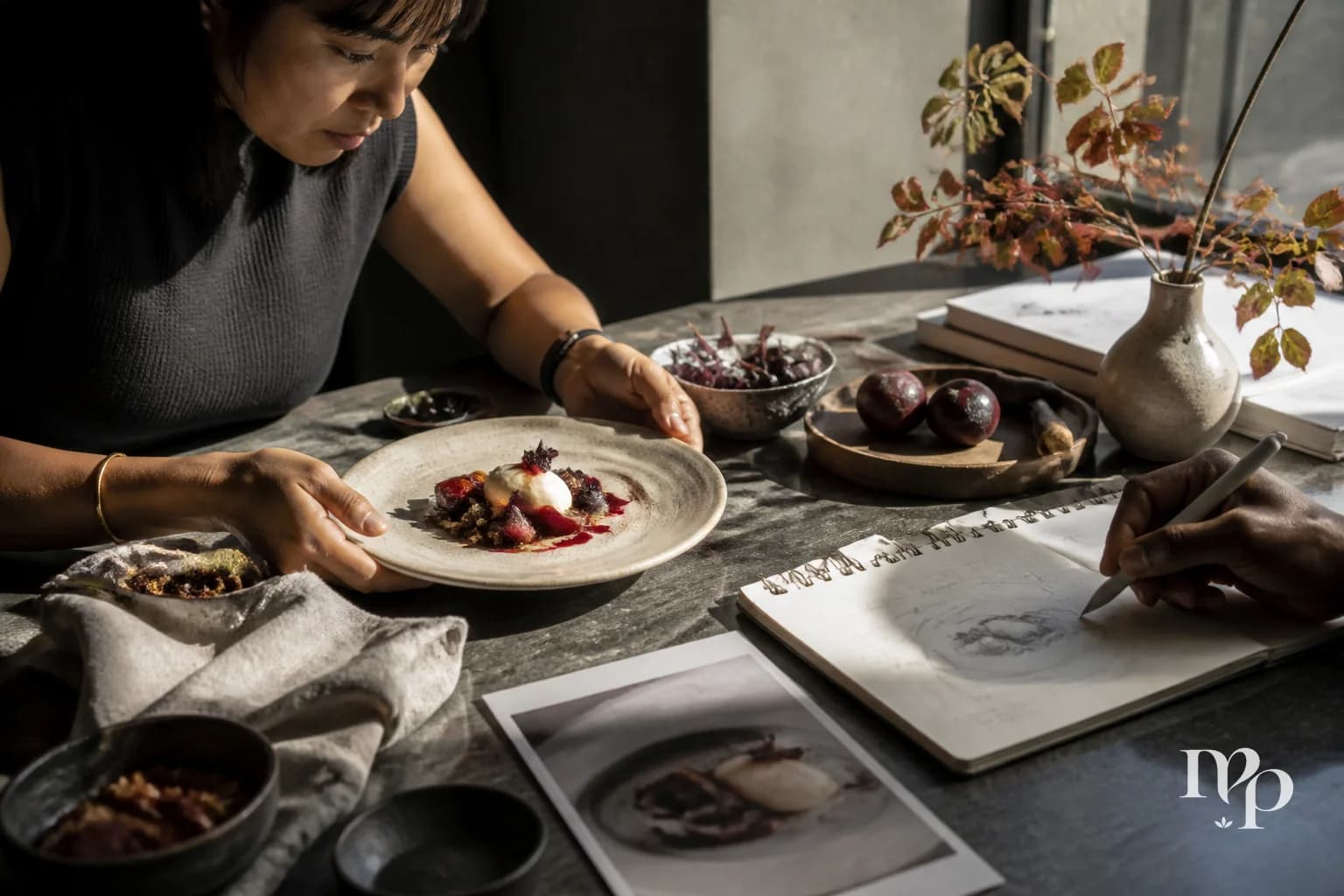
A plated dessert can be beautiful in the pass and still be wrong for the room.
It may take too long to finish. It may soften before the server reaches the table. It may demand an explanation when the guest wants ease. It may feel like a separate performance after a meal that has been quiet, direct, and grounded.
Signature dessert development is not only the search for a memorable flavor. It is the design of a final course that service can actually carry, physically and emotionally.
What the room has already told you
By the time dessert arrives, the restaurant has already taught the guest how to listen.
A room with low light, close tables, and a slow final glass asks for a different dessert than a bright cafe turning quickly at lunch. A tasting menu can hold suspense and detail. A neighborhood restaurant may need generosity without heaviness. A hotel lobby may need something legible across many appetites, hours, and reasons for sitting down.
The strongest signature dessert does not ignore that context. It absorbs it.
In our work, we often begin with the rhythm of the room before we begin with the plate. How long is the meal? How much does the guest usually eat before dessert? Is the final course shared, ordered individually, or sent as a gesture? Does the service team have time to describe it, or should the dessert speak clearly on arrival?
That is where signature dessert development becomes more precise. The dessert is not asked to impress in isolation. It is asked to belong to a system of hospitality.
For the broader question of identity, we have written about Why every restaurant needs its own dessert language. Service is one of the places that language becomes visible.
Before the spoon reaches the table
A dessert changes as soon as it leaves the pastry station.
Cold elements soften. Warm elements continue to move. Sauces spread. Crisps absorb moisture. Garnishes shift. A quenelle that looked precise thirty seconds ago may arrive tired if the path is long or the pass is crowded.
This is not a failure of craft. It is a design condition.
A restaurant dessert has to be composed for the distance between making and eating. That distance might be a few steps. It might include a server waiting for a tray to be complete. It might include a guest pausing to take in the plate before tasting it.
The design choices should respect that distance.
Texture can be placed where it will survive. Temperature contrast can be used with restraint, not as a fragile trick. Sauce can be portioned so the last bite still has shape. A garnish can carry aroma or bitterness rather than sit there as decoration. The plate can have enough negative space for service without feeling empty.
The point is not to make dessert safer or simpler by default. The point is to make the intended experience more likely to arrive intact.
The flavor should know its role
A signature dessert often fails when it tries to carry too many ideas at once.
One fruit, two creams, three textures, a crumble, a tuile, a gel, a powder, a foam, and a decorative leaf can create motion without direction. More elements do not automatically create more interest. Sometimes they only create more chances for the idea to blur.
A useful restraint is to decide what the dessert is asking the guest to remember.
Is it the perfume of roasted pineapple against cultured cream? The bitterness of cacao with a clean citrus edge? The quiet contrast between warm grain, cold milk, and toasted spice? The answer should shape the rest of the plate.
Flavor has to lead, but it should not shout over the meal that came before it. A final course can be expressive and still leave the guest comfortable. Sweetness can frame an ingredient without covering it. Acidity can wake up the palate without making the dessert feel sharp for the sake of sharpness.
An ingredient should still taste like itself.
Where the idea goes soft
The most common mistakes in signature dessert development are rarely dramatic. They are small compromises that add up.
A dessert is built around a visual reference instead of a restaurant idea. A dramatic finish depends on one person being available at the pass. The service team cannot explain the dessert without sounding rehearsed. The portion looks generous but eats heavy. The plate photographs well but loses contrast after three bites. The name promises more than the flavor delivers.
Another mistake is treating the signature dessert as a fixed monument.
A restaurant can have a recognizable final course without freezing it in place. Fruit can shift with the season. A spice can become quieter in summer. A sauce can become deeper in colder months. The structure may remain, while the expression changes.
That kind of evolution keeps the dessert alive without confusing the guest.
For a related view on belonging rather than novelty, see How to design a signature dessert that belongs to the restaurant.
Questions for the final course
Before a restaurant commits to a signature dessert, a few questions are worth asking with real honesty.
What should the guest feel at the end of this meal: refreshed, comforted, surprised, settled, sharpened?
Can the dessert be prepared consistently on the busiest night of the week?
Does the plate still make sense if a server has only one sentence to introduce it?
Is there one clear flavor memory, or are there several competing for attention?
Does the portion respect the appetite the menu has already created?
Can the dessert change with the season without losing its identity?
Would this final course feel strange in another restaurant, in a useful way?
That last question is important. A signature dessert should not be strange for novelty. It should be specific enough that moving it elsewhere would make it lose some of its meaning.
A quieter checklist
A simple way to test a signature dessert before launch:
- Taste it after the full meal, not on an empty palate.
- Time the plate from finish to table.
- Watch what happens to texture after two minutes.
- Ask the service team to describe it in their own words.
- Remove one element and see if the idea becomes clearer.
- Check whether the last bite is as considered as the first.
- Make sure the name, portion, and price feel like the same restaurant.
- Decide what can change seasonally and what should remain constant.
This kind of checklist is not glamorous. It is where the dessert becomes dependable without becoming dull.
From the studio
At Mistoura Pastry, we think a signature dessert earns its place when it can hold flavor, service, and identity at the same time.
It should have enough clarity for the guest to understand it, enough detail for the restaurant to recognize itself in it, and enough discipline to survive the night as it is actually served.
Dessert should not be an afterthought. But it also should not arrive as a separate ego at the end of the meal.
The strongest final course feels inevitable only after careful editing.
If your restaurant, cafe, hotel, or hospitality team is shaping a dessert that needs to feel unmistakably your own, Mistoura Pastry develops pastry concepts with restraint, memory, and service in mind. You can begin that conversation with Mistoura Pastry.
Studio note
Mistoura Pastry approaches dessert as culinary design. The goal is not more sweetness or more decoration. The goal is a final course with flavor, restraint, and intention.