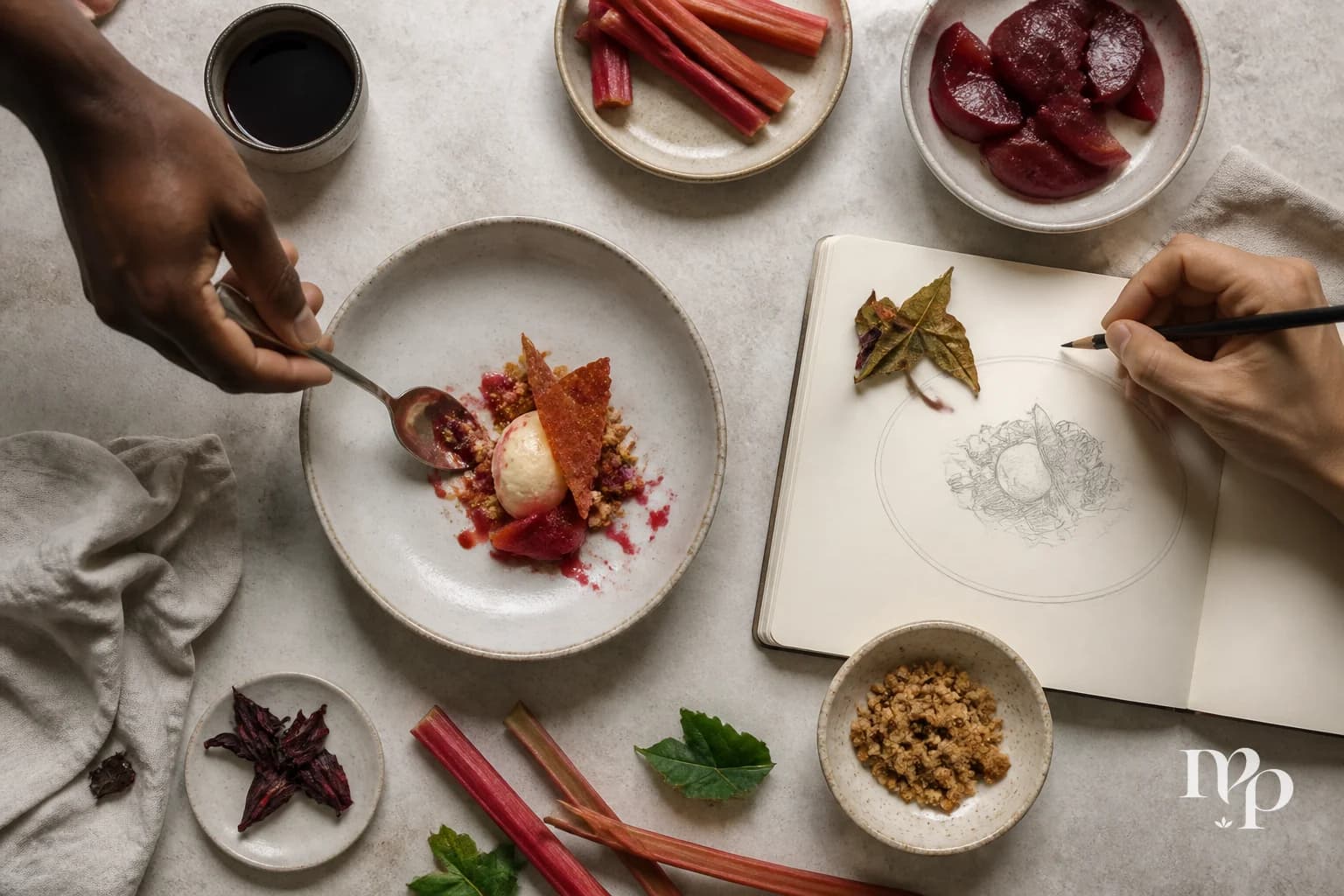
The first draft of a signature dessert often arrives as a list of ingredients. Chocolate. Citrus. Sesame. A little crunch. Something frozen. Something dramatic for the plate. The stronger work is usually beneath that list, in the brief that explains why the dessert should exist.
That list can be useful, but it is not yet a dessert. It is not even a brief.
Signature dessert development begins earlier, in the space between the restaurant’s identity and the guest’s final spoonful. The question is not only what should we serve. It is what should this final course know about the meal before it.
The brief has to taste like the restaurant
A signature dessert is not the most elaborate dessert on the menu. It is not the one with the longest description or the most visible technique. The strongest version is usually more disciplined than that.
It carries a point of view the restaurant can repeat with confidence.
That point of view might be quiet, sharp, generous, mineral, nostalgic, architectural, bitter, floral, or restrained. What matters is that it belongs to the house rather than borrowing personality from pastry trends. A dessert can be beautiful and still feel imported from somewhere else.
In our work, the brief often starts with non pastry questions. What does the room feel like at the end of service. How heavy is the meal before dessert. Is the restaurant built around fire, acidity, spice, seafood, wine, conversation, speed, ceremony, or ease. Should the final course settle the table or wake it slightly.
Those answers shape the pastry before any test batch begins.
For a broader view of belonging, read How to design a signature dessert that belongs to the restaurant.
The room edits the pastry
A dessert does not live in a tasting notebook. It lives under dining room light, beside the last glass of wine, in the hands of a server who has six other things moving at once.
That changes the design.
A fragile quenelle may make sense in a calm tasting menu and fail in a room with fast turns. A tall plated structure may photograph well and become awkward at the table. A rich chocolate dessert may feel generous after a lean menu and exhausting after several heavy courses. A citrus finish may be welcome in summer and too sharp in a room built around warmth and comfort.
Hospitality is part of the composition. Portion, pacing, plate temperature, spoon access, shareability, and the server’s ability to describe the dessert all affect the guest’s experience.
A signature dessert should not ask the dining room to perform tricks for it. It should understand the service it enters.
Flavor gives the idea a spine
Once the brief is clear, flavor becomes architecture.
Not decoration. Not a pile of agreeable notes. Architecture.
One ingredient may lead, but it should still taste like itself. Mango should not become a generic tropical signal. Chocolate should not be used only as weight. Vanilla should not be treated as empty softness. Coffee should not become bitterness without depth.
The work is in proportion. Acid against cream. Salt against fruit. Warm spice against cool dairy. A crisp edge against something yielding. Sweetness held low enough that aroma, origin, and texture have room to speak.
The strongest signature desserts usually have fewer moving parts than expected. They are not simple because nothing happened. They are clear because the extra gestures were edited out.
Where strong ideas get crowded
Many signature dessert projects go wrong from generosity. Everyone wants the dessert to say everything at once.
It must reference the concept, include a favorite ingredient, look dramatic, travel across seasons, suit every guest, photograph well, and carry a name the team can be proud of. That pressure can flatten the idea rather than strengthen it.
Common mistakes show up quickly:
- The dessert has too many references and no center.
- The garnish explains the idea instead of deepening it.
- Sweetness covers weak flavor decisions.
- Texture is added as noise rather than contrast.
- The dessert is designed for a photo before it is designed for a spoon.
- The name arrives before the composition has earned it.
- The build depends on a fragile move the service cannot protect.
Decoration has its place, but it should serve the idea. If the visual language is doing more work than the flavor, something is off. For more on that line, read When dessert decoration becomes composition.
Questions before the first test
Before the first test, a useful brief can be built from a few direct questions:
- What should the guest feel at the end of the meal: comfort, brightness, surprise, calm, lift, closure.
- Which flavors already define the restaurant, and which ones would feel false.
- How much appetite does the guest usually have when dessert arrives.
- Does the dessert need to be shared, plated individually, finished tableside, or served with speed.
- Which textures are missing from the meal before dessert.
- What can the kitchen execute repeatedly without thinning the idea.
- Which seasonal changes are welcome, and which parts must stay constant.
- What should the server be able to say in one clear sentence.
That last sentence matters. If the team cannot describe the dessert simply, the idea may still be cloudy.
A quieter checklist
A signature dessert does not need a rigid formula, but it does need discipline.
Before moving forward, check for these things:
- One clear leading idea.
- A flavor structure that supports the restaurant’s identity.
- Sweetness that allows the main ingredient to remain legible.
- Texture contrast with a reason to be there.
- A portion that respects the appetite left at the table.
- A plate that can survive real service.
- A description the dining room can carry naturally.
- A seasonal path that does not erase the dessert’s identity.
- A final bite that feels intentional, not accidental.
If one of these is weak, the dessert may still be attractive. It may not yet be signature.
From the studio
At Mistoura Pastry, we often find that signature dessert development becomes stronger when the first move is subtraction.
Remove the ingredient that is only there for familiarity. Remove the garnish that repeats the plate’s color but not its meaning. Remove the textural element that interrupts the spoon without changing the experience. Remove the cleverness that the guest has to decode.
What remains usually has more authority.
A restaurant does not need a dessert that shouts its identity. It needs one that understands it. The final course should feel considered from the first bite to the last trace on the spoon.
If your restaurant, hotel, cafe, or hospitality project is shaping a dessert that needs to belong more precisely, Mistoura Pastry can help develop the idea with restraint, clarity, and service in mind.
Studio note
Mistoura Pastry approaches dessert as culinary design. The goal is not more sweetness or more decoration. The goal is a final course with flavor, restraint, and intention.