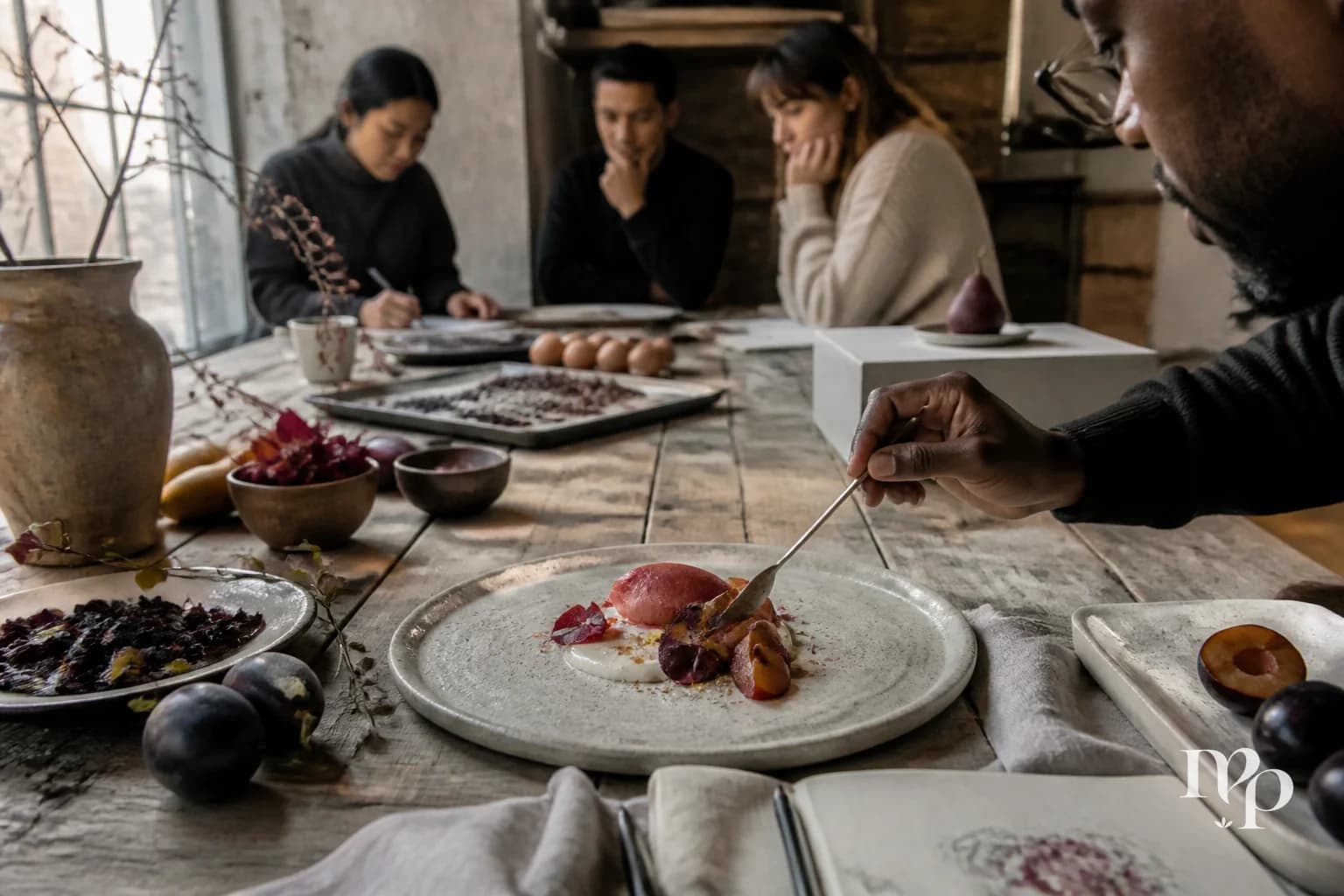
A signature dessert often begins in a quieter place than people expect. Not with a dramatic plate. Not with a name. Not with a garnish designed to be noticed from across the room.
It begins with recognition. The room has to recognize the dessert as part of its own language before the guest can remember it as a signature.
A guest takes the first spoonful and thinks, yes, this belongs here. It carries the same intelligence as the dining room, the same rhythm as the service, the same kind of restraint or generosity that shaped the meal before it. That is where signature dessert development becomes more than a pastry exercise. It becomes part of the restaurant's identity.
Recognition before attention
The strongest signature desserts are not always the loudest ones. They do not need height for its own sake, or a long list of components, or a flavor combination chosen because nobody else has used it this month.
A dessert becomes recognizable when its choices are edited around a clear idea. One ingredient may lead. One texture may create contrast. One temperature shift may change the pace of the final course. The work is not to add until the plate feels important. The work is to remove until the dessert feels specific.
That difference matters. Attention can be bought with spectacle. Recognition has to be earned through fit.
For a restaurant, a signature dessert should not feel imported from another room. It should carry the same point of view as the menu. A coastal restaurant may not need a heavy chocolate ending unless there is a reason for that weight. A small wine bar may need something concise enough to sit beside conversation. A hotel restaurant may need a dessert that holds its structure across service without losing grace.
The question is not only what tastes good. Many things taste good. The better question is: what could only make sense here?
The room sets the limits
Dessert lives inside hospitality, not outside it. A final course has to respect appetite, timing, staff language, table space, glassware, lighting, and the emotional temperature of the room.
A dessert that works beautifully in a tasting may become awkward in service if it needs too much explanation, too many last second movements, or a level of attention the room cannot give. This is not a failure of ambition. It is a failure to read the conditions.
In our work, we often find that the room tells the truth before the sketch does. Is the restaurant intimate or fast moving? Are guests lingering over coffee or turning tables quickly? Does the menu build toward richness, brightness, heat, smoke, fruit, bitterness, or spice? Does the final course need to settle the meal or wake it up again?
The answer shapes proportion. It shapes sweetness. It shapes whether the dessert should arrive as a composed plate, a shared object, a chilled finish, a warm spoon dessert, or something more restrained.
For more on fit, we have written about How to design a signature dessert that belongs to the restaurant. Belonging is not decoration. It is structure.
Flavor carries the name
A signature dessert may eventually receive a name, but the flavor has to carry that name before the menu does.
This is where restraint becomes useful. If five flavors compete for attention, none of them becomes memorable. If the dessert depends on surprise alone, the second encounter may feel thinner than the first. A strong signature dessert usually has an anchor: citrus against cream, bitterness against fruit, caramel against salt, toasted grain against something cold, spice against acidity.
The anchor should be clear enough to remember and flexible enough to support nuance.
Texture does similar work. A soft dessert with no interruption can feel sleepy after a long meal. A crisp element placed without purpose can feel like noise. Contrast should change the eating experience, not simply decorate the plate. A brittle edge, a cool center, a tender crumb, a clean acidic finish: each element earns its place by changing the next bite.
A useful test is whether the dessert can be described simply without becoming generic. If it needs a paragraph to sound interesting, the idea may still be cloudy.
Where signature desserts go wrong
The most common mistake is building a monument instead of a memory.
A restaurant decides it needs a signature dessert, then tries to make it unmistakable by making it larger, taller, stranger, or more complicated. The plate becomes busy. The servers inherit a script. The guest receives effort, but not clarity.
Another mistake is confusing novelty with identity. Newness can attract attention, but it does not automatically create attachment. If the dessert has no relationship to the restaurant's menu, ingredients, rhythm, or point of view, it may feel like a borrowed costume.
There is also the danger of naming too early. Once a dessert is called the house dessert or attached to the restaurant's name, it becomes harder to edit honestly. Better to test the idea quietly first. Let the flavor, structure, and service pattern prove themselves before the name asks for permanence.
Decoration can also blur the idea. A beautiful plate is not the same as a composed dessert. Garnish should sharpen the intention, not hide uncertainty. We have touched this from another angle in When the dessert has a point of view.
Questions before it goes on the menu
Before a restaurant commits to a signature dessert, the better conversation is not only creative. It is practical, sensory, and honest.
What should the guest remember after the last bite?
Does this dessert extend the meal or fight against it?
Can the service team describe it in one clean sentence?
Is the sweetness doing too much of the work?
What texture changes the pace of eating?
Does the dessert still feel like itself if one garnish disappears?
Can it be served consistently without turning the pass into a negotiation?
Would it make sense in this restaurant if no one took a photograph of it?
That last question is useful. It removes the noise. A signature dessert should survive without performance. It should still have flavor, proportion, and reason when no one is watching.
A quieter checklist
A simple development pass can help keep the dessert grounded:
- Define the role of the dessert before defining the form.
- Choose one clear flavor anchor.
- Build contrast through texture, temperature, or acidity, not excess.
- Match the portion to the appetite at the end of the meal.
- Make sure the plate can move through real service.
- Edit decoration until it supports the idea.
- Give the service team language that feels natural.
- Test whether the dessert still belongs beside the rest of the menu.
This kind of checklist is not meant to flatten creativity. It protects it. Constraints can make the final course more expressive because every choice has to answer to the room.
From the studio
Studio note: Mistoura Pastry approaches signature dessert development as culinary design. The work is not to create a dessert that could sit anywhere and impress for a moment. The work is to shape a final course that feels grounded in the restaurant's identity, attentive to service, and clear enough to be remembered.
That may mean less ornament. It may mean a cleaner flavor line. It may mean changing the portion, cooling the sweetness, adding bitterness, removing a flourish, or letting one ingredient speak with more precision.
The strongest version is rarely the most crowded one.
The ending should still feel open
A signature dessert should not close the meal with a period so heavy that the table goes quiet for the wrong reason. It should leave a trace: a flavor, a texture, a sense of care, a small recognition that the restaurant knew how to end.
That is the quiet value of development. Not novelty. Not spectacle. A dessert that belongs so clearly to the room that, after a while, guests cannot imagine the meal ending another way.
If your restaurant is shaping a final course with more intention, Mistoura Pastry can help design a dessert language that feels specific to the table it serves.