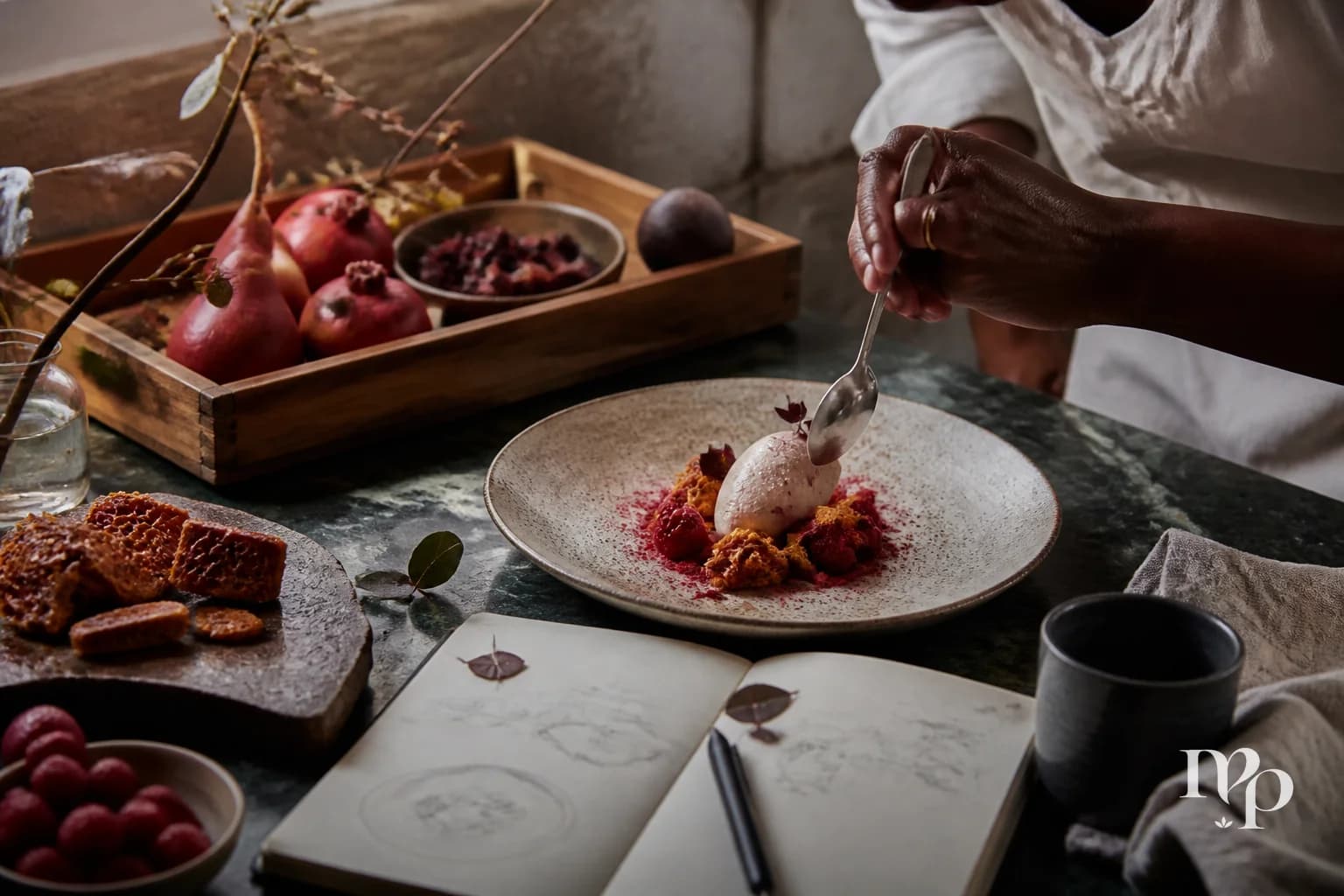
A dessert becomes permanent only after it survives the ordinary nights.
Not the preview dinner. Not the photographed table. Not the first week, when everyone is watching closely. The real test is quieter: a full room, a tired service, a guest who did not plan to order dessert, a server who has thirty seconds to describe it without making it sound precious.
That is where signature dessert development begins to matter. Not as a dramatic final gesture, but as a decision about what the restaurant can repeat with care.
A dessert earns its place slowly
A lasting dessert should feel inevitable once it arrives, but it rarely begins that way.
In our work, the strongest candidates often come from a simple tension: the restaurant needs something recognizable, but not loud. It needs a final course with enough character to be remembered, and enough restraint to be served again and again without exhausting the guest, the kitchen, or the idea.
That balance is easy to misread. A signature dessert does not need to contain every reference the restaurant values. It does not need to explain the whole concept on one plate. It needs to hold one clear thought and express it through flavor, texture, proportion, and service.
A useful question is not what would impress people most. It is what dessert could belong here after the novelty has gone quiet.
For a deeper look at that belonging, we have written about How to design a signature dessert that belongs to the restaurant.
The table does not need a monument
Guests meet dessert at a particular moment. They have already eaten. They may be full, pleased, distracted, lingering, celebrating, or ready to leave. The final course has to read the room.
A restaurant dessert can be expressive without becoming heavy. It can be generous without becoming oversized. It can carry a house identity without turning into a plate of symbols.
This is where hospitality shapes design. A dessert that works for the menu should be understandable from the server's description, stable enough for service, and pleasurable at the actual point of eating. It should not require the guest to study it before enjoying it.
The best version may have one strong flavor direction, one meaningful contrast, and one detail that gives it memory. Bitter cocoa against toasted grain. Citrus cutting through cream. Warm fruit against a cool, quiet element. A crisp edge that arrives before softness. These choices do not need to be elaborate. They need to be placed with intention.
Shape, temperature, texture, restraint
Signature dessert development is not only about flavor. Flavor is where many conversations begin, but structure decides whether the dessert can live on the menu.
Temperature matters because it affects rhythm. A frozen component may bring clarity and lift, but it changes plating pressure. A warm element can make the final course feel immediate, but it asks for timing. A room temperature component can offer ease, but it needs enough texture and aroma to avoid feeling flat.
Texture gives the guest a path through the plate. Softness alone can become dull. Crunch without purpose can feel like decoration. Cream, crispness, chew, melt, and acidity should not compete for attention. They should create movement.
Proportion is often the difference between memorable and tiring. Sugar can flatten a dessert when it arrives without contrast. Fat can feel generous at first and heavy by the third spoon. Acid, salt, bitterness, fruit, and toasted notes can give sweetness more space to speak. This is why less sugar can sometimes create a clearer final course, not a smaller one.
If this is part of a larger menu question, Why every restaurant needs its own dessert language may be useful reading.
Where lasting desserts go wrong
The most common mistake is trying to make the dessert unforgettable by adding more.
More components. More garnish. More references. More textures that do not speak to each other. The plate becomes busy, but not more distinctive.
Another mistake is designing for the image before designing for the spoon. A dessert can photograph well and still eat poorly. Tall elements collapse. Sauces run without purpose. Garnishes interrupt the bite. A brittle shard may look sharp and taste like an obstacle.
There is also the mistake of ignoring the people who carry the dessert to the table. If a server cannot describe it clearly, the dessert loses force before it arrives. If the kitchen needs ideal conditions every time, consistency suffers. If the plate depends on fragile timing during a busy service, the concept may be stronger than the operation can support.
None of this means the dessert should be timid. It means the ambition has to be disciplined.
Questions before it stays
Before a dessert becomes a fixture, restaurant teams can ask a few honest questions.
Does this dessert sound like our room, our food, and our service style?
Can a server describe it in one calm sentence without apologizing or over explaining?
Is there a clear flavor idea, or only a collection of pleasant parts?
Does the last bite feel as considered as the first?
Can the kitchen repeat it on an ordinary night, not only under careful testing conditions?
Is the portion aligned with the appetite guests actually have at the end of this meal?
Would we still want this dessert on the menu after the first wave of attention has passed?
These questions are not meant to make the process smaller. They protect the dessert from becoming a fragile idea that cannot survive service.
A quieter checklist
A dessert the menu can keep usually has:
- One clear reason to exist
- A flavor direction that belongs to the restaurant
- Texture contrast that supports the bite
- Sweetness held in proportion
- A portion that respects the meal before it
- Plating that service can repeat with care
- A description the team can carry naturally
- A final detail that gives the guest something to remember
The list is simple. The work is in the editing.
From the studio
At Mistoura, we often begin signature dessert development by removing pressure from the word signature.
The goal is not to create the loudest dessert on the menu. It is to find the dessert with the clearest role. Sometimes that means a restrained composition built around one ingredient. Sometimes it means a familiar form made more precise. Sometimes it means letting texture carry the memory instead of decoration.
Our perspective is shaped by different culinary languages, including Togo, France, and the United States, but the work always returns to the same table-level questions. What does the guest feel at the end of the meal? What does the restaurant want to leave behind? What can the team serve with confidence and care?
A lasting dessert does not need to announce itself as important. It needs to make sense after everything that came before it.
The final spoonful
A menu can keep a dessert when the idea is strong enough to repeat and quiet enough to breathe.
That is a difficult kind of design. It asks for memory without noise, generosity without excess, identity without costume. It asks the dessert to belong not only to the chef's intention, but to the guest's appetite and the room's rhythm.
If your restaurant is considering a dessert that should stay, Mistoura Pastry can help shape the final course with intention.
Studio note
Mistoura Pastry approaches dessert as culinary design. The goal is not more sweetness or more decoration. The goal is a final course with flavor, restraint, and intention.