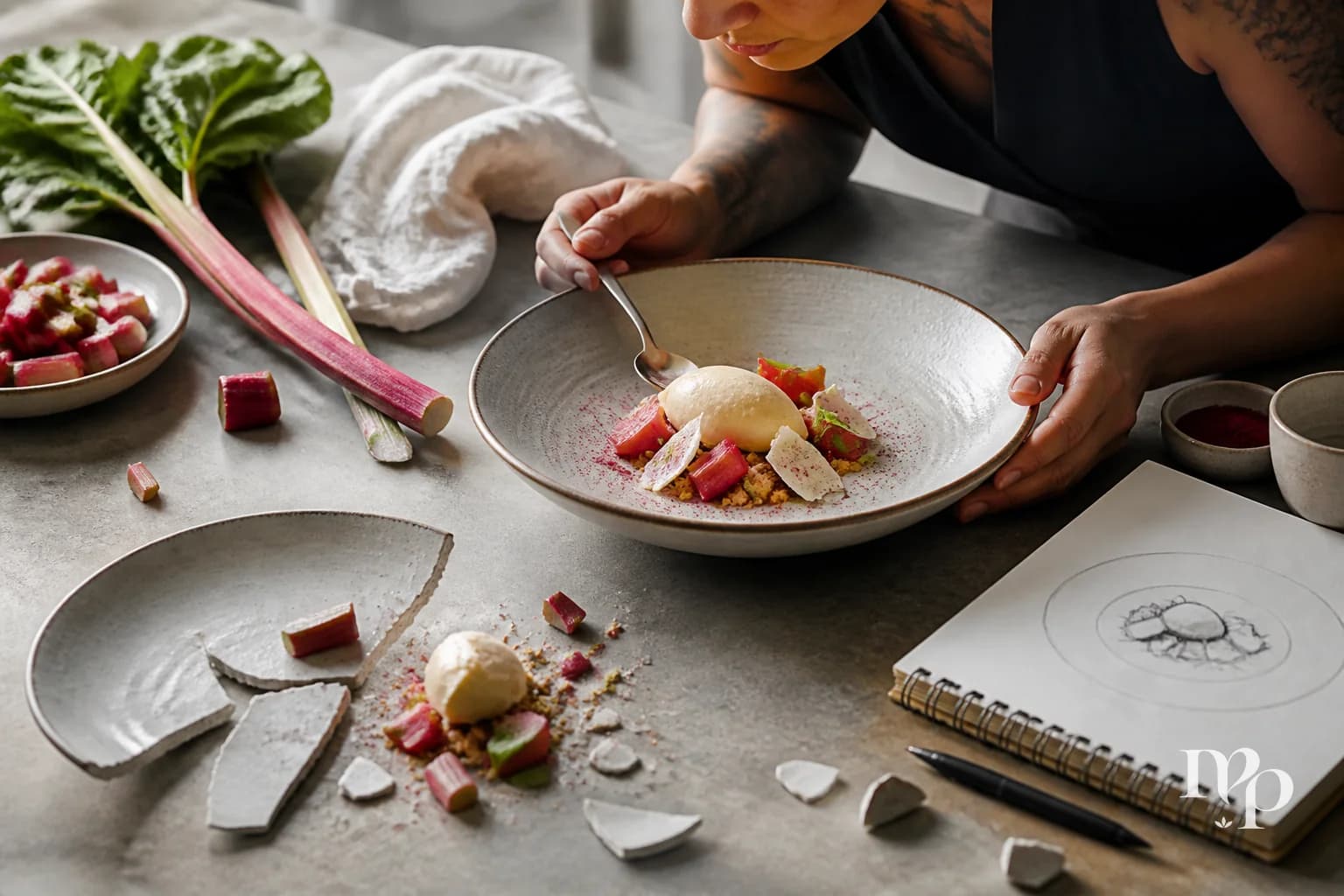
A restaurant can spend months shaping the room, the menu, the glassware, the music, the way a plate lands on the table. Then dessert appears from another world.
Not bad. Not careless. Just unplaced.
That is where many signature desserts lose their force. They are designed as objects first and restaurant experiences second. They may photograph well. They may carry technique. But they do not seem to know where they are.
A dessert with a place to stand begins differently.
The room has already spoken
By the time dessert arrives, the guest has learned the restaurant's language. They know the pace of service, the weight of the plates, the level of generosity, the sharpness or softness of the savory menu. They have felt whether the room is quiet, bright, intimate, theatrical, casual, spare, or abundant.
Signature dessert development should listen to that before it starts sketching components.
A final course for a small, ingredient led restaurant may need restraint, clarity, and a short finish. A hotel dining room may need something with presence that still survives timing, distance, and repeated service. A cafe may need a dessert that can live between afternoon appetite and evening memory. An event setting may need structure, speed, and a visual rhythm that reads in a larger room.
The dessert is not separate from hospitality. It is one of the last ways the restaurant says who it is.
What the dessert needs to carry
A signature dessert does not have to be loud. It does have to be specific.
Specificity can come from a flavor pairing, a texture sequence, a seasonal habit, a plating rhythm, a house ingredient, or a point of restraint. It can come from what the dessert refuses to do. Less sugar. Fewer garnishes. A warmer service temperature. A bitter note that keeps the spoon awake.
More elements do not automatically create more interest. Often they create uncertainty. A guest should not need to decode the plate to understand why it exists.
In our work, a useful question is simple: what should the guest remember after the last bite?
Not every detail will survive in memory. The exact garnish may disappear. The sauce pattern probably will. But the temperature contrast, the clean acidity, the quiet bitterness, the scent of toasted grain, the softness against a crisp edge, those can stay.
That is the material of a signature dessert.
For a related view on belonging, see How to design a signature dessert that belongs to the restaurant.
Before the spoon reaches the table
The strongest version is shaped by design choices that look modest from the outside.
Proportion matters. A dessert can be beautiful and still be too much after a full meal. Sweetness matters because sugar can blur fruit, dairy, chocolate, spice, nut, and grain until everything speaks with the same voice. Texture matters because the final course often needs movement: something tender, something crisp, something cool, something that breaks cleanly or melts slowly.
Service matters too.
Can the dessert be plated with consistency during pressure? Does it require a last second move that the room cannot support? Will the frozen element hold long enough? Will the sauce travel? Does the garnish improve the bite or merely decorate the surface?
This is where restaurant dessert design becomes more than pastry technique. It becomes a conversation between kitchen, service, appetite, timing, and identity.
A dessert can be ambitious without being fragile. It can be quiet without being forgettable.
The mistakes that make a dessert feel borrowed
The common mistake is designing from admiration instead of context.
A chef sees a form, a finish, a garnish, a shape, a style of plating, and tries to bring that energy home. The result may be polished, but it can still feel borrowed. The plate has no address.
Other mistakes are more practical:
- Building a dessert around a component the team cannot repeat calmly.
- Adding acidity only as a correction instead of making it part of the idea.
- Treating chocolate, caramel, cream, and crunch as automatic crowd safety.
- Making the portion generous in a way that punishes the end of the meal.
- Letting decoration carry meaning that flavor and texture do not support.
- Ignoring how the dessert reads beside the rest of the menu.
None of these choices are failures by themselves. The problem is when they are unexamined.
A signature dessert should not feel like a pastry case moved onto a restaurant plate. It should feel edited for that table.
Questions for the final course
Before developing a restaurant signature dessert, the operator and culinary team can ask better questions than what will sell.
What does the savory menu leave the guest craving: freshness, warmth, bitterness, fruit, cream, crunch, lift?
How full is the guest likely to be when dessert arrives?
Does the restaurant need one dessert with ceremony, or one with ease?
Which ingredients already belong to the house language?
What textures are missing from the meal before dessert?
Should the final course extend the mood of the room or shift it?
Can service describe the dessert in one clear sentence without flattening it?
What would make the dessert difficult to copy without making it complicated?
These questions do not restrict creativity. They give it a place to work.
For more on that broader house language, read Why every restaurant needs its own dessert language.
A quieter checklist
A dessert is ready to stand for the restaurant when a few things are true.
- The main flavor is clear before the plate is explained.
- The sweetness leaves room for the ingredient to taste like itself.
- The texture sequence has contrast, not clutter.
- The portion respects the appetite at the end of the meal.
- The plating can be repeated without losing its sense of intention.
- The dessert belongs beside the savory menu, not just after it.
- Service can carry the story without needing a speech.
- The final bite feels considered, not merely finished.
This is not a formula. It is a way to notice whether the dessert has enough internal logic to return to the menu again and again.
From the studio
At Mistoura Pastry, we often find that the first version of a signature dessert is too eager. Too many gestures. Too many ways of proving itself. The work is usually in the edit.
One element leaves. Another becomes smaller. Sweetness is pulled back. A garnish becomes a texture instead of a decoration. A familiar flavor is given more room. The plate starts to breathe.
That is often when the dessert begins to feel less like a proposal and more like part of the restaurant.
A dessert with a place to stand does not need to announce itself. It needs to make sense in the hand of the server, on the table, after the meal, and later in memory.
If your restaurant, cafe, hotel, or hospitality project is shaping a dessert that needs to belong more clearly, Mistoura Pastry can help think through the final course.
Studio note
Mistoura Pastry approaches dessert as culinary design. The goal is not more sweetness or more decoration. The goal is a final course with flavor, restraint, and intention.