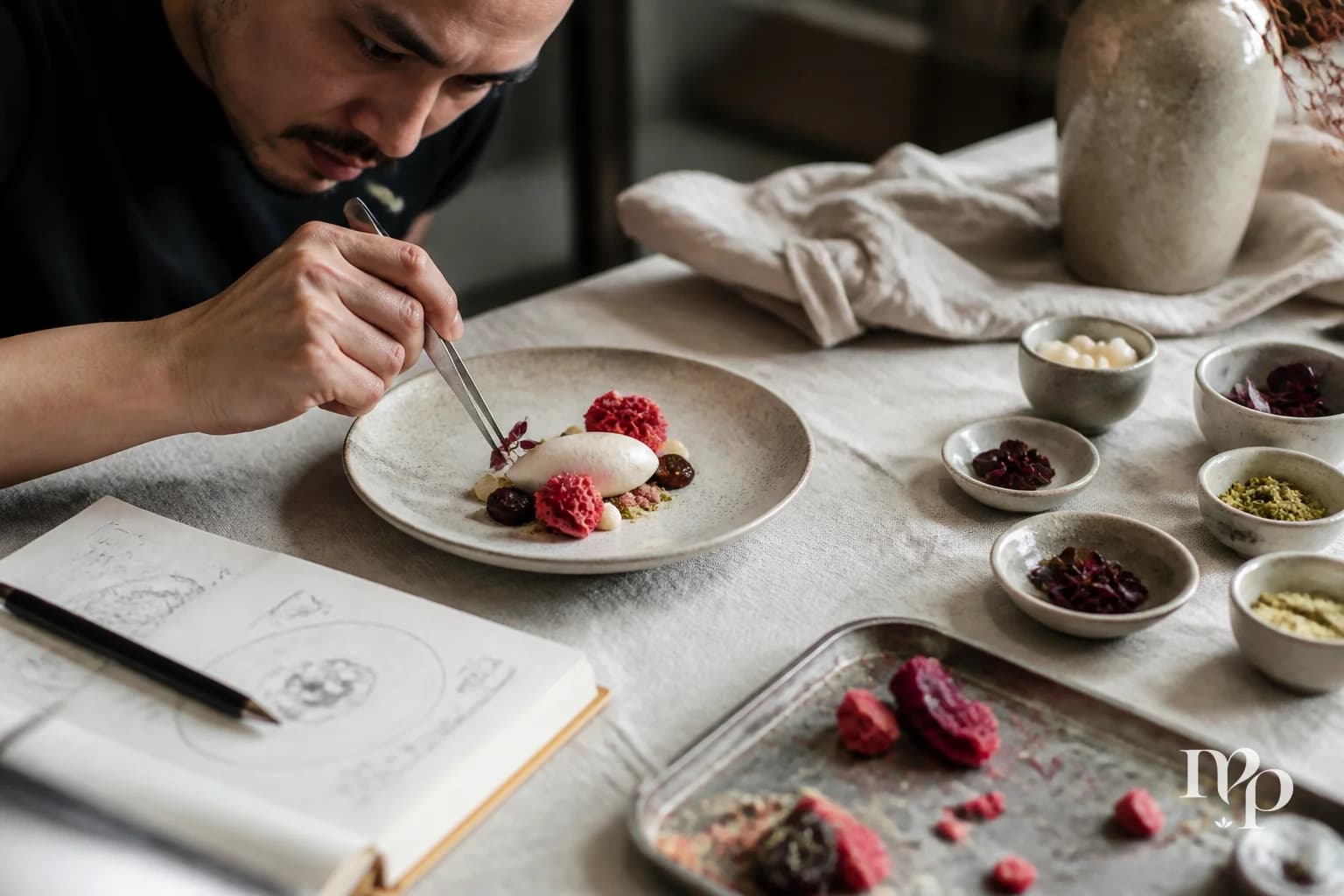
A restaurant can tell you what dessert it needs before anyone sketches a plate.
Listen to the room for a few minutes. Is the meal quiet and measured, or bright and fast? Are guests sharing plates, lingering over wine, moving toward coffee, or already full before the final course is offered? A signature dessert developed without that context may look composed, but it will feel imported.
Signature dessert development is not the search for a beautiful object. It is the work of making an ending that belongs to the house.
The room speaks before the pastry
A dessert that belongs to a restaurant does not need to explain itself loudly. It should feel like the next sentence in the meal.
For a small cafe, that may mean a dessert with warmth, speed, and a familiar ingredient treated with more care than expected. For a hotel dining room, it may mean something controlled enough for repeated service, but generous enough to mark the occasion. For a restaurant with a lean savory menu, the strongest final course may be spare, acidic, textural, and clean.
The mistake is starting with admiration. A chef sees a form, a technique, a garnish, a plated dessert from somewhere else, and tries to make it fit. But the room has already set the terms. The dessert has to answer the meal, not audition for attention.
We often find that the most distinctive signature desserts begin with constraints. Service speed. Plate size. guest appetite. Staff comfort. Seasonality. The tone of the menu. The flavor language already present in the restaurant. Constraints are not the enemy of expression. They keep the dessert from becoming decoration with a name.
As we wrote in Why every restaurant needs its own dessert language, a restaurant becomes more recognizable when its choices share a rhythm. Dessert is part of that rhythm.
Flavor has to belong before it can surprise
Surprise is easy to overvalue. Belonging is harder.
A signature dessert can have an unexpected note, but it still needs a center of gravity. The guest should understand what they are eating. Mango should still taste like mango. Chocolate should not be buried under cleverness. Citrus should carry brightness, not just acidity. Spice should have a role beyond announcing itself.
The strongest development work often starts with a simple question: what flavor would feel honest at the end of this meal?
From there, composition can begin. Not with a list of elements, but with proportion. Something creamy may need something crisp. Something sweet may need bitterness, salt, or acidity. A warm component may need a cooler one. A soft dessert may need a cut of texture so the spoon does not become tired after three bites.
Texture is not a garnish. It shapes pace. It tells the guest whether to linger, break, scoop, share, or finish quietly. A dessert with one soft register can feel heavy even when the portion is small. A dessert with too many textures can feel restless. The edit matters.
For a deeper look at the development of a restaurant specific final course, see How to design a signature dessert that belongs to the restaurant.
Where the plate begins to lose the house
Signature desserts often go soft in predictable places.
One is excess. More components are added because the dessert needs to feel important. A tuile, a gel, a crumble, a cream, a sauce, a powder, a leaf. Soon the plate has movement, but no argument. The guest remembers effort, not flavor.
Another is borrowed identity. A dessert can be technically sound and still feel like it belongs to another restaurant. This happens when the form is chosen before the reason. The plate may photograph well, but it does not carry the room.
A third mistake is ignoring service. A dessert that collapses under normal pickup, requires too many last minute touches, or depends on one person to plate correctly is not finished as a restaurant idea. It may work once. It may not work at eight tables with different tempos.
There is also the quiet mistake of sweetness without shape. Sugar can soften edges, but it can also flatten memory. When everything is sweet, nothing has a clear voice. A signature dessert needs contrast, not aggression. Bitterness, salt, acidity, roast, fermentation, fruit skin, herb, smoke, and temperature can all make sweetness more legible.
Questions before the first test
Before testing flavors, a useful set of questions can keep the work grounded.
What has the guest already eaten before dessert arrives?
Does the room need a dessert for sharing, for ceremony, or for a quiet individual finish?
Should the dessert extend the menu language, or offer a gentle change in temperature and mood?
What ingredients already feel connected to the restaurant rather than borrowed for novelty?
Can the service team describe the dessert without sounding rehearsed or vague?
Will the plate still make sense when the dining room is busy?
Does the dessert leave the guest with clarity, or only richness?
These questions are not meant to make the process dry. They protect the feeling of the final course. A dessert can be poetic and still answer practical demands. In restaurant work, it has to.
A quieter checklist
A signature dessert is ready to move forward when several things are true.
- The main flavor is clear within the first bite.
- The texture changes enough to keep the spoon interested.
- The portion respects the appetite left after the meal.
- The plate can be executed consistently during service.
- The dessert sounds natural when described by the team.
- The composition reflects the restaurant, not a general pastry mood.
- Decoration serves the idea instead of covering uncertainty.
- The final bite leaves a memory with shape.
This checklist is simple on purpose. It does not replace development. It keeps the work honest.
From the studio
At Mistoura Pastry, we think about signature dessert development as translation. The work is not to impose a pastry style on a restaurant. It is to study the house and give its final course a language with flavor, texture, and restraint.
That may mean removing an element rather than adding one. It may mean choosing a quieter ingredient because it carries the menu better. It may mean designing a dessert that service can execute with confidence instead of one that depends on fragile drama.
The point is not to make dessert smaller. It is to make it more exact.
Let the ending sound like the house
A restaurant's final course is not only the last thing served. It is the last thing interpreted. The guest may forget the sequence of the meal, but they often remember the feeling of how it ended.
A signature dessert earns its place when it feels inevitable without feeling obvious. It carries the room without copying it. It offers pleasure, but not noise. It gives the guest one more reason to understand where they are.
For restaurants, cafes, hotels, and hospitality teams shaping a dessert that should belong more clearly to the house, Mistoura Pastry develops final courses with intention, restraint, and a close reading of the room.
Studio note
Mistoura Pastry approaches dessert as culinary design. The goal is not more sweetness or more decoration. The goal is a final course with flavor, restraint, and intention.