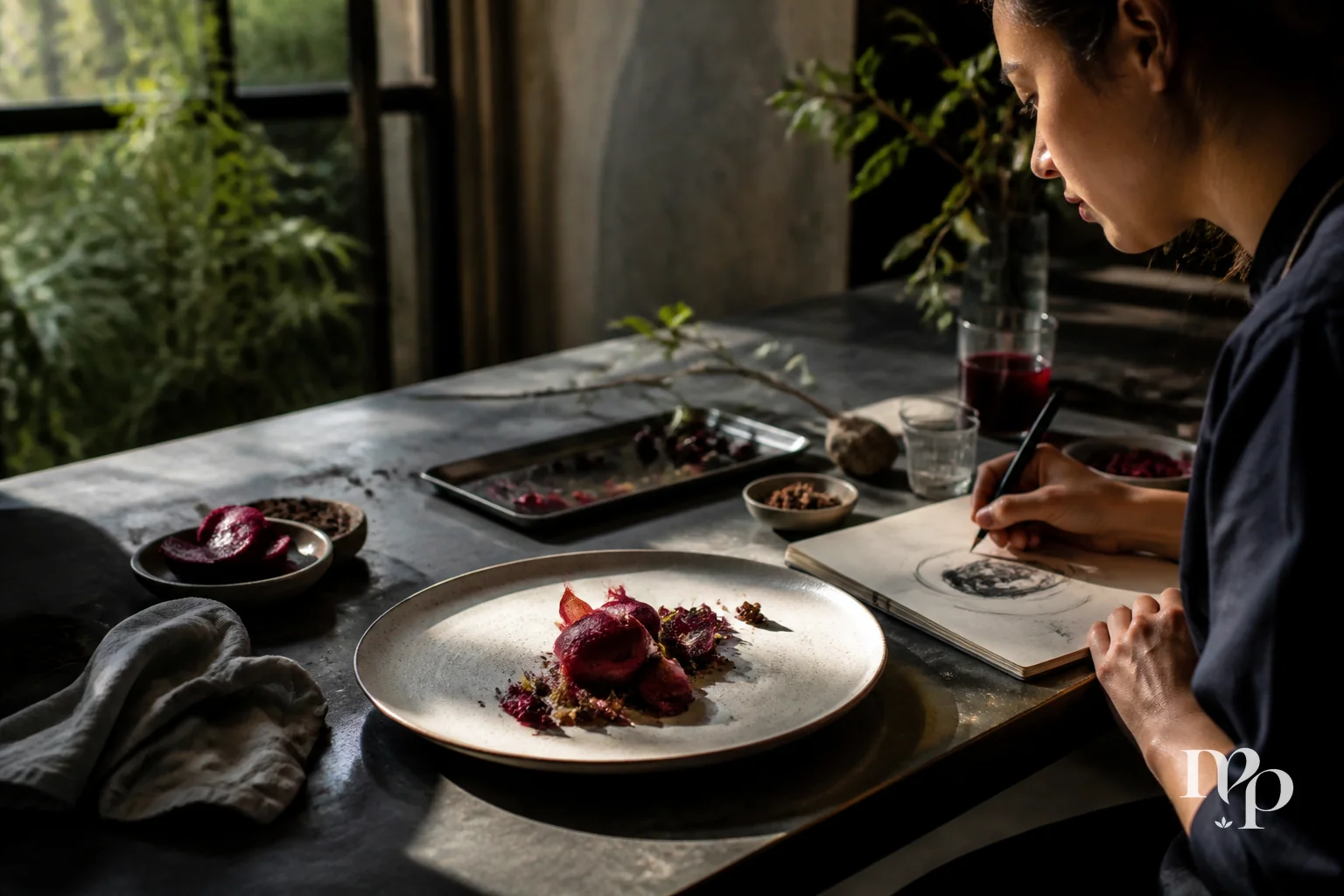
A restaurant can decide it wants a signature dessert before it knows what the dessert is supposed to protect.
That is where many promising ideas start to drift. The plate gets taller. The garnish gets louder. The flavor gets polite enough to offend no one, which also means it rarely says anything worth remembering.
Signature dessert development should begin with a smaller, sharper question: what should the final course make clear about this place?
What the sketch has to carry
The first sketch is not a drawing of a plate. It is a set of commitments.
Will the dessert close the meal with restraint or generosity? Should it refresh the guest after a rich savory progression, or deepen the mood with warmth and weight? Does the room call for something quiet and composed, or something with a little theatre that service can carry without strain?
A house dessert has to hold more than flavor. It carries pacing, appetite, labor, identity, and memory. If those pressures are ignored at the beginning, they return later as awkward plating, slow pickup, unclear portions, or a dessert that looks impressive but feels borrowed.
In our work, the strongest early ideas are often simple on the surface. A bitter cocoa note against ripe fruit. A cream that is barely sweet enough. A crisp layer that changes the spoonful without stealing attention. The point is not to reduce ambition. It is to give ambition a spine.
When the room starts speaking
A dessert belongs differently in a 30 seat neighborhood restaurant than it does in a hotel dining room, a cafe, a private event, or a high volume hospitality program.
The same flavor idea can fail or succeed depending on the room. A delicate frozen element may be beautiful until the pass is crowded. A plated dessert with six touches may read as care in one setting and delay in another. A dramatic tableside finish may feel generous when the room has space, and intrusive when the guest simply wants the last spoonful and the check.
This is why signature dessert development cannot be separated from hospitality. The dessert is not just what pastry wants to say. It is what the guest can receive at that precise point in the meal.
A useful companion thought is dessert language. If the restaurant already has a clear rhythm, the final course should speak that rhythm fluently. If the language is still forming, the dessert can help define it. We wrote more about that in Why every restaurant needs its own dessert language.
Choices that give the dessert a spine
A house dessert becomes clearer when the design choices are named early.
Start with temperature. Warm, cool, frozen, room temperature, or a deliberate contrast between them. Temperature changes the pace of eating and the feeling of closure.
Then texture. Cream alone can feel flat. Crunch alone can feel thin. A good spoonful often needs at least one point of resistance, but not a pile of competing effects. Texture should help the guest understand the dessert, not make them excavate it.
Then sweetness. Less sugar is not a wellness gesture here. It is a flavor decision. When sweetness steps back, acidity, bitterness, dairy, fruit, spice, grain, and fermentation can speak with more detail. The dessert still has to satisfy, but satisfaction does not require a heavy hand.
Then proportion. A signature dessert does not need to be large to feel complete. It needs the right ratio of richness to relief, softness to structure, familiarity to surprise. Proportion is where many desserts quietly win or lose.
Finally, service. Can the team describe it in one clear sentence without sounding scripted? Can the kitchen produce it with grace on a busy night? Can it survive the distance from pass to table? If not, the sketch is not finished.
For a deeper look at belonging, see How to design a signature dessert that belongs to the restaurant.
Where house desserts go soft
The first mistake is mistaking decoration for identity. A beautiful finish can sharpen an idea, but it cannot create one. Gold leaf, flowers, shards, powders, and dots become noise when they are asked to do the work of flavor and composition.
The second mistake is designing for a photograph instead of a spoon. A dessert may look composed from above and still collapse into sameness once eaten. What matters is the sequence of bites, the way the textures meet, and whether the final spoonful feels intentional.
The third mistake is chasing novelty without asking what the restaurant can keep. Strange is easy. Distinctive is harder. A house dessert should feel specific, not random.
The fourth mistake is ignoring appetite. By the time dessert arrives, the guest has already eaten a meal. The final course should understand that. It can be rich, but it needs air. It can be generous, but it should not punish the guest for saying yes.
Questions before the first tasting
Before the first tasting, a restaurant team can ask a few grounding questions.
- What does the guest usually feel by the time dessert is offered?
- Which flavors already belong to the restaurant, and which would feel forced?
- Should the final course refresh, settle, surprise, or extend the mood?
- What texture is missing from the meal before dessert arrives?
- How much explanation should this dessert need at the table?
- Can the service team carry the story without performance fatigue?
- What part of the dessert must remain unchanged, even as seasons shift?
These questions do not make the process slower. They prevent the wrong kind of speed, where a team moves quickly into testing before it has agreed on what success should feel like.
A quieter checklist
A house dessert is ready to move forward when it can answer plainly:
- The main flavor is clear.
- The sweetness has a reason.
- The texture changes the experience, not just the look.
- The portion respects the end of the meal.
- The plate can be produced consistently.
- The idea belongs to the restaurant, not only to the pastry bench.
- The guest can remember it without needing to recite every component.
If the dessert cannot pass this edit, it may still be a good idea. It may simply not be the house dessert yet.
From the studio
At Mistoura Pastry, we often begin signature dessert development by removing possibilities rather than adding them.
That edit can feel severe at first. Fewer flavors. Fewer gestures. Fewer reasons to decorate. But once the extra noise is gone, the useful details become easier to hear: the bitterness that makes a cream taste cleaner, the acidity that wakes up a fruit, the crisp edge that keeps the spoonful alive, the pause between savory and sweet.
A dessert with restraint is not a quiet dessert by default. It can be bold. It can be sensual. It can carry memory. Restraint simply means every element has been asked to earn its place.
The finish that stays
The first sketch of a house dessert should not try to impress everyone at once.
It should listen to the room, understand the appetite, and choose a few details with conviction. That is where a final course begins to feel less like an addition and more like a closing sentence the restaurant has been writing all night.
For restaurants, cafes, hotels, and hospitality teams shaping a dessert that needs to belong, Mistoura Pastry develops final courses with clarity, restraint, and a sense of place.
Studio note
Mistoura Pastry approaches dessert as culinary design. The goal is not more sweetness or more decoration. The goal is a final course with flavor, restraint, and intention.