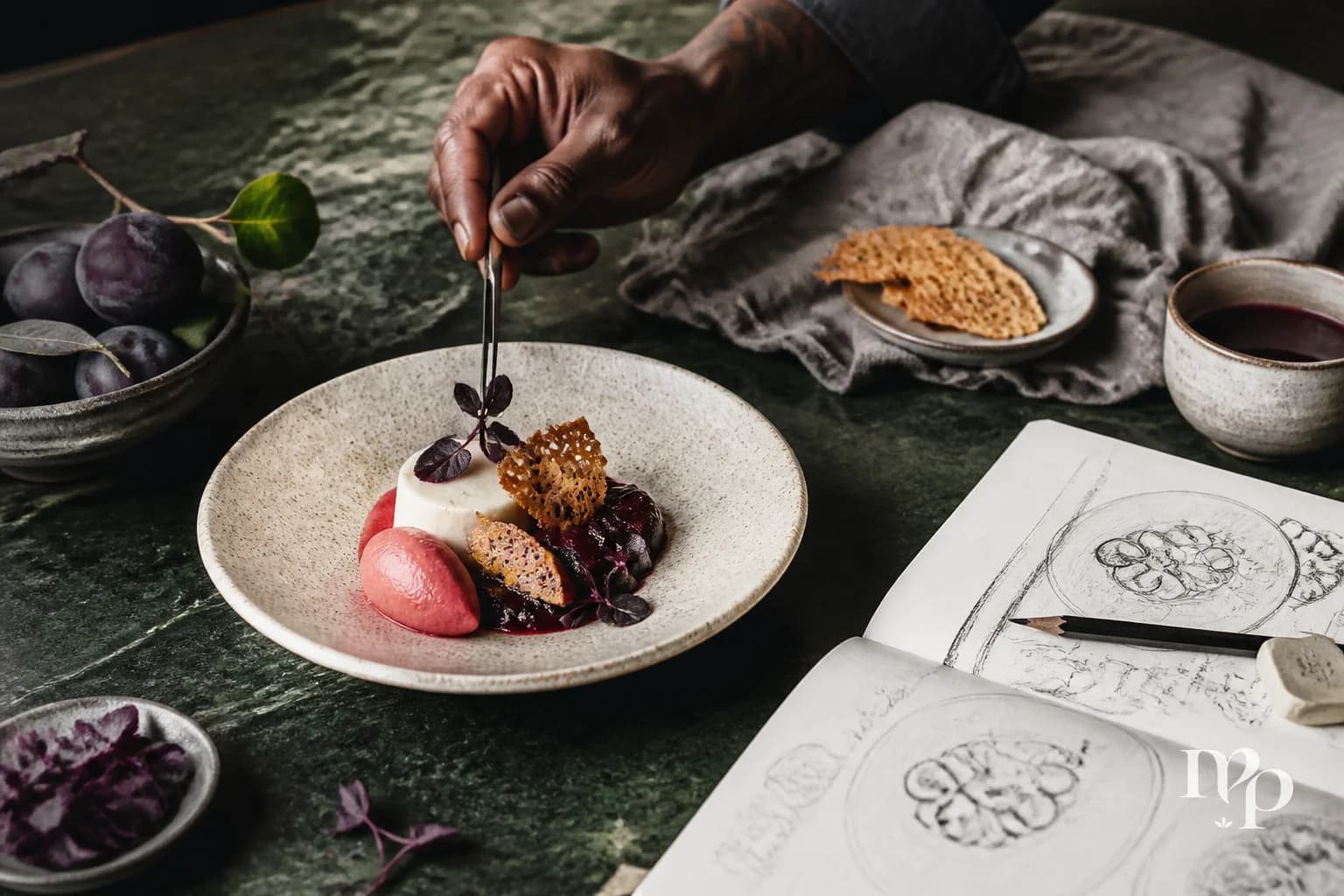
A restaurant has a sound before it has a dessert. The pace of the room, the weight of the plates, the way a server describes a dish, the kind of appetite guests bring to the table. A final course that ignores all of that may still be pleasant. It will not feel owned.
Signature dessert development is often treated as a search for an impressive object. We often find the stronger work begins somewhere less theatrical: with the restaurant's voice. Not a slogan. Not a theme pasted onto pastry. A voice made from appetite, service, ingredients, rhythm, and restraint.
What the room is already saying
Before a dessert is drawn, the restaurant has already given instructions.
A spare room with precise savory courses may not need a tall, busy plate at the end. A generous neighborhood table may need something warmer, easier to share, less brittle in its manners. A tasting menu may ask for a final course that lands cleanly after many small impressions. A cafe that moves through morning, afternoon, and evening may need a dessert that can shift with the light.
The mistake is to design the dessert as if it is auditioning alone. It never is. It arrives after salt, fat, heat, wine, conversation, delay, appetite, and expectation. It has to understand the room it enters.
For a wider look at this idea, we return often to Why every restaurant needs its own dessert language. Language is not decoration. It is the pattern guests begin to recognize.
A point of view you can taste
A signature dessert does not need to announce itself loudly. It needs to have a position.
That position might be freshness over richness. Bitter edges over soft sweetness. Fruit that tastes like the season rather than perfume. Cream used for calm instead of excess. Chocolate held in tension with acidity, salt, smoke, spice, or grain. The point is not novelty. The point is clarity.
The tradeoff is restraint. If every element tries to be memorable, the dessert becomes hard to remember. A guest may recall the shape or the garnish, but not the feeling. The strongest final courses often choose one central idea and let every part answer to it.
An ingredient should still taste like itself. A roasted pear should not disappear under caramel, mousse, crumble, sauce, tuile, and flowers. A citrus cream should not become sweet fog. A sesame note should not be used only because it looks interesting on paper. Flavor has to lead composition, not trail behind it.
Before the spoon reaches the table
Hospitality changes dessert design.
A dessert that works in a quiet development tasting may struggle on a busy Saturday night. The quenelle softens. The crisp element waits too long. The sauce loses its temperature. The plate requires more gestures than service can repeat with care. The idea may be good, but the restaurant cannot carry it consistently.
That does not make the idea wrong. It means the design has to respect service.
A final course should consider pickup time, plating rhythm, storage, temperature, portion size, and the number of hands involved. It should also consider how it will be described. If the server needs a speech to make the dessert make sense, the composition may be carrying too much explanation and not enough clarity.
This is where signature dessert development becomes less romantic and more useful. A dessert belongs to the restaurant when the kitchen can execute it, the dining room can speak about it, and the guest can understand it without being coached.
The choices that give it shape
A restaurant's voice becomes visible through proportion.
How sweet is the final bite after the savory menu? How much acidity is needed to reset the palate? Should texture come from pastry, fruit, seed, nut, ice, cream, or something more spare? Does the dessert need height, or would a lower composition feel more honest to the room? Is the garnish carrying meaning, or is it only making the plate busier?
Texture is often where memory settles. A cold element against something warm. A crisp edge that breaks cleanly. A cream that softens bitterness. A fruit component with enough structure to resist becoming sauce. If texture is doing real work, the dessert can be quieter and still hold attention.
We wrote more directly about that in When texture carries the final course, because texture is not a finishing detail. It is often the architecture.
Seasonality also edits the voice. Summer may ask for lift and water. Autumn may tolerate deeper tones. Winter can hold bitterness, spice, and warmth, but it still needs air. Spring often needs restraint most of all. The season should not become a costume. It should change the weight of the dessert.
Where the dessert starts to drift
Some mistakes look attractive at first.
The dessert becomes too literal. A restaurant known for fire gets smoke in the dessert even when the flavor does not want it. A coastal restaurant adds shells, blue tones, or sea shapes instead of asking how salinity, brightness, and restraint might behave in pastry. A brand color appears on the plate with no culinary reason to be there.
Another common drift is accumulation. More components, more gestures, more garnish, more story. Complexity can be beautiful, but only when it creates a clearer experience. Otherwise it becomes noise.
There is also the trophy problem. A signature dessert made to be photographed can forget the guest's appetite. It may look important and eat poorly. Too large, too sweet, too slow, too fragile, too separate from the meal that came before it.
Dessert should not be an afterthought, but it should not hijack the table either. The final course has a delicate job. It closes the meal without flattening it.
Questions before the first tasting
A useful conversation can begin with simple questions.
What should the guest feel in the last three bites of the meal?
Which part of the restaurant's identity should the dessert carry: generosity, precision, warmth, restraint, brightness, depth, play, calm?
What flavors already appear on the menu, and which ones should the dessert avoid repeating?
How sweet can the dessert be before it dulls the memory of dinner?
What texture is missing from the meal by the time dessert arrives?
Can the dining room describe the dessert in one clean sentence?
Can the kitchen plate it on the hardest night of the week without losing the idea?
These questions are not meant to make the dessert safer. They make it more specific.
A quieter checklist
Before committing to a final course, we like to look for a few signs of belonging:
- The dessert can be described without a long explanation.
- The main ingredient remains legible.
- Sweetness supports flavor instead of covering it.
- Texture gives the guest a reason to keep paying attention.
- The plate feels related to the savory menu without copying it.
- The portion respects the appetite at the end of the meal.
- Service can repeat the dessert with care.
- Decoration serves the idea.
- The final bite feels intentional, not leftover.
A checklist cannot design the dessert. It can reveal whether the dessert is still listening.
From the studio
In our work, we are less interested in making a dessert look like a restaurant and more interested in making it think like one.
That difference matters. A visual reference may produce a striking plate. A deeper reading of the restaurant produces choices that hold up over time: the right sweetness, the right finish, the right silence around an ingredient, the right amount of gesture.
A final course in the restaurant's voice does not need to explain the whole house. It only needs to leave the guest with a clear last impression. Something precise enough to remember, and generous enough to want again.
If your restaurant is shaping a dessert that needs to feel unmistakably its own, Mistoura Pastry develops final courses with attention to flavor, texture, service, and the memory left at the table.
Studio note
Mistoura Pastry approaches dessert as culinary design. The goal is not more sweetness or more decoration. The goal is a final course with flavor, restraint, and intention.