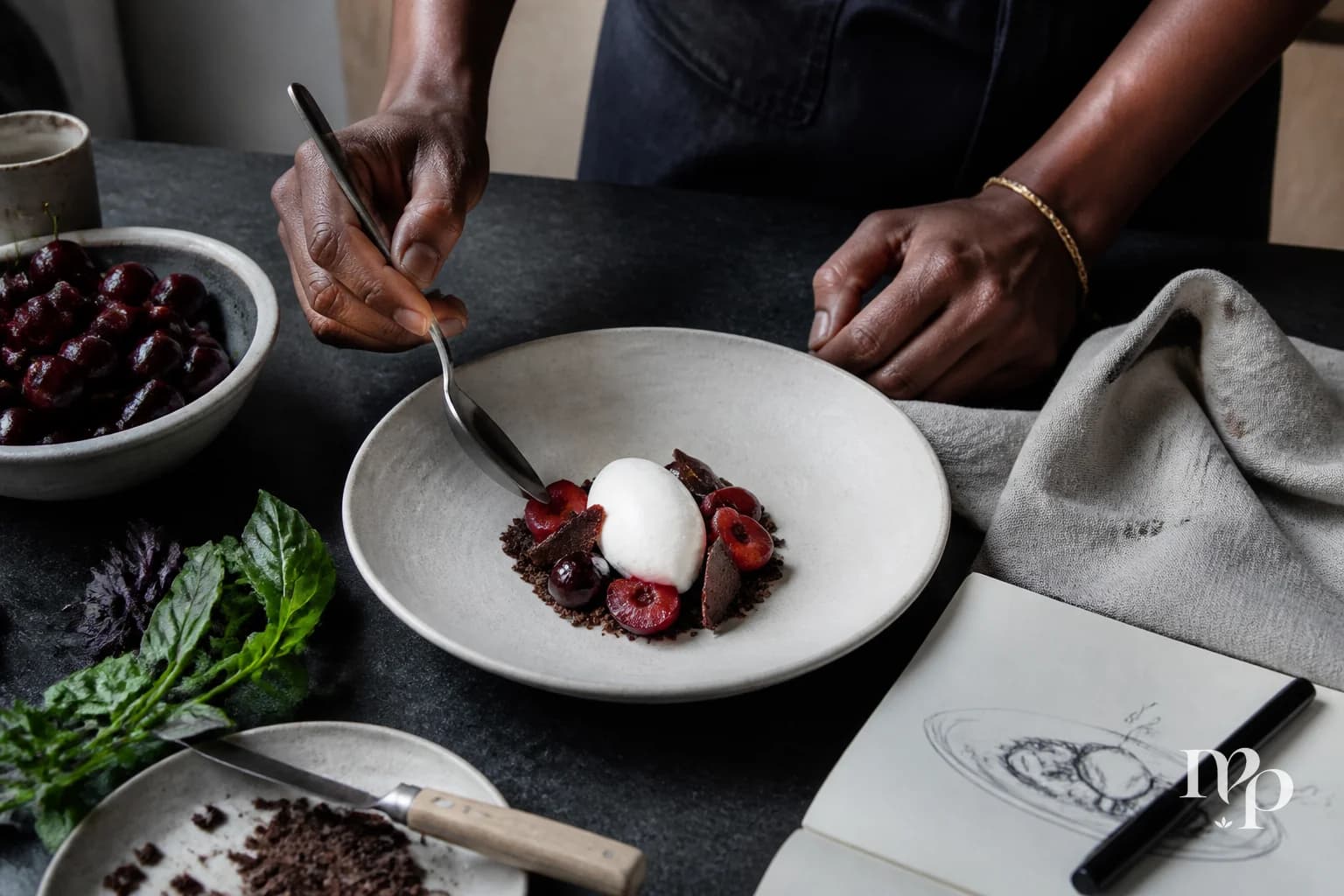
A dessert can look finished and still feel undecided.
The plate may have shine, height, garnish, color, and a name that sounds composed. But when it reaches the table, something is missing. Not technique. Not effort. A reason.
Signature dessert development begins there. Not with the question of what will photograph well, but with what the restaurant needs the final course to carry. Calm after intensity. Brightness after richness. A gesture of generosity. A sharper expression of the house. A last flavor that makes the meal feel edited rather than extended.
Dessert should not be an afterthought. But it should also not behave like a separate restaurant arriving at the end of the meal.
The room should recognize the choice
A signature dessert does not need to explain the whole restaurant. That is too much pressure for one plate. It does need to feel like it came from the same room, the same rhythm of service, the same point of view.
For one restaurant, that may mean restraint. A clean slice, a controlled sauce, a seasonal fruit left close to itself. For another, it may mean warmth, spice, smoke, crunch, or a generous shared format that changes the tempo of the table.
The stronger question is not, “What dessert do we want?” It is, “What kind of ending does this room know how to give?”
That question changes the work. Flavor becomes connected to hospitality. Texture becomes connected to pace. Portion becomes connected to appetite. Composition becomes connected to the way a server can describe the plate without sounding rehearsed.
We have written more directly about this in How to design a signature dessert that belongs to the restaurant, but the central idea is simple: belonging is designed before beauty is added.
Flavor has to carry more than sweetness
Sweetness is not the whole architecture of dessert. It is one material among many.
A final course often becomes forgettable when sugar is asked to do every job. It fills the mouth, flattens the fruit, hides the dairy, softens the acidity, and makes the last few bites feel heavier than they need to be.
Less sugar is not automatically more refined. It only works when something else is given responsibility. Acidity can create lift. Bitterness can create length. Salt can make flavor clearer. Fat can soften an edge. Heat, fermentation, roasting, or caramelization can deepen an ingredient without burying it.
In signature dessert development, the useful move is not subtraction for its own sake. It is deciding what the guest should remember first.
A pear should still taste like pear. Chocolate should not become only density. Cream should not erase the fruit it is meant to hold. A nut should bring more than decoration. When ingredients keep their character, the dessert gains confidence without getting louder.
The plate is only one part of the design
Restaurants often think about the dessert as an object. The better work is to think about the full path.
Can the kitchen execute it during pressure without losing the idea? Can the components hold their texture across service? Does plating require a level of delicacy that collapses during a busy night? Can the server describe it in one or two clear sentences? Does the dessert arrive at the right temperature? Does the first bite make sense? Does the last bite still have energy?
A dessert may be beautiful in testing and wrong for service. That does not make it a failure. It means the restaurant has learned where the design needs to be edited.
The final course has to survive reality. The pass is part of the composition. Timing is part of the flavor. A quenelle that melts too quickly, a tuile that softens before the plate lands, a sauce that bleeds into everything around it, these are not small details. They change the guest experience.
A signature dessert is not just conceived. It is carried.
Where the idea gets crowded
One common mistake is mistaking more components for more interest. Crumb, gel, mousse, foam, crisp, cream, fruit, powder, garnish. The plate fills up, but the idea gets harder to taste.
Another mistake is starting with decoration. Decoration can be useful. It can give rhythm, color, shadow, a point of focus. But if it does not serve the flavor or the experience, it becomes noise. The guest may notice it first and forget it fastest.
There is also the temptation to chase a dessert that feels universally impressive. That usually leads to a plate without an accent. A restaurant dessert should not be generic enough to fit anywhere. It should carry enough specificity that removing it from the room would weaken it.
A final mistake is ignoring appetite. After several courses, the guest does not need to be defeated. The strongest dessert may be the one that knows when to stop. A final course can be generous without being heavy, memorable without being excessive, composed without being crowded.
Questions before the spoon reaches the table
Before a restaurant commits to a house dessert, a few questions can clarify the brief.
What should the guest feel at the end of this meal: refreshed, comforted, surprised, settled, sharpened?
Which ingredients already belong to the restaurant’s language?
Where does the savory menu leave the palate?
Should the dessert be plated individually, shared, finished tableside, or kept quiet?
What texture is missing from the meal before dessert arrives?
What does the service team need in order to describe it naturally?
Which detail can be removed without weakening the idea?
If the dessert carries the restaurant’s name, what promise does that name make?
These are not formal exercises. They are ways to keep the dessert honest before technique takes over.
A quieter checklist
A strong signature dessert usually has a few things in place.
- A clear reason for existing on this menu
- A flavor structure that reaches beyond sweetness
- At least one memorable texture contrast
- A portion that respects the appetite
- Ingredients that still taste like themselves
- A composition that can be repeated under service pressure
- A description the team can say without strain
- A connection to the restaurant’s identity without becoming theatrical
- One edited detail that makes the dessert distinctive
- A final bite that feels intentional
The checklist is simple because the dessert does not need more ceremony. It needs alignment.
From the studio
In our work, we often find that the most useful moment comes before sketching the plate. It is the moment when a restaurant names what the dessert is supposed to do.
Not in marketing language. In dining language.
Hold the room a little longer. Cool the palate after spice. Bring fruit back into focus. Let bitterness make the chocolate cleaner. Give the table something to share. End with quiet rather than spectacle.
Once the reason is clear, the design becomes less decorative and more precise. The plate can be simpler. The flavor can be more direct. The service can feel less like presentation and more like hospitality.
For a related look at purpose inside the final course, see When a signature dessert has a job to do.
A restaurant does not need a famous dessert. It needs one that can stand at the end of the meal without pretending to be separate from it.
The guest may not name the structure. They may not notice every proportion. But they will feel when the ending belongs.
If your restaurant, hotel, cafe, or hospitality project is shaping a dessert with a clearer reason, Mistoura Pastry can help design the final course with you.
Studio note
Mistoura Pastry approaches dessert as culinary design. The goal is not more sweetness or more decoration. The goal is a final course with flavor, restraint, and intention.