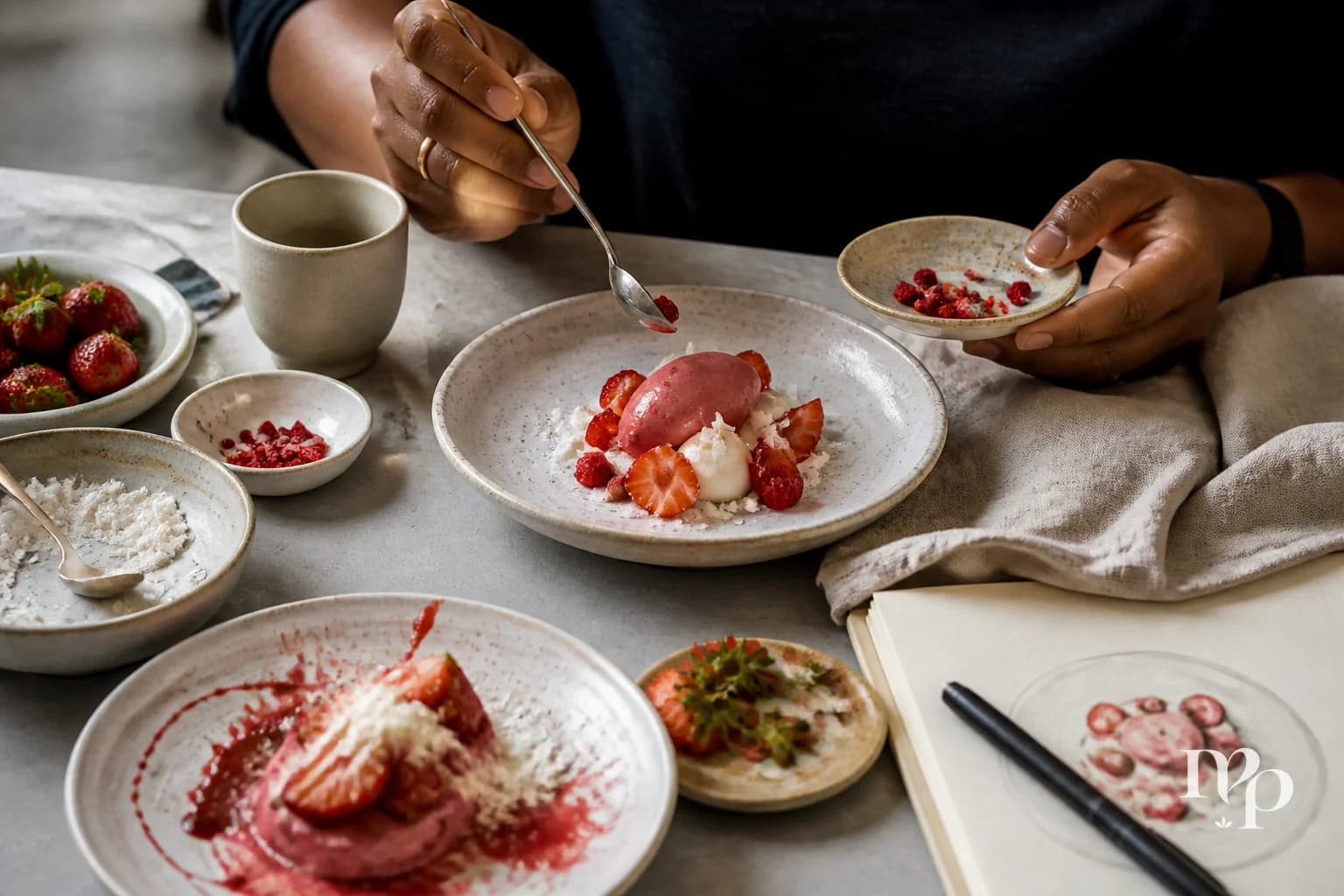
A dessert can be technically beautiful and still feel imported.
It arrives with polish, height, garnish, and a name that sounds composed. But the table does not quite believe it. The rhythm changes too abruptly. The flavor speaks a different language from the menu. The plate feels like it belongs to another restaurant.
Signature dessert development is not the search for the most impressive final course. It is the work of finding the dessert that could only make sense here, in this room, after this meal, with this service team carrying it to the table.
The room is part of the ingredient list
Before we think about chocolate, citrus, cream, spice, fruit, or heat, we look at the dining room.
Is the meal slow and ceremonial, or quick and generous? Are guests lingering over wine, or are they watching the clock before a show? Does the restaurant serve in low light, bright daylight, at a counter, on linen, outside, across a long communal table?
These details are not decoration around the dessert. They shape what the dessert can hold.
A quiet dining room may not need a loud plate. A lively cafe may need something direct enough to survive conversation and movement. A tasting menu may ask for precision and compression. A neighborhood restaurant may need warmth without sentimentality. A hotel dessert may need clarity across many kinds of guests and many service moments.
The room edits the idea before the kitchen does.
A signature dessert needs a reason before it needs a shape
Many signature desserts begin in the wrong place: with a form.
A sphere. A tart. A plated composition. A frozen element. A dramatic pour. A recognizable silhouette.
Form can be useful, but it should not lead the work. A stronger beginning is a reason. What should the last course do for the restaurant?
It may need to bring calm after a savory menu with fire, smoke, salt, and depth. It may need to extend a sense of place through seasonal fruit, grain, spice, or dairy. It may need to give the guest one final texture that feels generous but not heavy. It may need to become a quiet house marker, something regular guests recognize without needing it to be announced.
For a deeper look at belonging, we often return to How to design a signature dessert that belongs to the restaurant. The strongest signature work usually begins with alignment, not novelty.
What gets chosen before flavor
Flavor matters, but it is rarely the first decision.
In our work, we often choose the frame before the flavor: the weight of the dessert, the temperature range, the pace of eating, the number of bites, the level of sweetness, the role of acidity, and the amount of contrast the guest should meet.
A dessert built for the end of a long meal may need air, bitterness, or acidity more than richness. A dessert following a restrained savory menu may be able to carry deeper sweetness, provided the ingredient still tastes like itself. A dessert meant to be shared needs a different structure from one intended as a composed individual plate.
Texture is where many final courses earn their memory. Not by adding more pieces, but by giving the spoon something to discover: a tender base, a cool cream, a thin crisp, a soft fruit, a trace of bitterness, a finish that clears instead of clings.
More elements do not automatically create more interest. Sometimes they only make the idea harder to read.
Where development goes flat
A signature dessert weakens when it tries to be impressive before it is specific.
One common mistake is over decorating. A garnish can finish an idea, but it cannot supply one. If every plate needs petals, powders, crumbs, sauces, tuile shapes, and gold-colored gestures to feel complete, the composition may be avoiding a harder question: what is the dessert actually saying?
Another mistake is chasing recognition too directly. A restaurant does not need its version of whatever is moving through social feeds. It needs a dessert that can stay coherent when trends pass and service gets busy.
There is also the operational mistake: designing something the room cannot consistently serve. A dessert that collapses under timing, requires too many last minute touches, or depends on one person’s hand every night may not be a house dessert. It may be a fragile idea wearing the costume of one.
None of this means the dessert should be plain. It means the beauty has to be disciplined.
Questions before the first test
Before a restaurant commissions or changes a signature dessert, a few questions can protect the work from becoming vague.
What does the guest usually feel by the time dessert is offered: full, curious, celebratory, tired, still hungry, ready to linger?
What part of the restaurant’s identity has not yet appeared clearly by the final course?
Should the dessert echo the savory menu, or offer contrast?
Which ingredients feel natural to the house, and which would feel borrowed?
How much sweetness can the menu honestly support?
Can the service team describe the dessert in one clean sentence without sounding rehearsed?
Will the dessert still make sense in six months, or is it leaning too heavily on a passing visual language?
These questions are not meant to slow the process down. They keep development from becoming decorative guessing.
A quieter checklist
A signature dessert does not need a complicated brief, but it does need a clear one.
A useful working checklist may include:
- The role of the dessert in the meal
- The appetite it should respect
- The primary flavor direction
- The texture contrast that gives it rhythm
- The sweetness level and where balance comes from
- The service conditions it must survive
- The plating language of the restaurant
- The words the team can use at the table
- The seasonal range it can accept without losing itself
- The reason it belongs to this restaurant and not another one
If one of these points cannot be answered, the dessert may still be early. That is not a failure. It is information.
We have written separately about the difference between a dessert that fits and one that feels unmistakable in The dessert only this restaurant could serve. That distinction is often where signature development becomes interesting.
From the studio
Studio note: when we develop a final course, we are not only designing a plate. We are designing a moment of transfer.
The kitchen sends something out. The server gives it language. The guest receives it with the memory of the whole meal still present. The dessert has to move through all of that without losing its shape.
That is why restraint matters. Not because small is better, or quiet is always more refined, but because a restrained dessert leaves room for the restaurant to be felt. It does not crowd the final memory with unnecessary proof.
The strongest version may be a dessert with very few visible gestures: fruit held at the right ripeness, cream with enough salt to stand up, a crisp element that breaks cleanly, a bitter edge, a warm note, a finish that makes the guest set the spoon down slowly.
Not every restaurant needs a famous dessert. Every restaurant does need a final course that understands where it is.
If your restaurant, cafe, hotel, or hospitality project is considering a signature dessert with a clearer sense of place, Mistoura Pastry can help shape the brief.