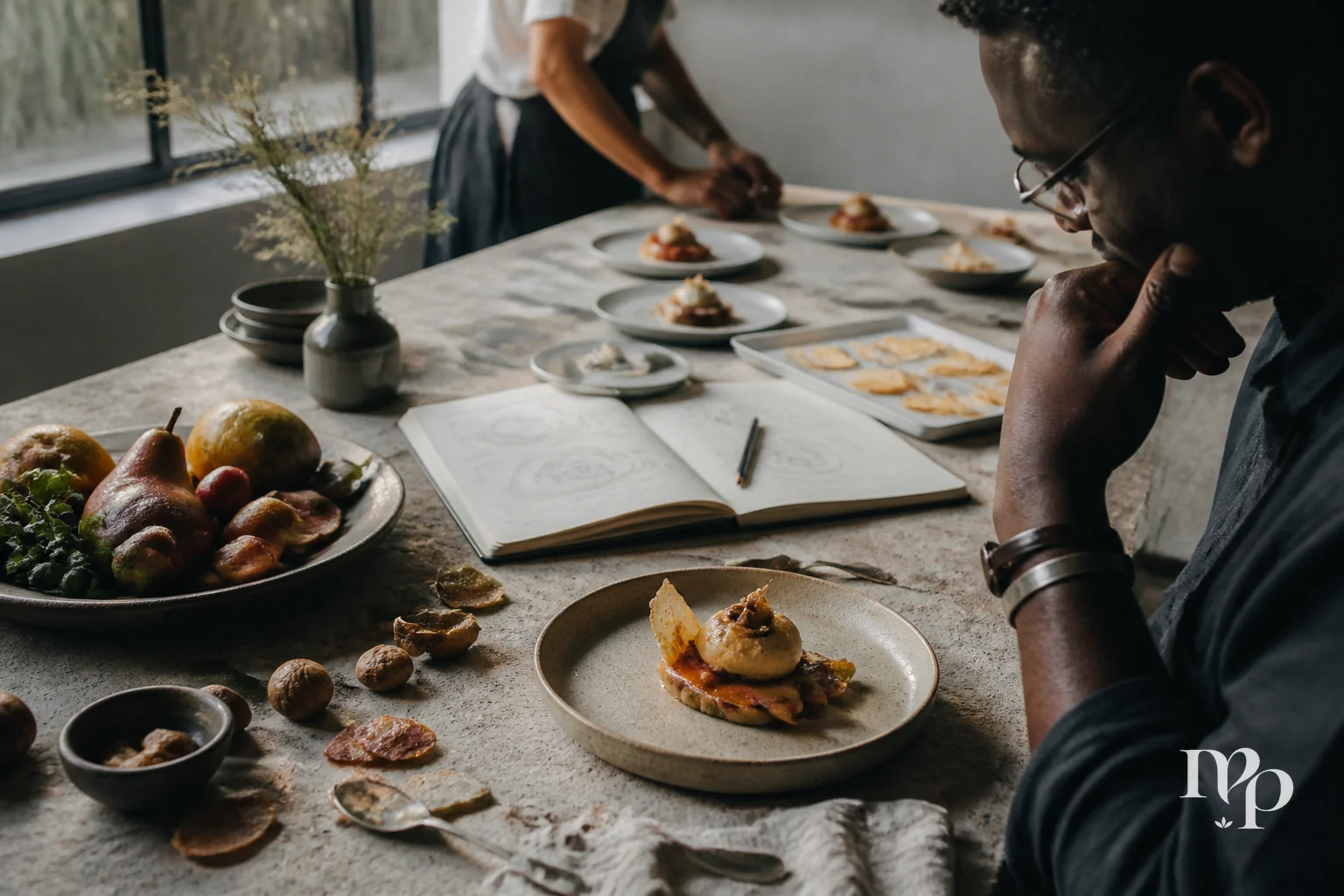
A dessert list can feel hungry.
Not hungry in the generous sense. Hungry in the way a page asks for too many ideas, too many garnishes, too many reasons to exist. The guest sees six desserts, each trying to be the ending, and the room loses its line.
Dessert menu strategy is not about filling a category. It is about deciding how much appetite the restaurant still has at the end of the meal, and what kind of appetite the guest is likely to bring to the table.
The appetite of the list
A strong dessert menu does not need to prove that the kitchen can do everything. It needs to show that the restaurant knows what belongs.
For some rooms, three desserts are enough: one bright, one comforting, one quiet and precise. For another, the list may need more range because the dining room holds different tempos, different check sizes, different reasons for being there. A hotel restaurant may need a dessert that works for a solo guest at 4 p.m. and another that can carry a celebration at 10 p.m. A small tasting room may need one final gesture, not a page.
The point of view is simple: a dessert menu should have proportion. It should feel chosen, not stocked. The strongest version may leave out a technically impressive dessert because the list already has enough weight. Restraint is not absence. It is how the page keeps its shape.
Mistoura has written before about The dessert the menu can keep, and that same thought applies to the whole list. A dessert does not only need to work once. It needs to live inside service, procurement, prep, language, and guest expectation.
What the guest has already carried
By dessert, the guest is not arriving empty.
They have carried salt, acidity, fat, heat, wine, conversation, pacing, noise, and the small emotional weather of the table. Dessert enters that room. It does not enter a blank one.
This is where many dessert lists become too eager. They treat the final page as a fresh beginning, when it is really a continuation. A rich main course may ask for lift. A bright, vegetable led menu may tolerate something deeper. A long tasting menu may need clarity more than grandeur. A quick lunch service may need a dessert that can be understood before the server finishes describing it.
Hospitality lives in that adjustment. The dessert menu should not make the guest work harder at the moment when the meal is asking them to release.
The weight, the light, the familiar
A useful dessert menu usually carries a few distinct roles.
One dessert gives weight: chocolate, caramel, nut, cream, pastry, something with depth and a slower finish. One gives lift: citrus, fruit, herb, cultured dairy, sorbet, something clean enough to reopen the palate. One gives recognition: a form the guest can understand quickly, even if the details are specific to the restaurant.
That does not mean every list needs one chocolate dessert, one fruit dessert, and one custard. Formulas flatten the room. What matters is contrast and proportion. If every dessert is creamy, the page feels tired. If every dessert is sharp, it feels nervous. If every dessert needs a long explanation, the server becomes a translator instead of a host.
Composition matters here. Texture can do work that sugar cannot. A crisp layer can make a restrained cream feel more generous. Bitterness can keep caramel from becoming dull. Temperature can create rhythm without adding more components. The dessert list should be edited through sensation, not only through flavor names.
Where the page loses its shape
The first mistake is adding variety without difference. Five desserts can still feel like one idea if they share the same sweetness, same richness, same plating language, and same emotional note.
The second is treating decoration as distinction. A new garnish does not create a new dessert if the structure underneath is unchanged. Decoration should serve the idea, not distract from a thin one.
The third is letting seasonality become noise. Seasonal ingredients are not automatically meaningful. A pear dessert should still taste like pear. A citrus dessert should not bury its brightness under cream, crumble, foam, and three sauces because the season needs to be announced.
The fourth is forgetting service. A dessert menu can be clever on paper and punishing at 9:15 p.m. If each plate needs too many last minute gestures, the list may create drag where the dining room needs grace.
For a deeper look at how a single dessert earns its place, A dessert with a place to stand sits close to this question.
Questions before changing the page
Before changing a dessert menu, a restaurant can ask sharper questions than what should we add.
- What does the guest need after the savory menu we actually serve?
- Which dessert currently carries the strongest sense of the restaurant?
- Where does the list feel heavy, repetitive, or vague?
- Is there enough contrast in texture, temperature, acidity, bitterness, and sweetness?
- Can the dining room describe each dessert with ease and honesty?
- Does the kitchen have the labor and rhythm to execute the list cleanly?
- Which dessert is present because it belongs, and which is present because removing it feels risky?
That last question often reveals more than a tasting does.
A quieter checklist
A dessert menu does not need a grand strategy document. It does need a clear edit.
- Keep the list short enough for the guest to choose without fatigue.
- Make sure each dessert has a different reason to exist.
- Balance richness with lift.
- Let ingredients taste like themselves.
- Use texture as structure, not decoration.
- Consider the final thirty minutes of service, not only the first plate of testing.
- Remove anything that repeats an idea without improving it.
- Write menu language that the room can carry naturally.
The best page often feels calm. Not empty. Not safe. Calm because each item has been given a job.
From the studio
Studio note: when we look at a restaurant dessert menu, we are not only looking for stronger desserts. We are looking for the relationship between them.
A single dessert can be beautiful and still be wrong for the list. It may be too heavy beside another item, too similar in texture, too fragile for the pace of service, or too loud for the restaurant identity. The work is not to protect every good idea. The work is to choose the ideas that can stand together.
This is where dessert menu strategy becomes culinary design. It is not trend selection. It is composition across the page, the station, the service, and the final memory of the meal.
What the last page leaves behind
Guests may not remember every component. They remember whether the ending felt considered.
A dessert list with appetite knows when to offer richness and when to offer air. It knows when to speak clearly and when to stay quiet. It gives the guest a choice without handing them a burden.
Dessert should not be an afterthought, but it should not behave like a second meal either. The stronger ending is often the one that understands what has already happened at the table.
For restaurants, cafes, hotels, and hospitality teams shaping that ending with more intention, Mistoura Pastry works as a culinary design studio for dessert language, menu rhythm, and signature final courses. Begin with Mistoura Pastry.