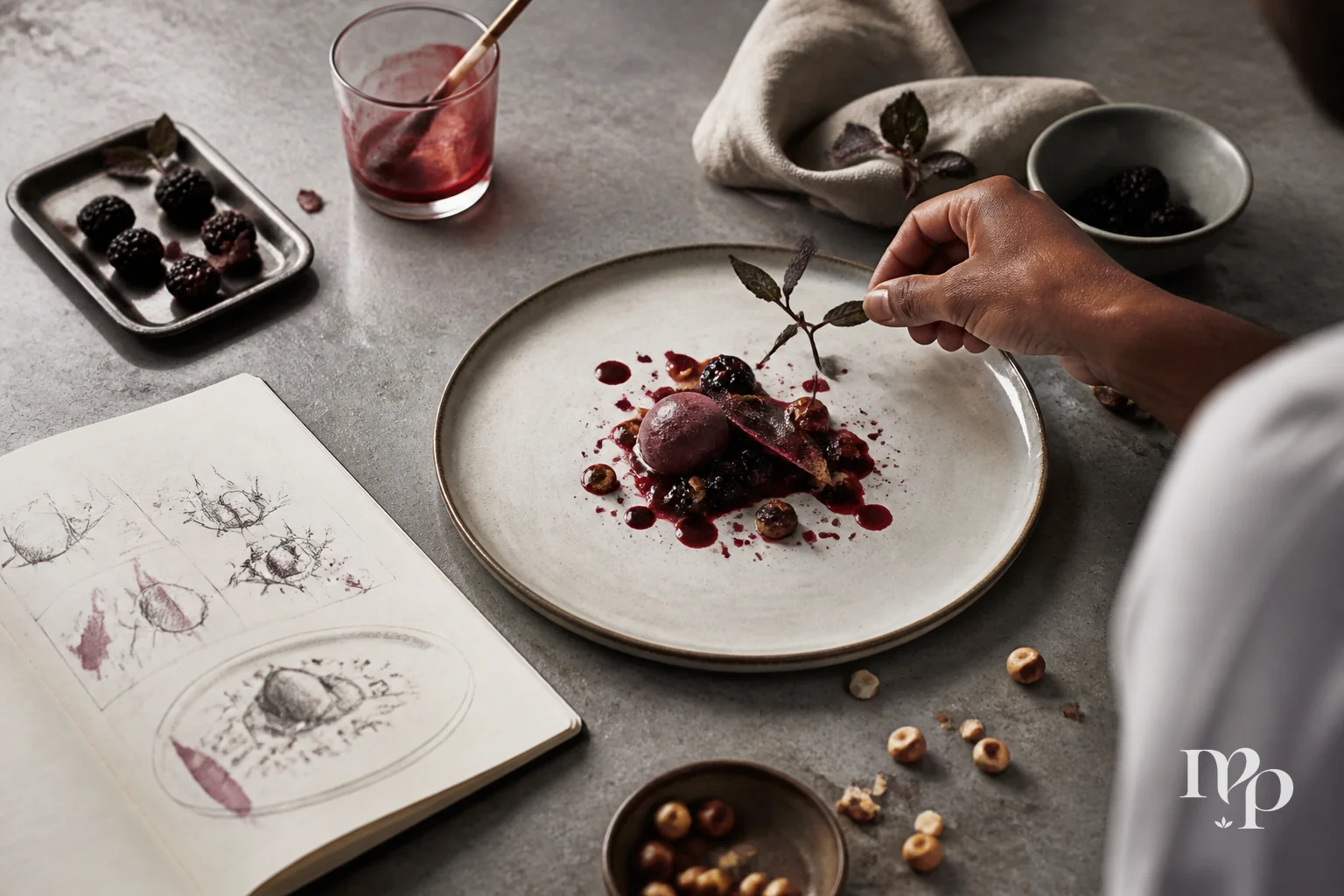
A dessert list can feel crowded long before it becomes long.
Sometimes four choices are too many. Sometimes six feel calm. The difference is not the count by itself. It is whether each dessert carries a different kind of desire, pace, temperature, texture, and finish.
A guest at the end of a meal is not reading the menu with the same energy they brought to the first course. They are deciding whether to stay a little longer, share something, order coffee, mark the evening with one final flavor, or leave cleanly. The last page should make that decision easier, not louder.
The final page needs a rhythm
Dessert menu strategy is often treated as a question of variety. Chocolate, fruit, cream, something frozen, something familiar, something seasonal. That can be useful, but it is not enough.
A stronger question is: what rhythm does the room need at the end?
Some restaurants need a quiet close. Some need a generous shared finish. Some need a bright interruption after a savory, mineral, or heavily sauced meal. A hotel lobby may need desserts that work across many moods and times of day. A tasting menu may need one precise final gesture, not a menu of options.
The dessert list should understand the meal before it. If the savory menu is rich and slow, the last page may need acidity, freshness, and lift. If the restaurant is spare and restrained, a heavy ornamental dessert can feel imported from another room. If the service style is relaxed and communal, a dessert too delicate to share may fight the table.
This is why the number of desserts is never only operational. It is also emotional. Too few choices can feel thin when the room expects generosity. Too many can make the ending feel undecided.
Variety is not the same as clarity
Restaurants often add desserts to cover every possible preference. One chocolate, one fruit, one custard, one frozen, one cake, one gluten free, one nostalgic, one dramatic. The intention is hospitable. The effect can be blur.
Guests do not need every category represented. They need a few clear invitations.
A useful dessert list often has contrast without clutter. One dessert may be deep, bitter, and slow. Another may be bright, cold, and clean. Another may be soft, familiar, and generous. Each one should give the guest a distinct reason to choose it.
If two desserts satisfy the same craving, one of them should probably change or leave. If three desserts rely on creaminess, the list will feel heavy even if the flavors are different. If every plate uses crunch, sauce, garnish, and frozen elements, the menu starts speaking in the same sentence again and again.
Clarity is not austerity. It is editing with care.
We have written before about how a dessert begins with an intentional choice in When a dessert begins as a decision. A dessert list works the same way. It should not be a storage shelf for ideas. It should be a set of decisions the restaurant can stand behind.
What each dessert has to carry
Every dessert on a menu has a job beyond tasting good.
It has to fit the kitchen's rhythm. It has to survive service without losing its shape or meaning. It has to make sense to servers when they describe it. It has to arrive at the table with enough clarity that the guest understands how to begin. It has to feel connected to the restaurant, not borrowed from a pastry case in another city.
That does not mean every dessert has to be serious. Pleasure matters. Familiarity matters. A spoonable dessert can be just as intentional as a composed plate. A slice can carry as much identity as a quenelle when the proportion, texture, and flavor are right.
The issue is not simplicity. The issue is whether the dessert belongs.
For a restaurant with a small menu, three desserts may be enough: one fruit driven, one chocolate or bitter leaning, one soft or shared option. For a cafe, the strategy may depend more on daypart, repeat visits, and display. For a hotel, the dessert language may need range without losing the property's point of view. For events, the last course may need to move beautifully through timing, temperature, and service constraints.
The strongest list is not the one with the most options. It is the one where each option knows why it is there.
Where crowded menus usually go wrong
Crowding often starts with good intentions.
A chef wants to keep a beloved dessert. A manager wants to satisfy regulars. A seasonal ingredient arrives and deserves attention. A new idea feels exciting. A dietary need needs a thoughtful answer. None of these are wrong.
The problem begins when nothing is removed.
Dessert menus become unclear when they collect instead of compose. A seasonal special stays past its season. A signature remains even after the savory menu has changed around it. A dish designed for one service style gets forced into another. Garnishes multiply because the dessert no longer has a strong central idea.
Another common mistake is confusing decoration with range. Five desserts can look different and still eat the same: sweet, soft, creamy, garnished, finished with sauce. The guest experiences repetition even when the plate design changes.
The reverse can also happen. A list may look minimal but feel scattered because each dessert speaks a different language. One rustic, one architectural, one nostalgic, one tropical, one hyper modern. Without a shared sense of proportion and restraint, the menu becomes a collage.
A dessert list should have contrast, but it also needs family resemblance.
Questions before the last page is printed
Before changing a dessert menu, operators can ask a few grounded questions.
What does the guest usually feel by the time dessert is offered: full, curious, celebratory, tired, still hungry, lingering?
Which dessert currently gets ordered because people truly want it, and which one gets ordered because it is the safest option?
Does the list offer different textures, or only different flavors?
Is there enough acidity, bitterness, salt, temperature contrast, or freshness to keep sweetness from flattening the end of the meal?
Can the service team describe each dessert in one clear sentence without sounding like they memorized a script?
Does every dessert still fit the restaurant's current identity, or is one of them attached to an older version of the place?
What can leave without weakening the experience?
That last question is often the most revealing. Removal is not punishment. It is how the remaining desserts get room to speak.
A quieter checklist
A clear dessert menu does not need a complicated framework. It needs honest pressure.
- Each dessert should answer a different guest desire.
- The list should include contrast in texture, temperature, and weight.
- Sweetness should be shaped by acidity, bitterness, salt, spice, fruit, dairy, grain, or fat, not left alone to dominate.
- The menu should make sense after the savory courses, not just beside them on paper.
- At least one dessert should feel easy to share if the restaurant's service style invites that.
- The kitchen should be able to execute each dessert consistently during real service.
- The service team should understand the reason for each dessert.
- Seasonal changes should clarify the list, not simply add to it.
- Decoration should serve the idea.
- If two desserts do the same job, one needs to change.
This kind of editing is not about making dessert smaller. It is about making the last page more legible.
From the studio
In our work, dessert menu strategy often begins before any flavor is named. We look at the room, the menu, the service pace, the guest expectation, and the kind of memory the restaurant wants to leave.
Only then does the pastry conversation sharpen: citrus or chocolate, spoon or slice, plated or shared, warm or cold, restrained or generous.
A dessert worth keeping is not just a good object. It has a place in the whole experience. That idea also sits behind The dessert the menu can keep, where the question is not novelty but endurance.
The last page should not feel like a final inventory. It should feel composed.
A guest may not remember every detail of the dessert list. But they can feel when the ending has been considered. They can feel when the options are calm, distinct, and properly placed. They can feel when the restaurant knows how to let the meal end.
If your dessert menu needs more clarity, Mistoura Pastry works with hospitality teams to shape final courses with intention, restraint, and a stronger sense of place. Begin with Mistoura Pastry.
Studio note
Mistoura Pastry approaches dessert as culinary design. The goal is not more sweetness or more decoration. The goal is a final course with flavor, restraint, and intention.