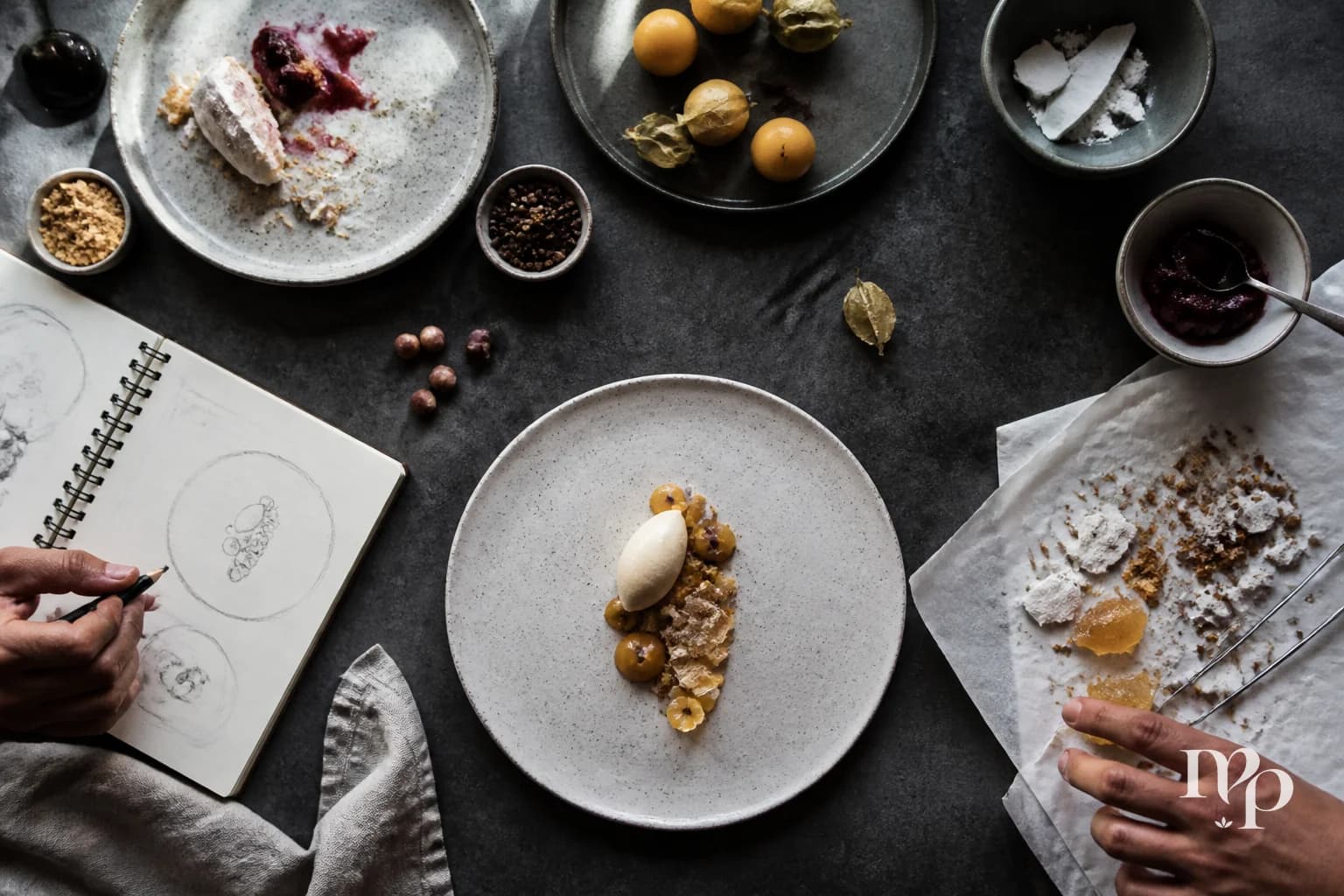
A dessert menu can look polite and still feel lost.
Three choices, five choices, one plated signature, a shared dish, something frozen, something chocolate, something seasonal. On paper, the list seems complete. At the table, it can feel like a collection of good ideas that never agreed to live in the same restaurant.
That is where dessert menu strategy begins. Not with quantity. Not with decoration. With a spine.
A spine gives the menu direction. It decides what the restaurant wants dessert to do at the end of the meal, then edits every option against that purpose.
What the last page is carrying
The dessert menu is often treated as a small appendix to the main menu. A quieter page. A place for familiar comfort. That can work, but only when comfort has been chosen with intention.
For a restaurant, the last page carries more than sweetness. It carries pace, appetite, price sensitivity, staffing realities, kitchen rhythm, guest expectation, and the final memory of the meal. A dessert menu strategy should hold all of that without becoming stiff.
The question is not only what desserts do we like. A better question is what ending belongs here.
A lively room may need desserts that move easily through service and keep the table in conversation. A restrained tasting menu may need a final course with precision and quiet. A neighborhood restaurant may need one dessert guests can return to without fatigue. A hotel dining room may need range, clarity, and service language that works across different guests and times of day.
The menu should know the room before it asks the pastry to perform.
A menu is not a dessert inventory
A common mistake is building the dessert menu by category rather than by experience. One chocolate, one fruit, one cream, one frozen, one safe option. That structure feels sensible, but it can flatten the point of view.
Categories are useful only if they serve the restaurant. A chocolate dessert may be right because the room needs depth and warmth. It may be wrong because the menu already ends heavy. A fruit dessert may feel seasonal, or it may feel thin if the composition has no contrast. A frozen element can bring relief, but it can also slow service if the rest of the plate is fussy.
Dessert menu strategy asks each choice to earn its place.
What texture does it bring? What temperature shift? What kind of sweetness? Does it offer lift after a rich meal, or does it deepen the final course? Does it repeat the same creamy language three times under different names? Does it ask too much of the line at the worst moment of service?
A dessert menu with a spine has difference without randomness. Each dessert has its own role, but the group still speaks one language.
For a related thought on keeping a dessert over time, see The dessert the menu can keep.
The shape of choice
More options do not automatically feel more generous. Sometimes they make the guest work too hard at the end of the meal.
A useful dessert menu might be small if the restaurant has a clear identity and a focused service model. It might be broader if the room serves different occasions at once: business dinners, hotel guests, bar guests, celebrations, late tables. The number is not the strategy. The relationship between the choices is.
One dessert may be familiar but deeply considered. One may express the season. One may carry the restaurant signature. One may be lighter, colder, sharper, or more immediate. If the menu includes a shared dessert, it should be designed for the table, not simply enlarged.
Proportion matters here. A final course can be small and still feel complete if its texture, acidity, and aroma are clear. It can be large and still feel unfinished if everything is soft, sweet, and brown.
We often find that the strongest dessert menus have a clear rhythm: one grounded choice, one bright choice, one distinctive house expression, and enough restraint to avoid overlap.
Where strategy becomes pastry
Strategy should not make dessert abstract. It should make the pastry more precise.
If the restaurant is built around fire, smoke, grain, and bitter leaves, the dessert menu should not suddenly become a sugar showroom. It might work with roasted fruit, toasted cream, buckwheat, cacao nib, citrus peel, coffee, herbs, or fermented notes. If the restaurant has coastal energy, the final course may need salt, acidity, freshness, and a lighter hand with fat.
This does not mean forcing savory ideas into dessert. It means keeping continuity.
Texture is one of the cleanest ways to do that. A menu with too many mousses, creams, and soft cakes becomes sleepy. A menu with crunch, chew, cold, warmth, melt, and snap has movement. Contrast lets sweetness stay in proportion.
Seasonality also needs judgment. A seasonal dessert should taste like the ingredient, not like a calendar announcement. Pear should still taste like pear. Citrus should cut through, not disappear under sugar. Spice should support, not announce itself from across the room.
Decoration comes last. If a garnish does not clarify flavor, guide the spoon, shape the bite, or support the restaurant language, it may be noise.
Mistakes that make the last page weaker
The first mistake is treating dessert as a rescue mission for ingredients left over from another part of the menu. Resourcefulness is valuable. A final course built from leftovers rarely feels intentional unless it has been designed from the beginning.
The second is copying a dessert language from somewhere else because it looks current. Guests may not name the imitation, but they can feel when a restaurant changes costume at dessert.
The third is making every dessert rich in the same way. Chocolate, caramel, cream, custard, and pastry can be beautiful, but if they all land with the same weight, the menu has no air.
The fourth is ignoring service. A dessert that collapses under real timing is not a better dessert because it looked refined in development. It has to live through pickup, conversation, delay, and the movement of a dining room.
The fifth is asking the menu description to do work the dessert cannot do. If the language promises nuance, the plate needs nuance. If the plate is simple, let the description be simple too.
Questions before the final course is changed
Before changing the dessert menu, restaurant owners and operators can ask a few grounded questions:
- What should the guest feel at the end of this meal: comfort, lift, surprise, calm, generosity, clarity?
- Which dessert currently feels most like the restaurant, and why?
- Which dessert sells because it is familiar, and which one belongs because it is distinctive?
- Are the textures across the menu too similar?
- Is sweetness doing all the work, or are acidity, bitterness, salt, temperature, and aroma helping?
- Can the kitchen execute the menu with consistency during the hardest part of service?
- Does the dessert language match the dining room, the staff, and the rest of the meal?
These questions keep strategy close to hospitality. The goal is not to make dessert complicated. It is to make the final page more honest.
For restaurants thinking through purpose before form, A final course with a clear reason sits close to this conversation.
A quieter checklist
A dessert menu with a spine usually has:
- A clear reason for the number of desserts offered
- Distinct roles for each option
- Contrast in texture, temperature, and weight
- Sweetness held in balance with acidity, bitterness, salt, or fruit character
- Seasonal expression without trend chasing
- Descriptions that are clear rather than inflated
- Service steps the team can repeat with care
- At least one dessert that could only belong to this restaurant
This checklist is simple on purpose. Dessert strategy should sharpen decisions, not bury them.
From the studio
Studio note: In our work, we often begin by removing before adding. Fewer components. Fewer gestures. Fewer borrowed ideas. Once the noise drops, the restaurant's own dessert language becomes easier to hear.
That language may be quiet. It may be playful. It may be spare, generous, mineral, floral, bitter, creamy, bright, or deeply nostalgic. What matters is that it belongs.
A dessert menu does not need to impress every guest in the same way. It needs to carry the end of the meal with confidence and care.
The strongest last page feels inevitable after the savory menu, but not predictable. It gives the table somewhere to land.
If your restaurant is rethinking the final course, Mistoura Pastry develops dessert language, signature desserts, and menu strategy with restraint and intention. Begin with Mistoura Pastry.