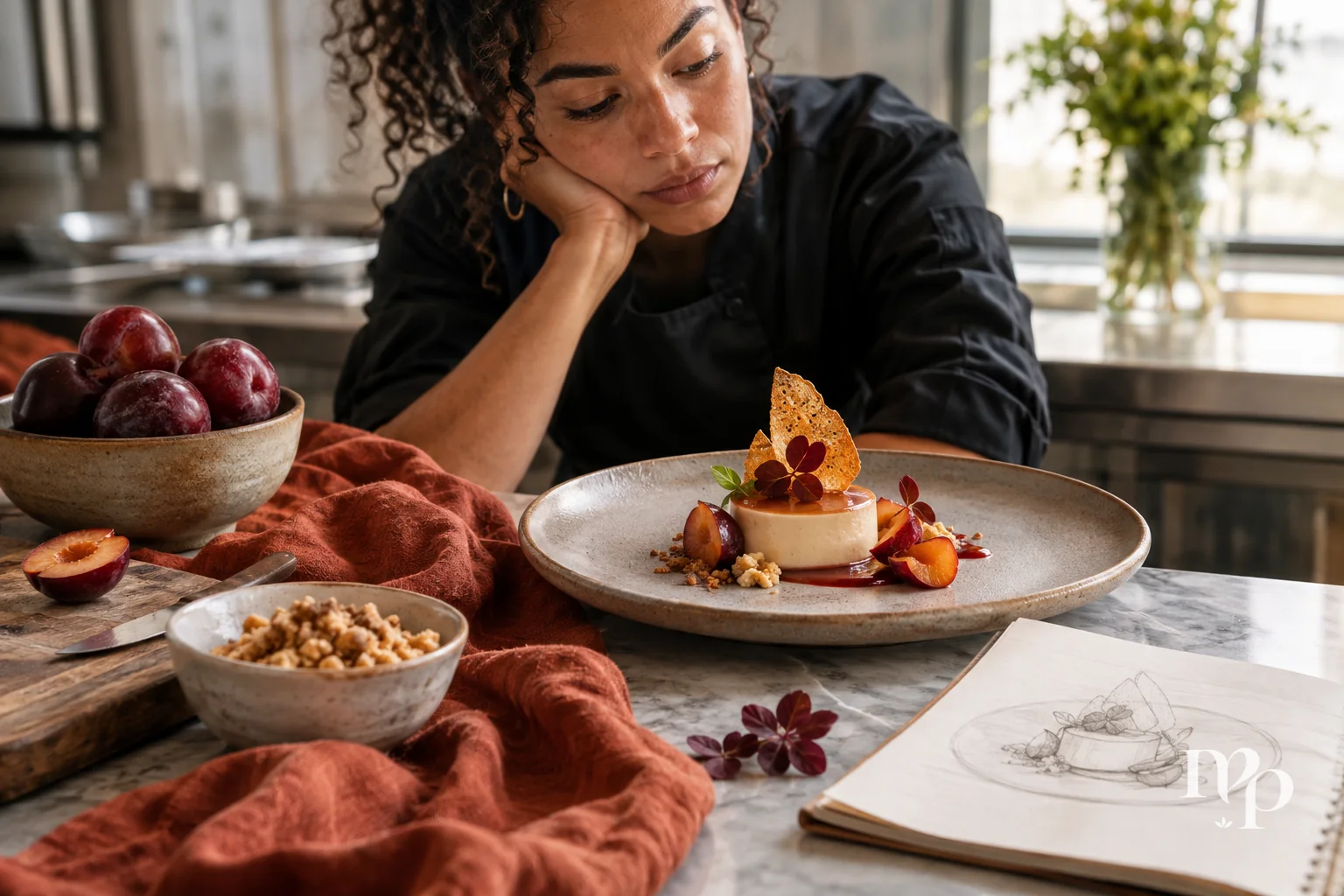
A dessert menu can look beautiful on paper and still fail in the room.
Not because the ideas are weak. Because they ask the kitchen for the wrong kind of attention at the wrong time. Because they slow the table when the room needs movement. Because they speak in a different voice than the rest of the meal.
Dessert menu strategy is not about adding more choices. It is about making the final course feel considered, possible, and unmistakably part of the house.
The last page still belongs to the restaurant
The dessert menu should not arrive like a separate business has entered the dining room.
If the savory menu is spare, seasonal, and direct, the dessert list cannot suddenly become theatrical without a reason. If the restaurant is generous and relaxed, dessert should not become stiff. If the room is quiet and edited, decoration has to work harder to earn its place.
A useful dessert menu carries the restaurant’s voice into the final course. Not by copying savory dishes, but by understanding the same rhythm. The same level of detail. The same appetite for restraint or abundance.
We often find that the strongest dessert menus are not the ones with the most range. They are the ones where every choice seems to belong to the same room.
That idea sits close to The house before the dessert: before a dessert can be memorable, the restaurant itself has to be understood.
Where service begins to shape flavor
A dessert can be technically beautiful and still be wrong for service.
Maybe it takes too long to plate. Maybe one element softens before the server reaches the table. Maybe the portion is too rich after a long tasting menu. Maybe the dish needs a speech when the guest only has room for a spoon.
These are not small issues. They change how flavor is received.
A crisp element that arrives tired does not read as contrast. A chilled cream that warms too quickly loses its line. A sauce poured at the table can feel generous, but only if service has the time and confidence to make the gesture calm.
Dessert menu strategy has to include the path from station to table. Not as an operational afterthought, but as part of composition. Temperature, texture, plate weight, garnish timing, cutlery, server language, and table pace all affect the final memory.
The menu is not finished when the dish is written. It is finished when the guest can receive it without friction.
Fewer choices can carry more intention
Many restaurant dessert menus become crowded because nobody wants to disappoint anyone.
There is chocolate for safety, citrus for brightness, fruit for seasonality, something frozen, something warm, something familiar, something dramatic, something gluten free, something to share. The intention is generous. The result can feel scattered.
A smaller menu is not automatically better. A thin menu with no point of view is just a thin menu. But fewer choices can give each dessert more responsibility.
One dish might offer comfort with structure: warm fruit, clean acidity, a crisp edge, restrained sweetness. Another might carry depth: cocoa, roasted notes, salt, a texture that lingers. Another might be quiet and fresh: cream, citrus, herb, cold fruit, or something floral without becoming perfume.
The point is not to cover every craving. The point is to create enough contrast that guests can choose by appetite, mood, and pace.
A dessert menu should know what kind of evening it is helping to end.
The mistakes that make dessert feel detached
The most common mistake is treating dessert as a collection of favorites instead of a designed ending.
A chef likes one dish. An owner wants a familiar seller. A manager asks for something easier to explain. A pastry idea gets added because it looks good in a photograph. Each decision may make sense alone. Together, they can produce a menu with no center.
Another mistake is confusing decoration with identity. A tuile, flower, quenelle, or dusting does not make a dessert specific. If the garnish can move to another plate without changing the idea, it may be noise.
Sweetness is another place where menus lose clarity. More sugar can flatten fruit, soften acidity, and hide the grain or dairy that should be speaking. Less sugar is not a virtue by itself, but restraint often lets the ingredient keep its shape.
And then there is the operational mistake: building desserts that only work when one person plates them. A restaurant dessert needs standards. It also needs tolerance. The design should survive real service without becoming dull.
Questions before the menu changes
Before changing a dessert menu, a restaurant can ask a few direct questions.
What does the guest usually feel by the time dessert is offered: curious, full, celebratory, tired, lingering?
How many tables are likely to order dessert at the same time, and what does that do to plating?
Which ingredients feel natural to the restaurant’s place, season, and voice without becoming predictable?
Where does the menu need contrast: temperature, texture, acidity, bitterness, creaminess, crunch, lightness?
Which dessert could become part of the restaurant’s memory, not because it is loud, but because it is clear?
What should the server be able to say in one sentence?
That last question matters. If a dessert cannot be explained simply, it may be overbuilt, or it may not yet know what it is.
A quieter checklist
A working dessert menu does not need to be complicated. It needs to be honest about the room it serves.
Check the balance of appetite. Not every dessert should be heavy, chilled, creamy, or chocolate led.
Check the rhythm of service. If three dishes require the same last minute attention, the menu may be asking for trouble.
Check the texture map. Soft with soft becomes fatigue. Crunch without purpose becomes decoration.
Check the language. Dessert names should give guests enough clarity without draining the dish of interest.
Check the portion. The last course should feel complete, not punishing.
Check the relationship to the rest of the meal. Dessert should not imitate the savory menu, but it should understand where it has arrived.
Check the memory. After the table leaves, what does the final course leave behind: warmth, brightness, surprise, calm, pleasure, relief?
From the studio
In our work, dessert menu strategy often begins with subtraction.
Not because restraint is more sophisticated by default. Because subtraction reveals what the restaurant is actually trying to say. When the excess is removed, the remaining choices have to carry flavor, service, identity, and memory with more precision.
That is where the work becomes interesting. A dessert menu is small, but it holds a great deal: the kitchen’s rhythm, the dining room’s mood, the guest’s appetite, the owner’s taste, the season’s materials, the last impression of the meal.
For restaurants thinking about a more distinct final course, A final course in the restaurant's voice is a useful companion piece.
The strongest dessert menu does not need to announce itself. It simply feels like it could not belong anywhere else.
If your restaurant, cafe, hotel, or hospitality project needs a dessert language built with that kind of intention, Mistoura Pastry works quietly at that intersection of flavor, service, and memory. Begin with the studio.
Studio note
Mistoura Pastry approaches dessert as culinary design. The goal is not more sweetness or more decoration. The goal is a final course with flavor, restraint, and intention.