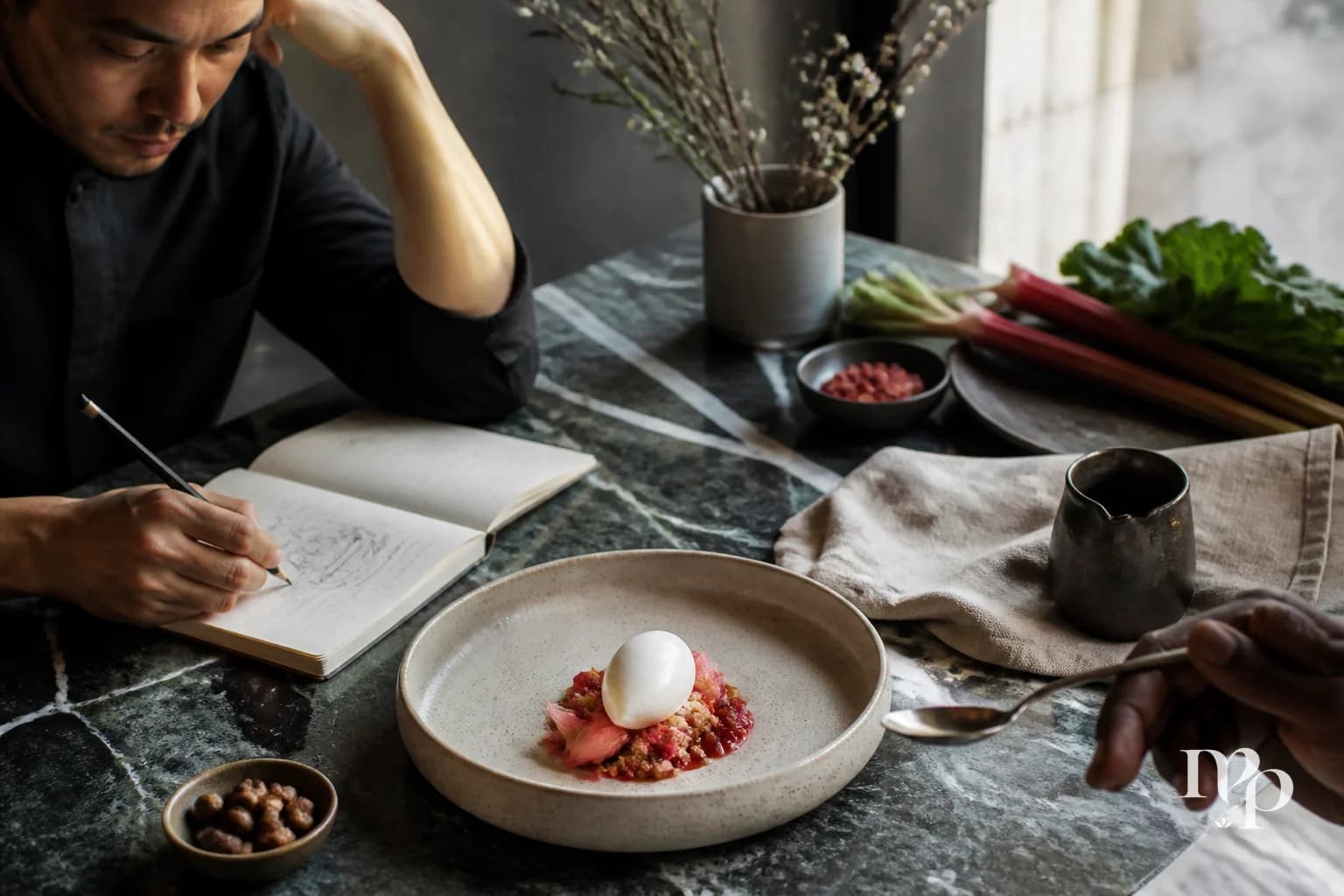
A dessert can be technically correct and still feel borrowed.
The plate arrives with clean lines, polished technique, a careful garnish. Nothing is wrong. Still, it could belong to almost any dining room. That is usually where signature dessert development begins, not with a pastry idea, but with the slightly harder question of belonging.
A restaurant dessert does not become memorable because it is louder than the meal before it. It becomes memorable when it understands what the meal has been saying all along.
What the room has already said
Before we think about mousse, fruit, pastry, cream, crunch, temperature, or shape, we look at the restaurant itself.
What kind of appetite does the menu create? Is the cooking generous and direct, or quiet and exact? Does the dining room move quickly, or does it ask people to stay? Are guests ending with wine, coffee, tea, conversation, or a second look at the menu because they are not ready to leave?
These details change the dessert.
A final course for a long, layered dinner may need relief more than richness. A dessert after grilled seafood may need mineral brightness and clean acidity. A cafe with a strong coffee rhythm may need something that respects bitterness instead of burying it under sugar. A hotel restaurant may need a dessert that feels composed enough for dinner but legible enough for room service or late seating.
The strongest signature dessert is not simply the chef's favorite idea. It is the one that can stand inside the restaurant's rhythm without asking the room to become something else.
For a wider frame on this, we often return to the idea that every restaurant needs its own dessert language. That language is not decoration. It is how flavor, portion, texture, service, and memory speak together. See Why every restaurant needs its own dessert language.
The dessert has to enter at the right volume
Dessert is the last interruption of the meal. That gives it power, but it also gives it responsibility.
If it is too heavy, it can flatten the table. If it is too sweet, it can erase the detail that came before. If it is too delicate, it may disappear before the guest understands why it was there. Signature dessert development is partly an exercise in volume control.
Sweetness is one dial. Texture is another. Temperature, portion, aroma, bitterness, acidity, salt, and fat all change how the final course feels in the body. A dessert can be restrained and still generous. It can be small and still complete. It can feel abundant because the contrasts are clear, not because the plate is crowded.
What matters is not whether the dessert looks impressive in isolation. It has to arrive at the table at the right moment, with the right amount of presence.
Choices that make the idea legible
A good restaurant dessert often begins with one clear decision.
Maybe the anchor is an ingredient: roasted pineapple, coffee, sesame, citrus, cacao, sweet potato, fig, cultured cream. Maybe it is a texture: brittle, custard, ice, sponge, cooked fruit, folded cream. Maybe it is a mood: clean, smoky, bitter, bright, quiet, celebratory, spare.
Once that decision is made, the rest of the plate should help the guest read it.
If coffee is the point, not every element needs to shout coffee. One part may carry bitterness, another may soften it with cream, another may sharpen it with citrus or spice. If fruit is the point, the dessert should let the fruit taste like itself. If chocolate is the point, the work may be in choosing restraint, not adding another chocolate component because the plate feels empty.
Composition is not the same as addition. More elements do not automatically create more interest. Often, they make the dessert harder to remember.
A useful test is simple: if one element left the plate, would the idea become clearer or weaker?
Where the plate starts to drift
The most common mistake is beginning with appearance.
A dessert that starts with a shape, a garnish, or a dramatic reveal can still succeed, but only if the idea underneath is strong. Without that, the plate becomes a set of gestures. It may photograph well. It may even impress for a second. But the guest remembers the decoration, not the dessert.
Another mistake is mistaking complexity for identity. A restaurant does not need a final course with nine components just to prove care. It needs a dessert with proportion. A crisp element should have a reason. A sauce should change the bite. A garnish should belong to the flavor, not hover over it like a costume.
Service is another quiet place where good ideas fail. A dessert may work in a tasting, then struggle on a busy Saturday night. It may need a frozen element that softens too quickly, a fragile garnish that breaks under pressure, or plating steps that only one person can execute well.
A signature dessert has to survive contact with service. That does not mean it should be dull. It means the design should respect the people carrying it.
For restaurants considering a named or central dessert, How to design a signature dessert that belongs to the restaurant looks more closely at how a dessert earns that role.
Questions before the tasting
Before moving into samples, a few questions can save a lot of wandering.
What should the guest feel after the last bite: refreshed, settled, surprised, comforted, sharpened, slowed down?
What flavors have already appeared across the menu, and which ones should dessert avoid repeating?
Is there an ingredient, origin, season, or technique that feels natural to the restaurant rather than imported for effect?
How much appetite does the average guest realistically have by the time dessert is offered?
Can the service team describe the dessert in one clear sentence without sounding rehearsed?
Will the dessert still make sense six months from now, or is it depending on a passing visual idea?
These questions are not meant to make the process rigid. They protect the dessert from becoming generic.
A quieter checklist
A signature dessert should have a clear anchor.
It should make sense after the savory menu, not apart from it.
It should use sweetness with intention, not as the only source of pleasure.
It should offer contrast in texture, temperature, or acidity without crowding the plate.
It should be possible for the kitchen to execute consistently during real service.
It should give the service team language that feels natural.
It should leave a memory that belongs to the restaurant, not just to the pastry case.
If these pieces are missing, the dessert may still be pleasant. It may not yet be yours.
From the studio
In our work, we often find that the strongest dessert direction is quieter than the first idea.
The first sketch may be expressive, but development asks for editing. Less sugar so the ingredient can speak. Fewer components so the structure becomes clear. A sharper contrast so the final bite has movement. A smaller portion so the guest leaves with pleasure rather than fatigue.
Mistoura Pastry approaches signature dessert development as culinary design. That means the plate is considered, but so are the menu, the room, the guest, the service path, and the final memory of the meal.
The goal is not a dessert that announces itself as special. The goal is a dessert that could not have arrived anywhere else with the same meaning.
The last taste should feel placed
A restaurant dessert does not need to explain the whole house. It needs to hold one true part of it.
When the final course belongs, it changes the end of the meal. Not by making it bigger, but by making it more precise. The guest may not name every decision. They may only feel that the last bite landed in the right place.
That is enough.
If your restaurant, hotel, cafe, or hospitality team is developing a dessert that needs to feel specific to the room, Mistoura Pastry can help shape the final course with intention.
Studio note
Mistoura Pastry approaches dessert as culinary design. The goal is not more sweetness or more decoration. The goal is a final course with flavor, restraint, and intention.