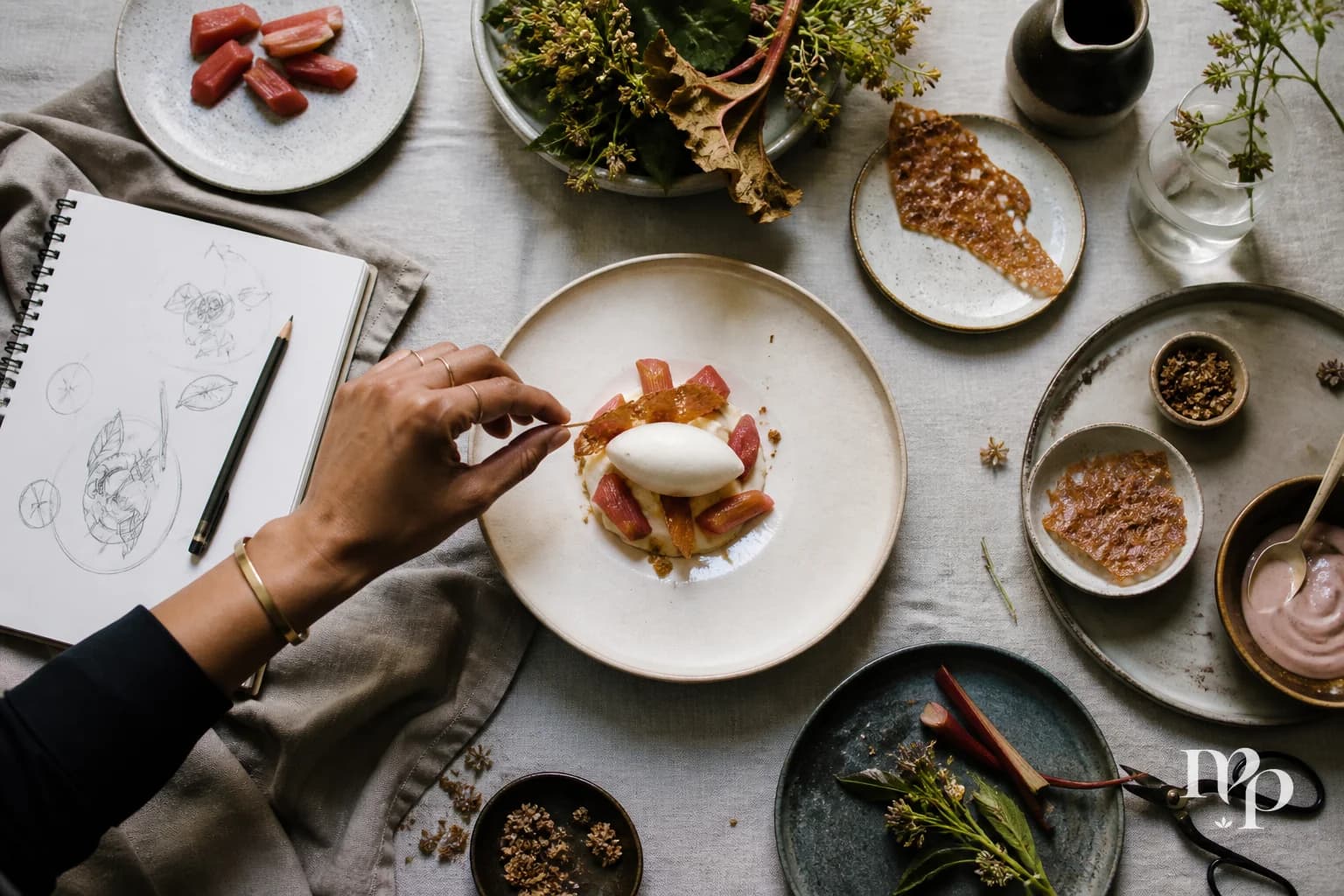
The first version of a signature dessert is rarely a flavor. It is usually a set of limits.
The room is loud or quiet. The menu is generous or spare. Service is fast, theatrical, intimate, stretched, or tightly timed. Guests arrive at the final course full, curious, distracted, celebratory, or ready to leave. A dessert that ignores those conditions may look complete in a photograph and still feel wrong at the table.
Signature dessert development is not the search for the most elaborate idea. It is the work of finding the dessert that can belong to a restaurant without asking the restaurant to become something else.
The shape the room allows
A final course has to understand where it is being served.
In a small restaurant with a quiet rhythm, the strongest dessert may need restraint. A warm fruit component, a crisp edge, a cream with acidity, a bitter note that keeps the sweetness awake. In a hotel dining room, the dessert may need to travel across a larger service system without losing its intention. At an event, it may need clarity at scale, with enough structure to survive timing and movement.
These are not creative restrictions in the weak sense. They are the material of the design.
A signature dessert that belongs to the room should feel specific without becoming difficult. It should carry the restaurant's identity through flavor, texture, proportion, and service, not through decoration placed on top at the end. For a deeper look at that relationship, we often return to How to design a signature dessert that belongs to the restaurant.
Constraints are part of the flavor
A useful dessert brief does not begin with, what can we make that will impress people? It begins with quieter questions.
How sweet can the final course be after this menu? What temperature feels welcome after the last savory dish? Should the guest leave with brightness, comfort, bitterness, fragrance, creaminess, or snap? Is the restaurant asking for something generous and familiar, or something more edited and architectural?
The answers shape the dessert before a sketch appears.
Less sugar may let fruit taste more like fruit. A smaller portion may make richness more graceful. A single crisp element may do more work than four decorative fragments. A sauce may be better when it connects two textures instead of filling empty space on the plate.
What people often get wrong is treating constraints as the unglamorous part of pastry design. In practice, they are where the dessert gains precision. Without them, the final course can become a collection of attractive gestures with no center.
Where the dessert starts to drift
A signature dessert usually loses its way in one of three places.
It tries to say too much. The plate gathers many elements because each one seems interesting on its own. But interest does not automatically become composition. If the guest has to work through mousse, crumble, gel, foam, tuile, ice cream, sauce, powder, and garnish before understanding the point, the dessert may be decorated rather than composed.
It borrows a language the restaurant does not speak. A rustic, ingredient-led dining room does not always need a highly technical architectural plate. A polished, tightly edited menu may not be served by a dessert that feels casual in the wrong way. Contrast can be beautiful, but contradiction without intention feels imported.
It forgets service. A dessert can taste considered in development and collapse during a busy evening if it needs too many last minute motions, too much freezing, too much fragile handling, or too much explanation. The kitchen and floor team are part of the design environment, not obstacles to it.
Texture is often where these issues become visible. If the dessert depends on contrast, that contrast has to survive the path from pass to table. We have written more about that in When texture carries the final course.
Questions for the final course
Before developing a signature dessert, a restaurant owner, chef, or hospitality team can ask:
- What should the guest remember after the last spoonful?
- What part of the restaurant's identity has not yet appeared in dessert?
- Does the final course need to calm the meal, sharpen it, or give it warmth?
- Which ingredients make sense for the season, the kitchen, and the menu's rhythm?
- How much sweetness can the meal honestly carry?
- What textures are missing from the rest of the experience?
- Can service execute the dessert consistently on a full night?
- Does the dessert need explanation, or can the first bite do enough work?
These questions are not meant to make dessert cautious. They are meant to make it intentional.
A quieter checklist
A signature dessert is ready to move forward when it can answer a few simple tests:
- The main ingredient still tastes like itself.
- The sweetness has a reason, not just volume.
- Each texture changes the bite in a clear way.
- The portion respects the appetite at the end of the meal.
- The garnish is part of the idea, not a decoration habit.
- The plate can be executed within the real service rhythm.
- The dessert sounds natural when described by the team.
- The restaurant could stand behind it for more than one season, even if details shift.
The strongest versions often feel calm. Not plain. Not safe. Calm because the decisions have been made.
From the studio
In our work, we often find that the most useful development conversation happens before flavor trials begin. It is the conversation about the room, the guests, the kitchen, the pace of service, and the kind of memory the restaurant wants to leave.
That memory does not have to be loud. It may be a clean bitter finish, a spoon through cold cream and warm fruit, the crack of something thin and toasted, or a final note of citrus that makes the meal feel complete rather than heavy.
The signature dessert is not freer because it ignores limits. It becomes more itself when the limits are understood, edited, and used.
If your restaurant is ready to shape a final course with more intention, Mistoura Pastry works with hospitality teams on dessert identity, signature dessert development, and menu direction. Begin quietly with Mistoura Pastry.
Studio note
Mistoura Pastry approaches dessert as culinary design. The goal is not more sweetness or more decoration. The goal is a final course with flavor, restraint, and intention.