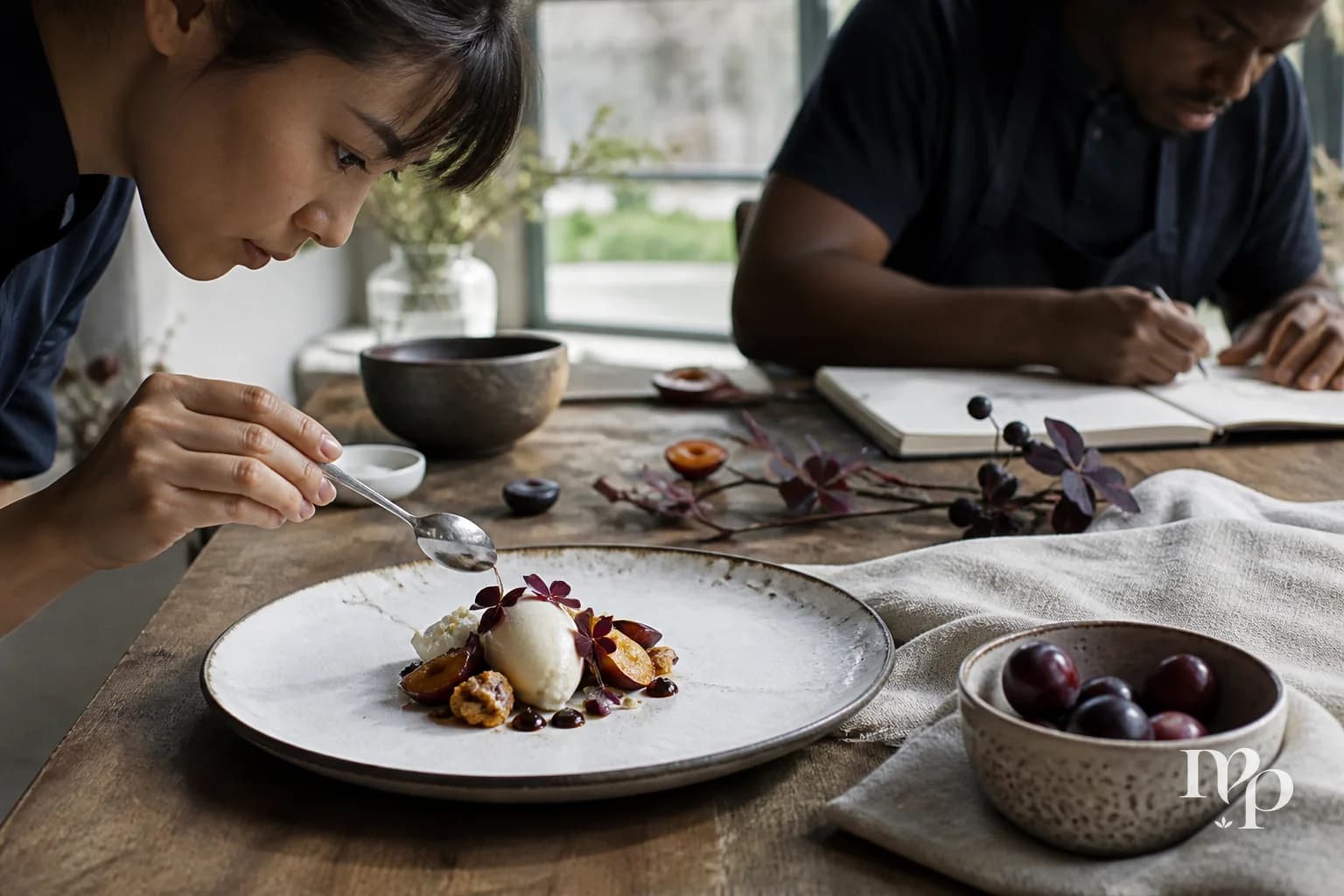
A dessert can look finished long before it is ready for the room. The plate may be balanced, the garnish may be precise, the name may sound right. Still, something can feel borrowed.
That is where signature dessert development begins for a restaurant. Not with a dramatic shape. Not with a rare ingredient. Not with a garnish that photographs well. It begins with a more demanding question: what does this dessert need to hold for the house?
A final course carries appetite, timing, service, identity, and the guest's last clear taste of the meal. If it carries only decoration, it collapses quickly.
The room arrives before the pastry
A restaurant dessert is not developed in isolation. It enters a room already full of cues: the lighting, the pace of the meal, the weight of the plates, the way servers speak, the kind of hunger guests still have after the savory courses.
A dessert for a quiet tasting menu cannot behave like a dessert for a lively dining room with fast table turns. A hotel lobby dessert has different work to do than a final course in a small restaurant where the chef's point of view is felt in every dish.
In our work, we often find that the strongest dessert idea is not the loudest one. It is the one that understands where it will be served. It respects the kitchen. It respects the guest's appetite. It gives service something clear to say without making the explanation longer than the pleasure.
For a broader frame on belonging, see How to design a signature dessert that belongs to the restaurant.
One flavor idea is usually enough
A signature dessert does not need to prove range by carrying every technique in the kitchen. More elements do not automatically create more interest. Often they create fog.
A useful starting point is one flavor idea with enough depth to develop. Citrus and olive oil. Roasted pineapple and smoke. Chocolate and coffee with bitterness kept in check. Millet, caramel, and cultured cream. The pairing can be familiar or unexpected, but it needs a center of gravity.
From there, the work becomes proportion. How much acidity keeps the spoon awake? Where does cream soften the edge? Does crunch arrive early, or does it appear after the first bite? Should the dessert finish warm, cool, clean, or lingering?
Sweetness should carry flavor, not cover uncertainty. When sugar is reduced with intention, fruit can taste more like fruit, chocolate can show its edges, dairy can feel more alive, and spice can speak without shouting. The question is not whether a dessert is sweet. It is whether sweetness has been given a job.
If texture is the real carrier of the idea, When texture carries the final course is a useful companion.
Where strong ideas get crowded
The most common mistake in signature dessert development is starting with the visual ending. A sketch can help, but decoration should not become the concept. A beautiful plate with no internal logic feels thin once the spoon enters it.
Another mistake is naming too early. Once a dessert is called the house pavlova, the mango cloud, or the chocolate garden, the name starts making decisions before the flavor has earned them. The better order is usually taste, structure, service, then language.
There is also the problem of reference overload. A dessert can honor a place, ingredient, memory, or cultural thread without trying to carry an entire biography on the plate. Specificity is generous. Compression is not the same as erasure. What matters is choosing one clear expression and treating it with care.
The last mistake is ignoring service until the end. If a dessert cannot be plated consistently, explained calmly, held briefly when the room shifts, or eaten at the right temperature, the idea may be stronger on paper than at the table.
Questions before the spoon reaches the table
Before developing a signature dessert, restaurant owners and operators can ask:
- What should the guest remember after the last bite?
- Does the dessert continue the meal, or does it suddenly change the language?
- Is the appetite at this point generous, tired, curious, or nearly finished?
- Can the kitchen execute the dessert during its hardest service, not only during testing?
- What does the server need to understand in one sentence?
- Which ingredient is allowed to lead?
- What should be removed before another element is added?
These questions are not meant to make the dessert smaller. They make it more exact.
A quieter checklist
A restaurant dessert built to last usually has a few things in place:
- A clear flavor center
- A reason for every texture
- Sweetness that supports the ingredient
- A form that suits the room
- A plating rhythm the kitchen can repeat
- A service note that feels natural
- A portion that respects the appetite
- A name that arrives after the idea is clear
- Enough restraint to be remembered cleanly
The checklist is simple because the work is not about adding more. It is about choosing better.
From the studio
At Mistoura Pastry, we do not think of signature dessert development as making a restaurant's most elaborate plate. We think of it as designing the final course the house can stand behind.
Our perspective is shaped by more than one pastry language, including Togo, France, and the United States. That does not mean mixing references for effect. It means paying close attention to origin, technique, memory, and restraint. An ingredient should still taste like itself. A gesture should have a reason. A dessert should know when to stop.
The strongest signature dessert may be quiet at first glance. Then the spoon moves through it, and the structure becomes clear: acidity against cream, crispness against softness, warmth against coolness, a final note that stays without becoming heavy.
The last taste should feel considered
A restaurant does not need a famous dessert. It needs a dessert that belongs so clearly to the room that another restaurant serving it would feel slightly wrong.
That kind of dessert is built through decisions, not decoration. It holds the meal without repeating it. It gives the guest a final taste with shape, restraint, and memory.
If your restaurant, cafe, hotel, or hospitality project is thinking through a signature dessert, Mistoura Pastry can help shape the idea with care. Visit Mistoura Pastry.
Studio note
Mistoura Pastry approaches dessert as culinary design. The goal is not more sweetness or more decoration. The goal is a final course with flavor, restraint, and intention.