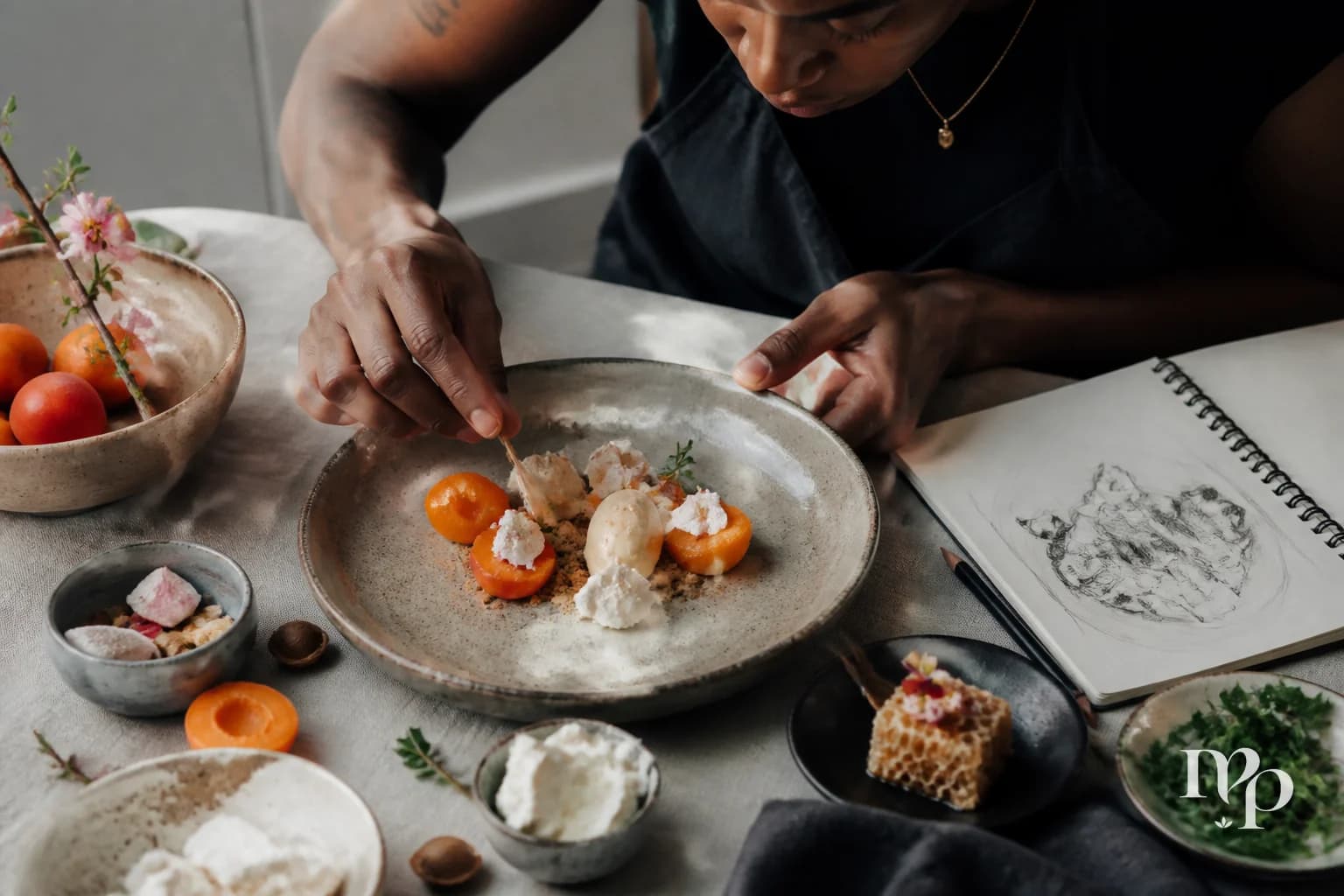
A restaurant often asks for a signature dessert at the exact moment when it should slow down.
The impulse is understandable. The menu has found its shape. The room has a rhythm. Guests remember the savory dishes, the wine, the service. Now the final course needs something more distinct than a familiar tart or a safe chocolate plate.
But commissioning a dessert is not the same as ordering a dramatic ending. The strongest work begins before flavor sketches, before plate drawings, before anyone decides whether there should be a quenelle, a crisp, a sauce, or a garnish.
It begins with what the restaurant can carry with clarity.
The dessert has to inherit the meal
A commissioned restaurant dessert is not a standalone object. It arrives after salt, fat, acidity, heat, conversation, pacing, and often a few small decisions made by the guest without thinking. Another glass. Bread. A shared starter. The dessert enters a body and a table that are already full of information.
That changes the design brief.
A dessert for a short cafe menu may need generosity and directness. A dessert after a long tasting menu may need restraint, freshness, and a clean finish. A hotel dessert may need to survive different service moments without losing composure. An event dessert may need to read quickly, hold well, and still feel considered.
What people often get wrong is treating signature dessert development as a search for novelty. Novelty can attract attention, but it does not automatically create memory. A dessert becomes memorable when flavor, texture, proportion, and service all seem to belong to the same thought.
For restaurants shaping that larger language, our earlier journal piece Why every restaurant needs its own dessert language sits close to this conversation.
Before flavor, settle the room
Before we ask what the dessert should taste like, we often ask what kind of room it will enter.
Is the restaurant quiet or charged? Does the menu move with precision or looseness? Are the plates spare, abundant, architectural, rustic, playful, severe? Does service have time to explain the final course, or should the dessert speak almost immediately?
These questions are not decorative. They shape the work.
A dessert with too much explanation can feel heavy in a room built on ease. A fragile construction can punish a service team during a busy turn. A soft, subtle flavor can disappear after an assertive savory menu. A large portion can flatten the last ten minutes of hospitality, leaving the guest impressed but tired.
The final course should not fight the restaurant for attention. It should gather what the restaurant has already promised and make that promise edible one last time.
The choices that do the quiet work
Once the room is understood, the design can become more precise.
Flavor comes first, but not as a list of appealing ingredients. It needs direction. Bitter against cream. Fruit against toasted grain. Cold against warmth. Acidity against a slow, rounded sweetness. The ingredient should still taste like itself. If citrus becomes only perfume, chocolate becomes only weight, or spice becomes only signal, the dessert loses honesty.
Texture gives the spoon a reason to continue. A smooth custard may need a brittle edge. A frozen element may need something tender or airy beside it. A cake may need moisture, but not so much that it loses structure. Texture is where appetite is protected. Without contrast, sweetness can feel longer than it is.
Proportion decides whether the dessert feels generous or exhausting. Not every component deserves equal volume. The strongest element may need less space, not more. A sauce can guide the plate without flooding it. A crisp can sharpen the experience without turning the dessert into noise.
Service is part of the design, not a later inconvenience. How many moves does the pickup require? What holds? What must be finished at the last second? Can the plate survive the walk from pass to table? Can the team describe it in one clear sentence without sounding rehearsed?
A beautiful dessert that collapses under normal service is not refined. It is unresolved.
Where commissioned desserts go wrong
The easiest mistake is adding too much meaning. A restaurant wants the dessert to express place, season, memory, technique, personality, and surprise. Soon the plate is carrying more explanation than pleasure.
Another mistake is confusing decoration with composition. A flower, shard, dust, or line of sauce can be useful when it changes the way the dessert is eaten or understood. If it only proves that someone decorated the plate, it becomes a distraction.
Sugar can also cover weak thinking. More sweetness may make a dessert immediately pleasant, but it can blur the ingredient and tire the guest. Less sugar is not a virtue by itself. The question is whether sweetness is being used with enough restraint to let flavor come forward.
Then there is the novelty trap. Smoke, surprise centers, unusual shapes, and rare ingredients can all have a place. But if the restaurant would not still believe in the dessert without the trick, the idea is too thin.
A commissioned dessert should not need to shout that it was commissioned.
Questions worth asking at the beginning
Before a restaurant begins signature dessert development, a few questions can save time and protect the final result.
What should the guest feel at the end of the meal: refreshed, comforted, sharpened, slowed down, amused, grounded?
Where does the dessert sit in the menu: as one option among several, the clear final gesture, a shareable plate, a tasting menu finish, or a banquet service piece?
What flavors already dominate the meal, and what would feel like relief after them?
What textures are missing from the broader menu?
How much explanation will the service team realistically give?
Which ingredients, techniques, or visual gestures already belong to the restaurant, and which would feel imported?
What cannot be compromised during a full service?
These questions are not meant to make the dessert cautious. They give the work edges. Within clear limits, a dessert can become more distinctive, not less.
For a related look at ownership and fit, see How to design a signature dessert that belongs to the restaurant.
A quieter checklist before development
A useful starting brief can be simple:
- Name the role of the dessert in the meal.
- Define the desired final memory in one sentence.
- Identify the service constraints before sketching the plate.
- Choose one primary flavor direction, not five.
- Decide what texture contrast will carry the spoon.
- Set a portion that respects appetite.
- Remove any decoration that does not affect taste, texture, rhythm, or meaning.
- Test the dessert in the conditions where it will actually be served.
The tradeoff is real. A dessert designed around service may lose a little theatrical freedom. A dessert designed around identity may reject a few fashionable gestures. A dessert designed around appetite may look quieter than expected.
That restraint is not a lack of ambition. It is often where the work becomes more exact.
From the studio
At Mistoura, we think of commissioned dessert work as culinary design before pastry display. The plate matters, but the plate is not the whole assignment.
The assignment is to understand the restaurant, the guest, the final minutes of the meal, and the kind of sweetness that can close without crowding. Sometimes that means a composed dessert with several textures. Sometimes it means one precise gesture with almost nothing to hide behind.
More elements do not automatically create more interest. More decoration does not create a stronger idea. A dessert becomes distinctive when every choice has a reason to stay.
The final course is a small space, but it holds a strange amount of memory. If it is being commissioned, it deserves more than a pretty finish. It deserves a clear brief, a disciplined edit, and enough room for the ingredient to speak.
If your restaurant, cafe, hotel, or hospitality project is considering a custom final course, Mistoura Pastry develops dessert concepts with attention to identity, service, flavor, and memory. Start quietly here: Mistoura Pastry.
Studio note
Mistoura Pastry approaches dessert as culinary design. The goal is not more sweetness or more decoration. The goal is a final course with flavor, restraint, and intention.