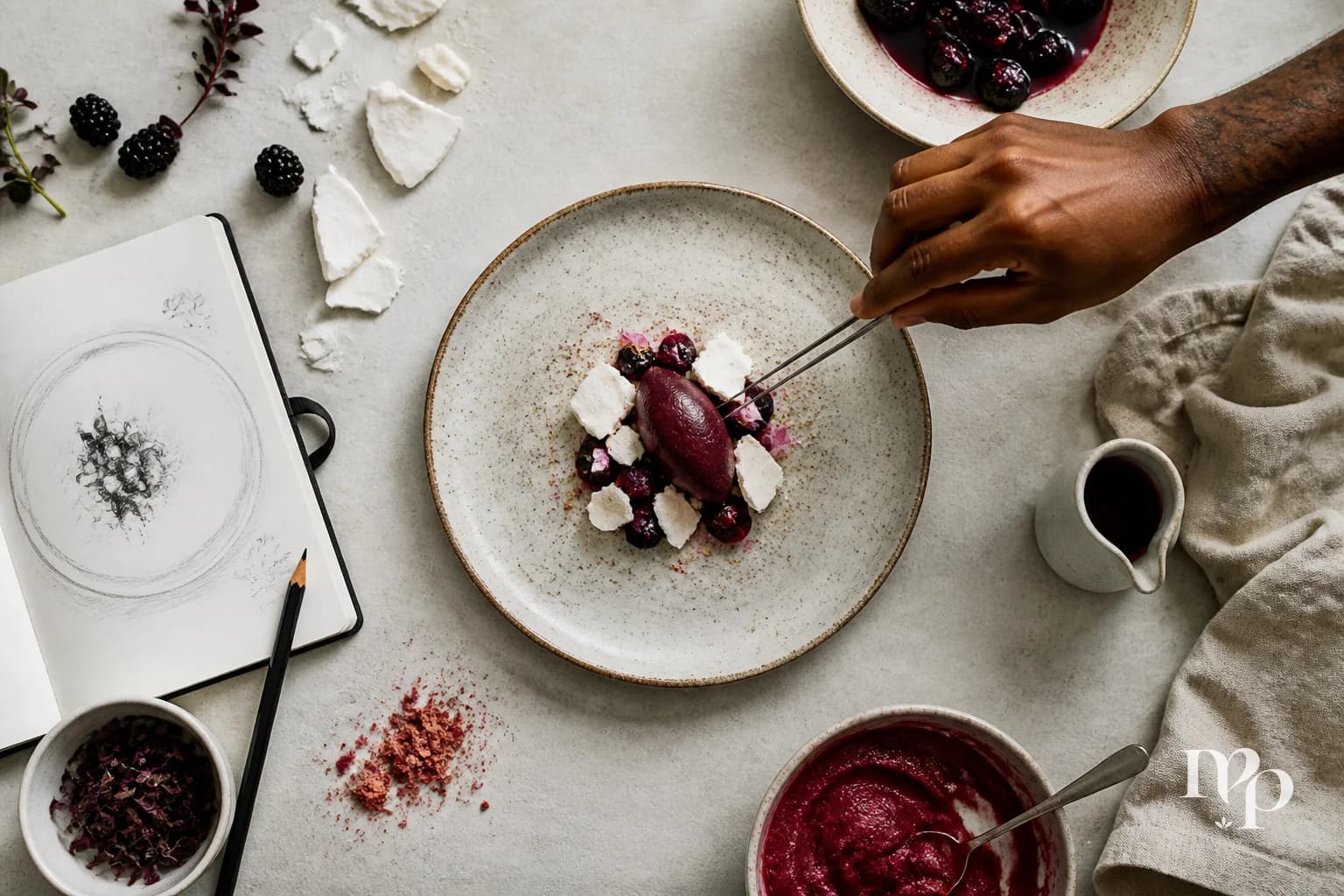
A dessert can be beautifully plated and still feel homeless. It arrives with height, gloss, garnish, and effort, yet nothing about it explains why it belongs at this table.
That is where signature dessert development often goes thin. Restaurants look for a form before they have named the feeling. They choose a shape before they know what the final course needs to carry.
The shape comes after the reason
A signature dessert is not just the most recognizable item on the menu. Recognition is too shallow a goal. The stronger question is whether the dessert has a reason to exist inside this restaurant, with this food, this room, this pace, and this kind of guest.
In our work, signature dessert development begins with the brief beneath the bite. Is the restaurant spare and mineral, or generous and layered? Does the meal build toward comfort, surprise, lightness, or quiet intensity? Should the final course settle the table or sharpen it one last time?
Only after those questions does shape become useful. A tart, custard, frozen element, composed plate, shared dessert, or small final bite can all work. None of them work by format alone. The form has to protect the idea.
For restaurants still shaping that larger identity, Why every restaurant needs its own dessert language is often the better starting point than the plate itself.
What the room asks from sweetness
Dessert enters late. That sounds obvious, but many menus ignore what it means.
By the time the final course arrives, the guest has already made a small journey. There has been salt, fat, acidity, heat, wine, conversation, waiting, pacing, perhaps too much bread, perhaps restraint. Dessert does not meet an empty appetite. It meets a shaped one.
A restaurant dessert has to understand that condition. Too much sweetness can flatten the memory of the meal. Too much richness can make generosity feel heavy. Too much delicacy can disappear in a room that needs a firmer ending.
The hospitality context matters as much as the pastry logic. Can the floor describe it without sounding rehearsed? Can the kitchen send it at the right temperature on a busy night? Does the portion feel considerate after the menu that came before it? Does it invite one more spoonful, or does it ask the guest to push through?
A final course can be memorable without being loud. Sometimes it holds the room by knowing when to stop.
The decisions guests can taste
The clearest desserts are built from a few decisions made carefully.
First comes the primary flavor. Not a list of ingredients, but the thing the guest should understand first. Citrus that stays bright. Chocolate that tastes dark rather than merely sweet. Sesame that keeps its earth. Mango that still tastes like fruit, not perfume.
Then comes sweetness. Less sugar is not a health pose. It can be a design choice. When sweetness is restrained, acidity speaks more clearly, bitterness has room, dairy feels cleaner, fruit keeps its edge, and salt can do quiet work.
Texture is often where the memory forms. A soft set custard needs interruption. A frozen element needs warmth or friction. A mousse needs contrast that does more than decorate. Crispness, chew, cream, melt, and crumble are not extras. They decide how the dessert moves through the mouth.
We wrote more directly about that in When texture carries the final course, because texture is often the difference between a dessert that is admired and one that is remembered.
Composition is the next edit. Decoration should serve the bite. If an element does not change flavor, texture, aroma, temperature, or proportion, it should be questioned. Pretty can be useful, but only when it deepens the idea.
Where development loses its nerve
The most common mistake is adding instead of deciding.
A restaurant wants the dessert to feel important, so it adds a second sauce, another garnish, a brittle, a powder, a shaped tuile, a quenelle, a flower, a drizzle. The plate becomes busy, but not more expressive. More elements do not automatically create more interest. They often make the original thought harder to taste.
Another mistake is borrowing a familiar format without changing its point of view. A chocolate cake, fruit tart, pavlova, panna cotta, or frozen dessert can belong deeply to a restaurant. But if it arrives as a generic version of itself, the guest has no reason to connect it to the place.
Seasonality can also become cosmetic. A seasonal fruit placed beside an unchanged base is not the same as allowing the season to edit sweetness, acidity, portion, and texture. The ingredient should not feel like a label added at the end.
And then there is the photograph trap. A dessert chosen because it looks strong in one still image may fail in motion. Restaurants serve in time, not in pixels. The spoon matters. The first crack matters. The way sauce travels matters. The last bite matters.
Questions before the final course is named
Before a restaurant commits to a signature dessert, a useful operator question is not what will look impressive. It is what the dessert needs to do.
What should the guest remember after the last spoonful?
Which part of the restaurant should the dessert echo: the restraint, the warmth, the edge, the origin, the season, the room, the service style?
Is the dessert meant to be shared, lingered over, finished cleanly, or ordered almost without thinking?
What flavor needs protection from too much sweetness?
What texture will create the clearest contrast?
Can the team serve it consistently without turning the final course into a strain?
Does the name explain too much, or not enough?
For this type of menu, clarity is usually more valuable than novelty. A dessert can be distinctive without being strange. It can be familiar without being anonymous. The work is in the edit.
A quieter checklist
Before the plate is finalized, we often look for these signs:
- One clear primary flavor leads the dessert.
- Sweetness supports flavor rather than covering it.
- Texture contrast is built into the eating experience.
- Decoration changes the bite or earns its absence.
- Portion respects the meal that came before it.
- The dessert can survive real service, not just a tasting.
- The floor can describe it simply and truthfully.
- The last bite feels intentional, not leftover.
This is not about making dessert smaller or quieter by default. It is about making it more exact. Restraint is not a lack of generosity. It is generosity with better aim.
From the studio
At Mistoura Pastry, we think of a signature dessert as a design problem with sensory consequences. It has to taste right, but it also has to behave right: on the menu, in the kitchen, in the hand of the server, on the table, and in memory.
The strongest version may not be the most elaborate one. It may be the one with a clear center, a disciplined shape, and enough confidence to let the ingredient speak without crowding it.
A dessert earns its shape when nothing feels arbitrary. Not the sweetness. Not the garnish. Not the temperature. Not the pause before the guest takes another spoonful.
If your restaurant is ready to think through a final course with more intention, Mistoura Pastry works with hospitality teams on dessert concepts that belong to the room.
Studio note
Mistoura Pastry approaches dessert as culinary design. The goal is not more sweetness or more decoration. The goal is a final course with flavor, restraint, and intention.