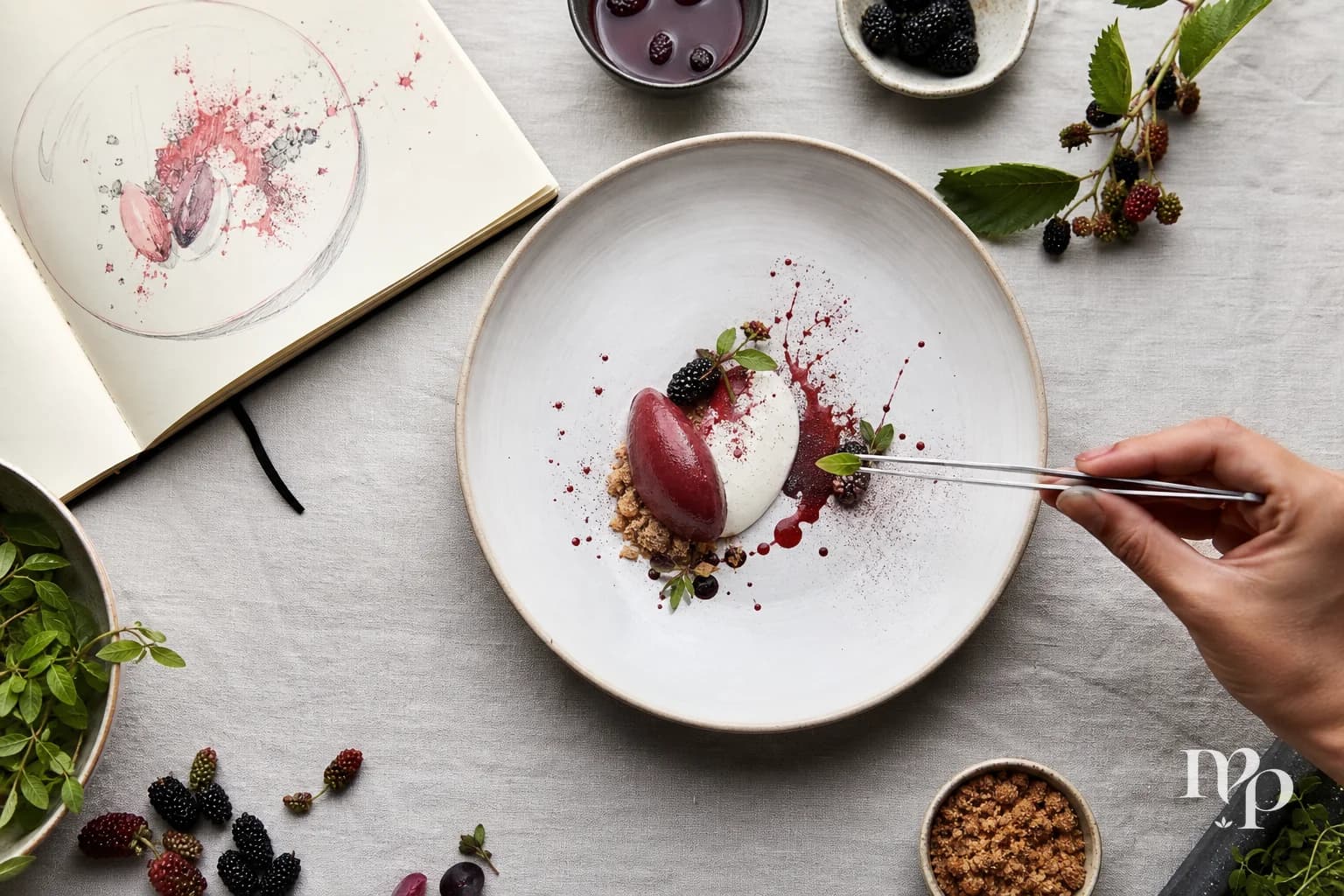
A signature dessert often fails when it tries too hard to announce itself. It arrives taller, shinier, more decorated, and less connected to the meal that came before it.
That is the wrong kind of attention.
For a restaurant, a signature dessert should feel inevitable. Not predictable, not safe, not copied from a pastry case somewhere else. Inevitable. It should make sense in that room, after that food, with that style of service, at that price point, for that guest.
The point of view
A signature dessert is not simply the dessert that sells well or photographs neatly. It is the dessert that carries the restaurant’s identity with the most clarity.
That identity may be quiet, generous, sharp, seasonal, nostalgic, restrained, playful, or precise. The dessert has to know which one it is serving.
In our work, a useful first question is not “what dessert should we make?” It is “what should the final course say about this restaurant?”
A coastal restaurant may need something bright, saline, and clean rather than heavy chocolate. A wood fired restaurant may want smoke, char, cream, fruit, or grain to appear in a way that feels connected to the rest of the menu. A small cafe with a short savory menu may need one dessert that can carry more emotional weight without slowing service.
The strongest signature dessert is rarely a separate performance. It belongs to the same conversation.
The hospitality context
Dessert is the last thing many guests taste before they leave the table. That gives it a specific responsibility.
A first course can open appetite. A main course can anchor the meal. Dessert has to resolve it. Sometimes that means softness. Sometimes brightness. Sometimes contrast. Sometimes a final note of bitterness, spice, fruit, or warmth that keeps the meal from ending flat.
This is where restaurants often misread the task. They treat dessert as an extra item, not as the final part of hospitality. A guest does not experience the dessert menu in isolation. They experience it after salt, fat, acid, wine, conversation, pacing, and service.
A signature dessert should respect that condition. It should not punish the guest for ordering it.
Design considerations
Start with proportion. A signature dessert can be generous without being large. It can feel complete without having six separate components. More elements do not automatically create more interest.
Then look at texture. A memorable dessert usually gives the spoon something to discover: cream against crunch, warm against cold, soft fruit against crisp pastry, dense chocolate against something lifted and bitter. Texture should create rhythm, not clutter.
Flavor needs the same discipline. One central idea should lead. The supporting flavors should sharpen it, deepen it, or give it contrast. If every element is trying to be noticed, the dessert loses its shape.
Seasonality matters, but not as decoration. A summer dessert does not need fruit scattered across the plate to prove the calendar. It may need acidity, coldness, herbs, or a lighter structure. A winter dessert may need depth, spice, roasted notes, or a warmer service temperature.
Service is part of the design too. Can the team plate it consistently? Can it survive the pace of a busy night? Does it require a last minute action that makes sense for the room? Does it arrive at the table with enough clarity that the guest understands it before the first bite?
A signature dessert should be distinctive, but it should also be repeatable.
For more on building a recognizable point of view, see Why every restaurant needs its own dessert language.
Common mistakes
The first mistake is mistaking decoration for identity. A garnish can finish an idea, but it cannot create one. Gold leaf, quenelles, flowers, shards, powders, and sauces do not make a dessert belong to a restaurant. They only reveal whether the idea underneath is clear.
The second mistake is building the dessert around a reference instead of a reason. “A version of tiramisu” or “a chocolate dessert” can work, but only if the restaurant knows why that form belongs there. Familiarity is not the problem. Vagueness is.
The third mistake is making the dessert too sweet because it is dessert. Sugar has a job. It carries flavor, supports structure, rounds bitterness, and creates comfort. But when sweetness leads every decision, fruit tastes less like fruit, chocolate loses its edges, and cream becomes heavy instead of generous.
The fourth mistake is ignoring the staff. If a dessert needs delicate timing, fragile components, or a complicated explanation, it may work in development and fail in service. A restaurant dessert is not finished when it tastes good in isolation. It is finished when it can live well during service.
Questions for operators
Before naming a signature dessert, ask sharper questions.
What should the guest remember from the final course?
Does the dessert reflect the restaurant’s food, room, and service, or could it belong anywhere?
Is the main flavor clear after one bite?
Does the texture change as the guest eats, or does it stay flat?
Can the kitchen execute it with consistency on a busy night?
Does the portion respect the meal that came before it?
Is there one detail that makes it unmistakably yours without making it complicated?
These questions are not meant to make the dessert smaller. They make it more exact.
Practical checklist
Use this as a simple filter before a dessert becomes the signature item:
- One clear central flavor leads the dessert
- Texture contrast is intentional, not added for noise
- Sweetness supports the ingredient instead of covering it
- The plate feels connected to the restaurant’s savory menu
- The portion fits the guest’s appetite at the end of the meal
- The team can prepare and serve it consistently
- The description is short and specific
- Decoration serves the composition
- The dessert can hold interest across a season
- The final bite leaves a clean memory
If too many of these points need explanation, the dessert may not be ready yet.
Studio note
At Mistoura, we often think of a signature dessert as a small act of translation. The restaurant has a language already: its ingredients, pacing, room, culture, restraint, generosity, and way of hosting. The dessert should translate that language into the final course.
That does not mean it has to be quiet. It means it has to be coherent.
A bold dessert can still be disciplined. A simple dessert can still be distinctive. A familiar dessert can still feel personal when the proportions, textures, and choices are exact.
Quiet closing
The best signature dessert does not ask to be remembered because it is loud. It is remembered because it completes the meal with clarity.
It gives the guest one final expression of the restaurant’s point of view, then lets them leave with that taste still organized in the mind.
If your restaurant is shaping a dessert menu or developing a final course with more intention, Mistoura Pastry works with hospitality teams on dessert identity, composition, and menu direction.