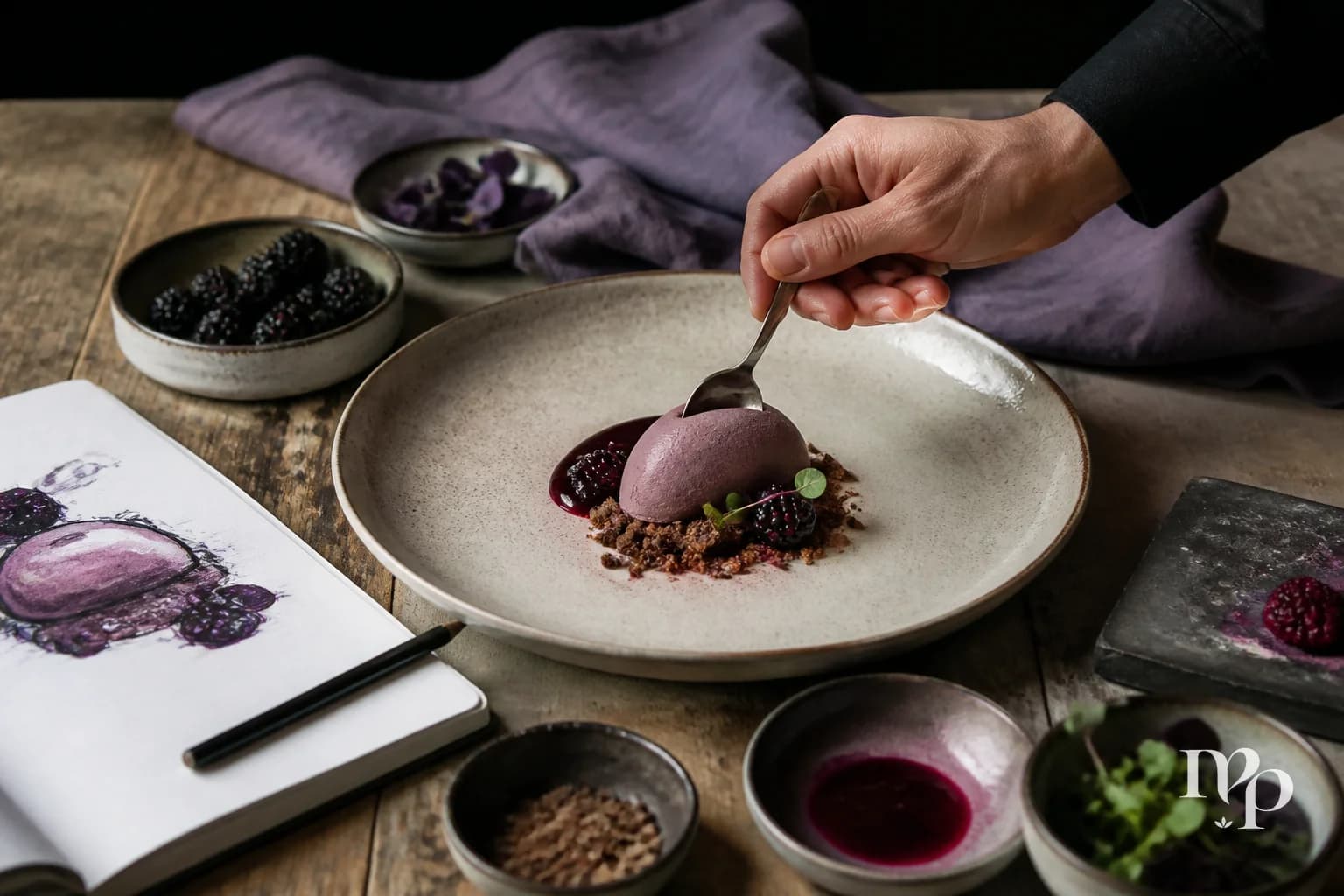
The first spoonful is rarely remembered as sweetness alone. It is the crack before the cream, the way something cold slows the mouth, the crumb that disappears too quickly or stays just long enough. Texture carries the final course when it gives the guest a physical rhythm to remember.
Texture is one of the cleanest ways to make dessert feel designed instead of assembled. Not bigger. Not louder. More deliberate.
What the last course remembers
A restaurant dessert has a small window of attention. The guest has already moved through the salt, acid, heat, fat, smoke, broth, bread, wine, conversation, delay, appetite, and pace of the room. By the time dessert arrives, the palate is not blank. It is carrying the meal.
Texture gives the final course a way to speak without shouting.
A soft dessert can be generous, but if everything collapses into the same texture, the guest loses the thread. A crisp element can wake the plate, but if it exists only for height or noise, it becomes a prop. The strongest texture choices are not decorative. They shape how the dessert is eaten.
This is why texture belongs early in the design conversation. It should sit beside flavor, sweetness, temperature, and service rhythm. We often think of sugar first, but restraint changes what the guest can actually taste. We explored that more directly in Why less sugar can create more flavor. Texture works in a similar way. When it is edited well, it makes the whole dessert clearer.
The room has already eaten
A final course has to respect the room it enters.
After a long tasting menu, the most generous dessert may not be the richest one. After grilled fish, bitter greens, and bright wine, a dense chocolate plate might feel like a door closing too hard. After a slow braise or a winter menu, something icy and sharp may feel abrupt unless the transition is handled with care.
Texture helps manage that transition.
A warm spoon cake with a cool cultured cream can soften the end of a meal without making it heavy. A fruit dessert with a thin crisp or toasted element can keep freshness from feeling thin. A custard can become more memorable when it has one precise interruption: sesame brittle, roasted nut, cocoa crumb, a layer that breaks cleanly under the spoon.
Hospitality is not only how the plate looks when it leaves the pass. It is how the guest feels five minutes later. Texture affects that memory because it controls pace. It asks the guest to break, scoop, cut, wait, combine, or return for a second bite.
Crisp, cream, heat, pause
Texture contrast does not mean every dessert needs every texture.
The useful question is not, What else can we add? It is, What movement does this dessert need?
Some desserts need a clean break. A thin caramelized surface, a fragile tuile, or a baked edge can create that first moment of attention. Some need weight. A ganache, custard, mousse, or cooked fruit can give the plate a center of gravity. Some need lift. Ice, granita, raw fruit, herbs, or acidity can make a heavier element feel more alive.
Proportion matters. A crisp garnish the size of a sail can dominate the bite. A crumb scattered across the plate can feel like filler if it has no role. A sauce that floods the plate may erase the one texture that made the dessert interesting.
Good composition lets the guest understand how to eat. The spoon should not need instructions. The textures should meet naturally, with enough contrast to create interest and enough restraint to keep the idea intact.
This is also part of a restaurant's identity. Repeated with care, texture becomes a recognizable part of the dessert language, just as flavor and plating do. For a broader look at that idea, see Why every restaurant needs its own dessert language.
Where texture gets loud
The common mistake is confusing variety with depth.
A plate can have crumble, gel, cream, chip, foam, frozen element, fresh fruit, sauce, powder, and still feel flat. More parts do not automatically create more interest. Often they create indecision.
Another mistake is using crunch as decoration. A brittle shard placed upright on every dessert starts to feel automatic. If it does not change the bite, it is architecture without hospitality.
Temperature can also work against texture. A frozen element that arrives too hard makes the guest wait when the dessert should be opening. A crisp element placed too early into moisture loses its purpose before the plate reaches the table. A crumb that is too fine can read as dust rather than texture.
The issue is not technical ability. It is editing. Texture needs a reason to be there.
Questions before the spoon lands
For restaurant owners, chefs, and hospitality teams, texture is a useful way to evaluate whether a dessert belongs on the menu.
Ask:
- What is the first physical sensation the guest will notice?
- Does the dessert change from bite to bite, or stay the same all the way through?
- Is there one texture carrying too much of the plate?
- Does the texture suit the restaurant's pace, service style, and portion size?
- Will the crisp element still be crisp when served?
- Does the dessert feel like a continuation of the meal, or a separate event?
- If one component were removed, would the idea become clearer?
These questions are simple, but they catch a lot. They reveal whether the dessert has composition or just components.
A quieter checklist
A texture led dessert does not need to be complicated. Before adding another element, check the basics.
- One clear center: cream, cake, custard, fruit, frozen element, or chocolate.
- One intentional contrast: crisp, tender, cold, warm, chewy, airy, or fluid.
- One clean transition from the savory menu into the final course.
- Enough moisture for the dessert to feel generous.
- Enough restraint for each ingredient to remain legible.
- A serving plan that protects the intended texture.
- A bite that makes sense without explanation.
The checklist is not meant to flatten creativity. It protects the idea from becoming crowded.
From the studio
At Mistoura Pastry, we often begin texture conversations by removing something.
Not because minimalism is automatically better. It is not. A sparse dessert can be just as empty as an overloaded one. But removal shows what is actually working. If the plate loses nothing when a component disappears, that component was not carrying enough.
The strongest version may be a soft cream against bitter caramel. Or roasted fruit with a tender cake and a small salted crunch. Or something colder, sharper, and leaner after a heavy menu. The form changes. The principle stays steady: texture should serve the experience, not decorate it from the outside.
Dessert should not be an afterthought. It is the last piece of hospitality the table receives.
Texture is how that last piece finds its rhythm.
If your restaurant, cafe, hotel, or event team is reconsidering the final course, Mistoura Pastry can help shape desserts with clarity, restraint, and identity.
Studio note
Mistoura Pastry approaches dessert as culinary design. The goal is not more sweetness or more decoration. The goal is a final course with flavor, restraint, and intention.