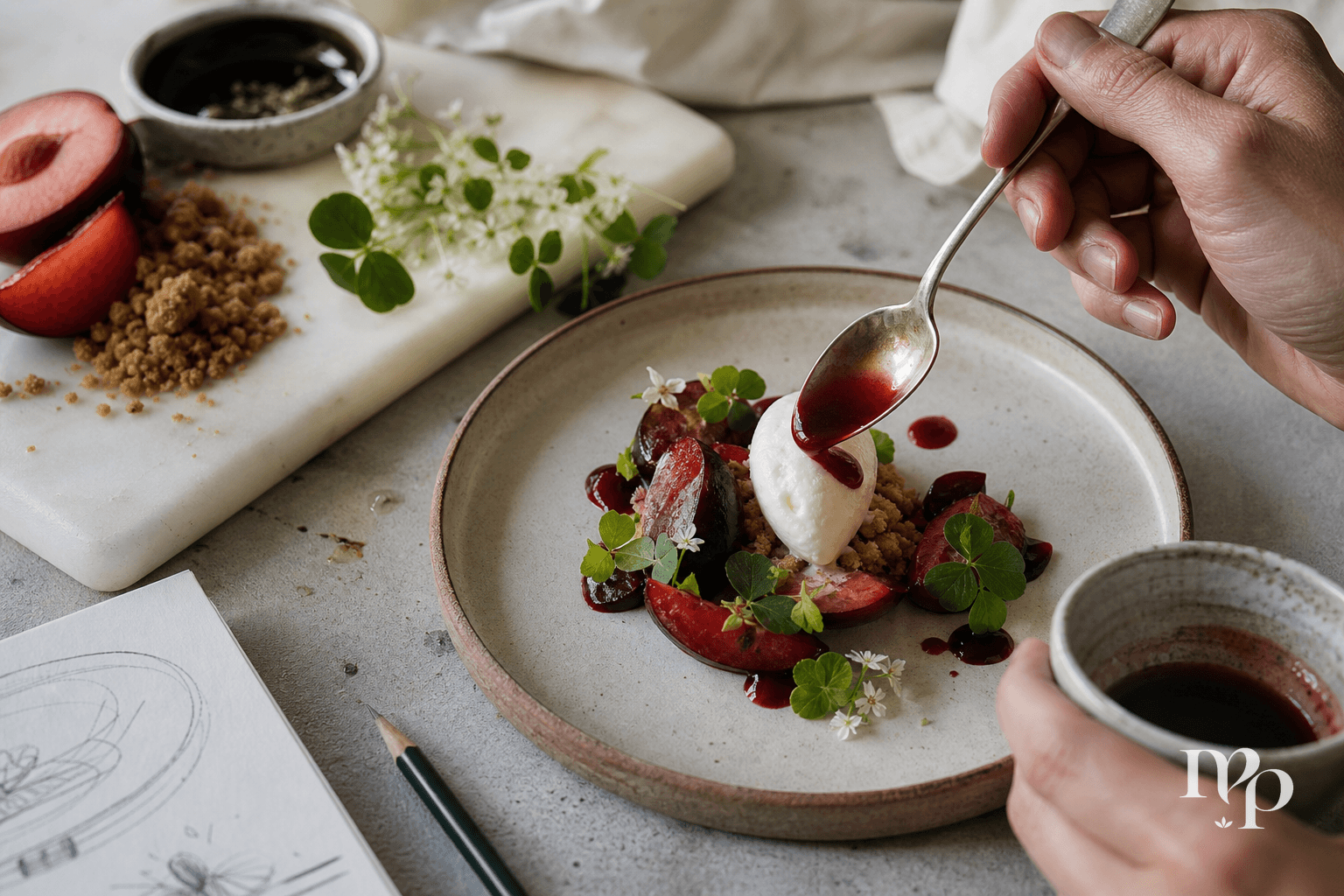
A spoonful of dessert can go quiet for the wrong reason. Not because it is subtle, but because sugar has covered every other detail.
The citrus loses its edge. The cream feels heavy. The chocolate becomes flat. The last course arrives with effort, when it should bring clarity.
Less sugar is often treated as a compromise. In restaurant dessert design, it can be the opposite. It can be the move that lets flavor return.
A direct point of view
Sugar is not the enemy. Careless sweetness is.
In pastry, sugar does important work. It carries aroma, affects texture, supports browning, changes freezing point, extends shelf life, and gives structure to creams, cakes, meringues, sorbets, and sauces. Removing it without understanding its role can make a dessert dull, brittle, icy, or thin.
But sweetness should not be the only message. A restaurant dessert needs shape. It needs a beginning, a middle, and a clean finish. When sugar is pushed too far, everything lands at the same volume. The guest tastes sweet first, sweet second, and sweet last.
The strongest desserts often use sugar with discipline. Not to make the dish feel restrained for its own sake, but to make space for acidity, bitterness, salt, fat, warmth, aroma, and texture.
Where hospitality enters
Dessert is not eaten in isolation. It arrives after bread, drinks, savory courses, conversation, and time at the table. A guest may be curious, full, tired, celebratory, or simply ready for one final note.
That context changes what sweetness should do.
A dessert that might work beautifully at 3 p.m. with coffee may feel heavy after a tasting menu. A plated chocolate dessert with multiple sweet components can ask too much at the end of a rich meal. A fruit dessert with acidity, cream, and a crisp element may feel more generous because it gives the guest lift instead of weight.
This is where restaurant pastry differs from display pastry. The goal is not to win attention in a case. The goal is to complete an experience at the table.
Less sugar can help the final course feel intentional rather than automatic. It gives the guest a reason to take another spoonful, not because the dish is louder, but because the palate has not been exhausted.
For a broader look at how dessert supports restaurant identity, see Why every restaurant needs its own dessert language.
Design considerations
Reducing sweetness starts with the whole composition, not only the sugar measurement.
Fruit needs acidity. If the fruit is ripe and expressive, too much sugar can blur its character. A peach should still taste like peach. Passion fruit should not be softened into vague tropical sweetness. Citrus should be allowed to cut.
Chocolate needs contrast. Bitterness, salt, dairy, smoke, coffee, toasted grain, olive oil, or fruit can give chocolate more dimension. Sugar alone makes it round, but not necessarily interesting.
Cream needs relief. Custards, mousses, ganaches, and ice creams can be beautiful, but they need something to interrupt them. A lean biscuit, a sharp compote, a bitter caramel, a crisp tuile, or a salted nut can keep richness from becoming fatigue.
Texture also changes the perception of sweetness. A smooth component can feel sweeter than a crisp one. A cold component can dull sweetness. A warm sauce can amplify it. A crunchy element with salt can make a dessert feel more complete without adding more sugar.
Proportion matters as much as formulation. A small sweet element may work if it is framed by acidity or bitterness. A large sweet base with sweet sauce, sweet garnish, and sweet cream usually collapses into sameness.
Common mistakes
The first mistake is replacing sugar with performance. A dessert labeled as less sweet should not feel apologetic. Guests do not need a lecture. They need a dish that tastes resolved.
The second mistake is confusing bitterness with sophistication. Bitter notes can be useful, but if they are not integrated, they feel punitive. Restraint still needs pleasure.
The third mistake is removing sugar without replacing structure. Pastry is technical. Sugar affects body, tenderness, preservation, freezing, and mouthfeel. If sweetness is reduced, the rest of the formula may need adjustment.
The fourth mistake is letting every component carry the same sweetness level. A dessert becomes more interesting when elements have different jobs. One can be creamy, one acidic, one crisp, one bitter, one aromatic. Not everything has to flatter the palate in the same way.
The fifth mistake is using decoration to distract from imbalance. More garnish will not fix a dessert that is too sweet at its core. Decoration should serve the idea, not cover the absence of one.
Questions for operators
Before changing a dessert because guests say it is too sweet, ask what they may actually be responding to.
Is the portion too large for the end of the meal?
Are there too many sweet components stacked together?
Does the dessert lack acidity, salt, bitterness, or texture contrast?
Is the main ingredient still clear, or has sugar made it generic?
Does the dish fit the pacing of the menu?
Is the dessert designed for the restaurant you are, or borrowed from somewhere else?
These questions are more useful than simply cutting sugar by a fixed percentage. The point is not to make dessert smaller in spirit. The point is to make it more precise.
A simple checklist
Use this as a quick review when developing or editing a dessert menu:
- Can the main ingredient still be identified clearly?
- Does sweetness have a defined role in the dish?
- Is there enough acidity or bitterness to create movement?
- Is salt used with intention, not as decoration?
- Does texture break up richness?
- Does the portion make sense after the savory menu?
- Are any components repeating the same sweet function?
- Would the dessert still feel generous if one garnish were removed?
- Does the final bite feel clean, heavy, sharp, or unfinished?
A dessert does not need to be austere to be balanced. It needs an edit.
Studio note
At Mistoura, we often find that sweetness is one of the first places a dessert reveals its discipline. Not because less is always better, but because sugar has a way of hiding weak decisions.
When a dessert is designed carefully, sweetness becomes part of the architecture. It supports fruit, softens bitterness, rounds dairy, deepens caramelization, and gives comfort where comfort is needed. It does not flatten the whole plate.
For restaurants, cafes, hotels, and event teams, this is a practical design issue. A less sweet dessert can pair better with coffee, wine, cocktails, or tea. It can sit more comfortably at the end of a meal. It can make the final course feel considered rather than added because a menu needed something sweet.
Quiet closing
The question is not how little sugar a dessert can contain. The better question is how clearly the dessert can speak.
Sometimes sugar should be warm, generous, and present. Sometimes it should step back. What matters is whether it helps the ingredient taste more like itself, whether the texture has rhythm, and whether the guest leaves with a final memory that feels complete.
Sweetness is only one part of pleasure. Used with restraint, it gives the rest of the dessert room to breathe.
If your restaurant or hospitality team is rethinking the role of dessert on the menu, Mistoura Pastry can help shape a final course with more clarity and intention.